Semantic Debt
Why many organizations struggle with AI visibility long before they struggle with rankings.
Most organizations do not primarily suffer from a lack of content.
They suffer from accumulated semantic instability.
Over time, digital ecosystems tend to grow through layers of operational decisions, migrations, SEO initiatives, platform constraints, ownership changes and content expansion.
What emerges is often not a coherent information system, but a fragmented semantic landscape.
Historically, many of these inconsistencies were tolerable.
Traditional search systems could compensate through link structures, query matching, domain authority and behavioral signals.
AI-driven retrieval and interpretation systems operate differently.
They depend far more heavily on structural clarity, contextual consistency and stable semantic representation.
As a result, many organizations now face a growing but largely invisible problem:
semantic debt.
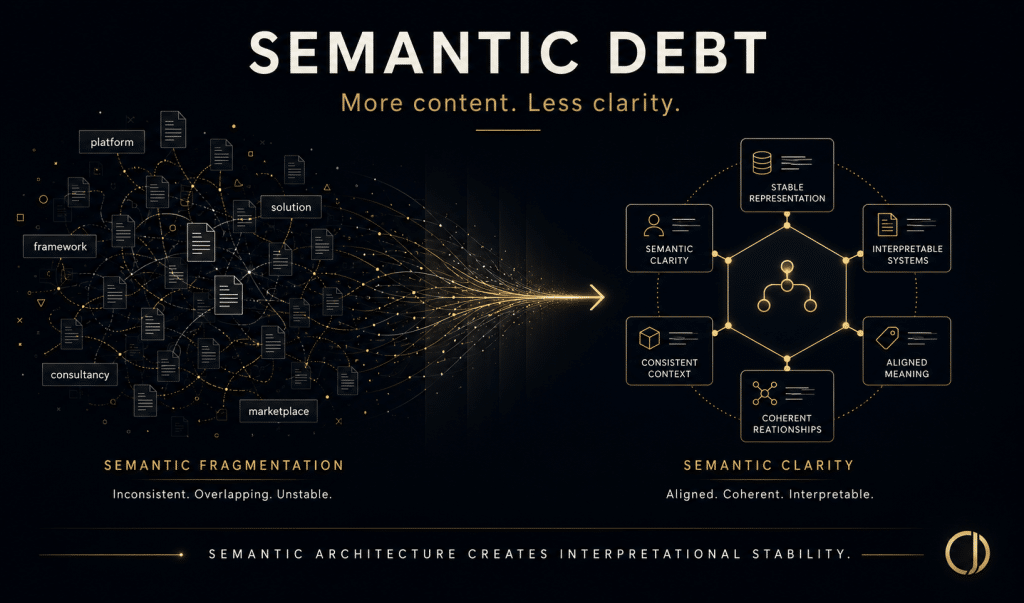
Definition
Semantic debt describes the accumulated structural and interpretive inconsistencies within a digital ecosystem that reduce machine confidence, retrieval clarity and selection eligibility over time.
Semantic debt is rarely caused by a single decision.
It typically emerges gradually through years of disconnected optimization, fragmented content production and inconsistent information architecture.
The result is not necessarily lower indexability.
The result is reduced interpretability.
Semantic Debt vs. Technical Debt
Technical debt primarily affects implementation quality, maintainability and operational efficiency.
Semantic debt affects meaning systems.
It influences how reliably machines can:
- interpret entities
- connect relationships
- infer topical authority
- resolve ambiguity
- establish confidence
- select information during retrieval
An organization can have a technically modern website while simultaneously operating within a highly unstable semantic environment.
How Semantic Debt Emerges
Semantic debt often accumulates through structurally rational decisions that create long-term interpretive fragmentation.
Common drivers include:
SEO-driven URL inflation
Large volumes of near-overlapping landing pages designed primarily for query coverage rather than semantic clarity.
Fragmented content ownership
Different teams, agencies or departments creating incompatible terminology, narratives or entity framing over time.
Taxonomy drift
Navigation systems and category structures evolving without maintaining conceptual consistency.
Platform migrations without semantic consolidation
Technical migrations that preserve historical fragmentation instead of reducing it.
Inconsistent entity representation
Organizations describing the same products, services or capabilities differently across systems and contexts.
AI-generated content layering
Rapid content expansion without stable conceptual architecture underneath.
Navigation-led architectures
Structures optimized around menus, CMS logic or internal politics instead of coherent information retrieval.
Why Traditional Search Systems Tolerated It
Classical search engines were often capable of compensating for semantic inconsistency.
Strong domains could continue to rank despite fragmented architectures because traditional retrieval systems relied heavily on:
- link authority
- behavioral data
- query-document matching
- historical trust signals
- redundant indexing capacity
In many environments, “good enough” semantic consistency was sufficient.
AI systems operate under different constraints.
They increasingly depend on compressed interpretation, contextual synthesis and confidence-weighted retrieval.
This changes the tolerance threshold dramatically.
AI Systems Are Interpretation Systems
AI visibility is not simply a ranking problem.
It is an interpretation problem.
Modern AI systems must continuously determine:
- what an entity is
- how stable its representation appears
- whether multiple sources reinforce or contradict each other
- how confidently information can be synthesized
- whether retrieval is safe enough for selection
This creates a fundamentally different environment from classical search.
Visibility increasingly depends on interpretive coherence.
Not merely discoverability.
Symptoms of Semantic Debt
Semantic debt often manifests indirectly.
Organizations may observe:
| Symptom | Possible Structural Cause |
|---|---|
| inconsistent AI citations | fragmented entity representation |
| fluctuating AI visibility | unstable semantic signals |
| weak retrieval confidence | overlapping topical structures |
| contradictory AI summaries | inconsistent contextual framing |
| declining selection probability | semantic ambiguity |
| poor synthesis quality | fragmented information architecture |
These symptoms are often mistaken for content or ranking problems.
In reality, they may reflect deeper architectural instability.
The Hidden Organizational Problem
Semantic debt is not only a search problem.
It is often an organizational problem expressed through digital systems.
Many organizations operate without a stable conceptual layer that defines:
- terminology
- entity relationships
- structural hierarchy
- retrieval logic
- narrative consistency
- contextual ownership
As digital ecosystems expand, these inconsistencies compound.
AI systems merely expose them more visibly.
Reducing Semantic Debt
Semantic debt cannot be solved through isolated content production.
It requires structural clarification.
Reduction strategies may include:
Structural consolidation
Reducing unnecessary duplication and semantic overlap.
Entity clarification
Creating stable and consistent representations across systems.
Narrative alignment
Aligning terminology, positioning and contextual framing.
Retrieval-oriented architecture
Designing structures around interpretability instead of navigation convenience alone.
Canonical meaning systems
Establishing stable semantic reference points throughout the ecosystem.
Semantic compression
Reducing interpretive noise while increasing contextual clarity.
The objective is not maximal content volume.
The objective is stable machine understanding.
Strategic Implication
In AI-driven environments, visibility increasingly becomes a byproduct of interpretive stability.
Organizations with lower semantic debt may gain disproportionate advantages in:
- AI retrieval
- synthesis quality
- citation probability
- confidence generation
- selection eligibility
Not because they publish more.
But because they are easier to understand.
Closing Thesis
Many organizations continue to optimize for discoverability while underestimating interpretability.
This distinction becomes increasingly important as AI systems evolve from indexing mechanisms into selection and synthesis systems.
In such environments, semantic stability becomes strategic infrastructure.
And semantic debt becomes increasingly expensive to ignore.