Researching how AI systems
interpret, evaluate and select information.
Technical SEO, search architecture and AI visibility.
Because AI visibility begins long before selection.
It begins with interpretation.
Modern AI systems do not simply retrieve information.
They interpret requests, retrieve candidates, evaluate competing information and progressively reduce uncertainty before generating responses.
Understanding this process makes AI visibility easier to diagnose, structure and improve.
→ Explore the Concepts Library
AI Visibility Architecture
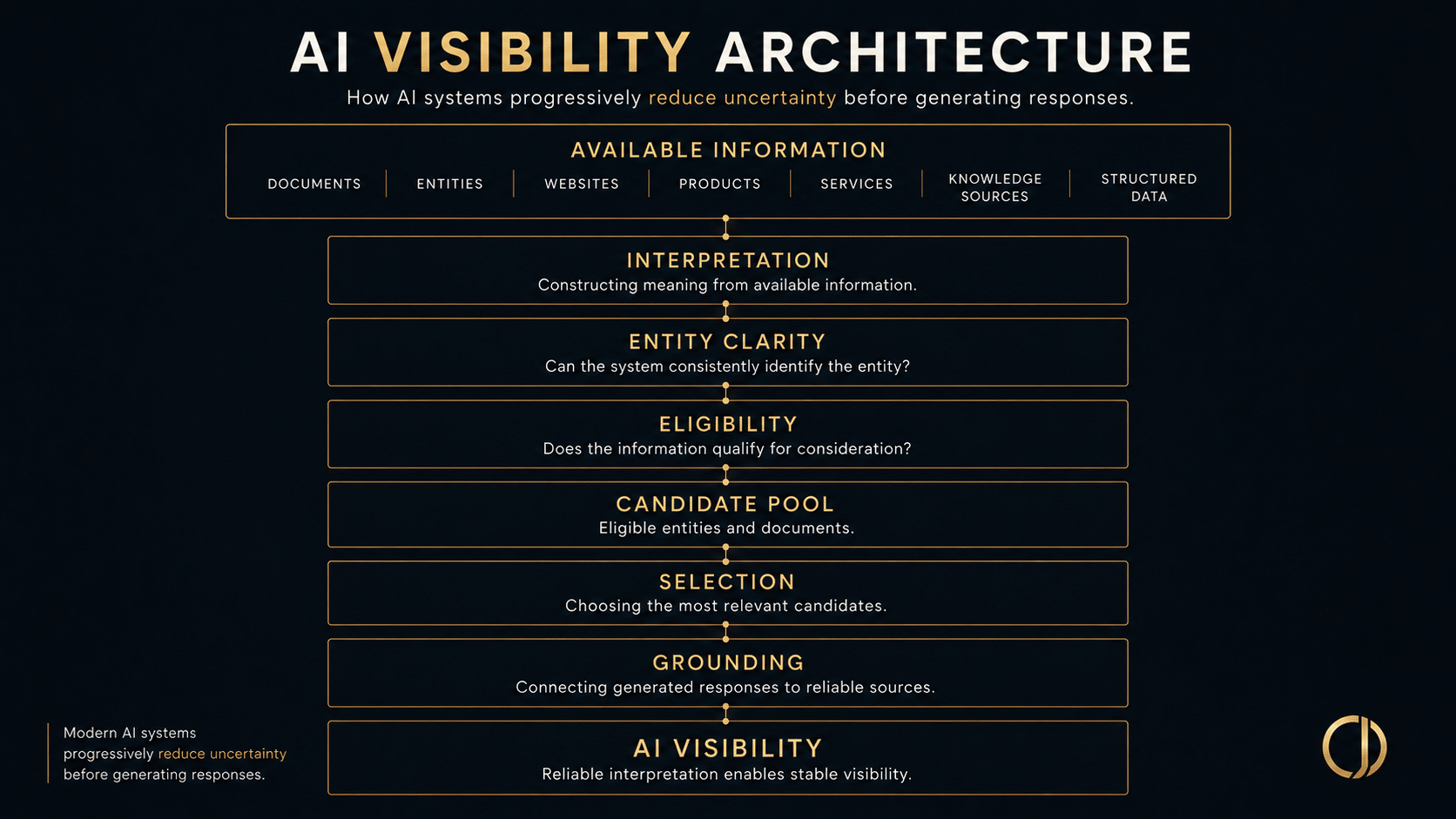
AI visibility is not the result of a single ranking decision.
Information must first become understandable.
Entities must become identifiable.
Relevant information must become retrievable.
Retrieved candidates must compete for selection.
And selected information must ultimately contribute to a generated response.
I use this architecture to study the mechanisms that determine how organizations become visible across modern search and AI systems.
→ Explore How AI Selection Works
Interactive Model
Explore the AI Search Visibility Model
Navigate the architecture from Search Representation and Retrieval through Candidate Evaluation, Selection, Grounding and Search Influence.
→ Explore the Interactive AI Search Visibility Model
Research Library
A growing collection of concepts exploring how AI systems interpret information, construct candidate sets and make selection decisions.
Current concepts include:
- Interpretation
- Entity Clarity
- Semantic Debt
- Eligibility
- Retrieval
- Candidate Pool
- Candidate Evaluation
- Selection Systems
- Grounding
- Search Influence
- Ownership (Coming Soon)
From frameworks to applied work
Conceptual models are useful only when they survive real systems.
My work applies the same architectural thinking across very different environments — from international e-commerce migrations and professional services to independent AI visibility research.
International E-Commerce Migration
Preserving search signals through a complex multi-market migration.
Technical SEO · International SEO · Migration Architecture
Building the SEO architecture for a Shopware migration involving multiple markets and locales, evolving technical requirements and approximately 33,000 redirects.
The objective was not simply to move URLs.
It was to preserve valuable search signals while the underlying technical system changed.
Professional Services Search
Turning fragmented expertise into a structured search and AI visibility system.
Search Strategy · Information Architecture · AI Visibility
Restructuring a historically grown law-firm search footprint around practice areas, user demand, expert knowledge, internal linking and local search.
The program resulted in +326% YoY organic impressions, alongside reported improvements in the quality of incoming inquiries.
AI Visibility Research
Building an AI-readable information system from the ground up.
Independent Project · AI Visibility · Entity Architecture
A complete rebuild of a decade-old finance website around entities, semantic relationships, structured information and AI visibility measurement.
The project also serves as an ongoing experimental environment for observing how search and AI systems interpret, retrieve and represent information.
Different environments.
Different constraints.
The same underlying principle:
Understand the system. Reduce uncertainty. Build the architecture. Measure what changes.
Search is becoming a decision system.
Traditional SEO has largely measured observable outcomes:
Rankings.
Impressions.
Clicks.
Sessions.
Those signals still matter.
But they describe only part of what modern search systems do.
AI-mediated search increasingly influences how users:
- discover organizations
- understand expertise
- compare alternatives
- build confidence
- create shortlists
- make decisions
Some of that influence happens before a measurable website visit ever occurs.
That changes the question from:
How do we rank?
to:
How does information become understood, retrieved, evaluated and selected?
This is the intersection between traditional search, AI visibility and the systems architecture behind both.
About
I’m Oliver Jordanov.
I work at the intersection of Technical SEO, AI Visibility and information architecture.
My work ranges from complex technical search environments and international migrations to research into how AI systems interpret, retrieve, evaluate and select information.
Rather than treating SEO and AI visibility as separate disciplines, I study the systems connecting them.
Let’s talk.
If you’re working on AI visibility, Technical SEO, information architecture or a complex search environment, I’d be happy to connect.