Eligibility
Why visibility begins before retrieval and selection.
AI visibility does not begin when a system selects a source.
It begins earlier.
Before information can be retrieved for a specific request, it must exist in a form that makes it a plausible candidate within the relevant information system.
This condition is eligibility.
But eligibility should not be understood as a universal property of a page, source or entity.
Information may be eligible for one task, unavailable within another retrieval system and irrelevant within a third.
Eligibility is therefore conditional.
It depends on the relationship between:
the task
the retrieval system
the available representation
and
the information itself.
A source that cannot become eligible within the relevant retrieval environment cannot enter the active decision process.
Definition
Eligibility describes the conditions under which information can plausibly qualify for retrieval and subsequent evaluation within a specific task and retrieval environment.
It does not determine whether information will actually be retrieved.
It does not determine whether it will be selected.
Instead, eligibility defines the possibility space from which retrieval can operate.
A useful distinction is:
Eligibility determines what could reasonably be considered.
Retrieval determines what actually enters the active candidate set.
Selection determines what is ultimately used.
Why Eligibility Exists
AI-mediated search operates across enormous information environments.
For any given task, potentially relevant information may exist across:
- web pages
- entities
- products
- business listings
- news sources
- images
- databases
- structured feeds
- specialized information systems
Not all of this information can participate equally in every request.
Systems therefore need mechanisms that constrain the information space before deeper evaluation occurs.
Eligibility represents this boundary.
Its purpose is not to rank every available source.
Its purpose is to define which information can plausibly participate within a particular retrieval environment.
In that sense:
Eligibility is fundamentally a mechanism for reducing computational and interpretive uncertainty.
Eligibility Is Not Global
A common simplification is to treat eligibility as binary:
Eligible
or
Not Eligible
Reality is more conditional.
The same entity may be represented across multiple information systems, each with different requirements, data sources and retrieval mechanisms.
An organization might be:
- eligible within general web retrieval
- unavailable within a local retrieval system
- ineligible for a product-specific task
- represented differently within image search
- accessible through a specialized data source for another task
Eligibility therefore cannot be understood independently from the system performing retrieval.
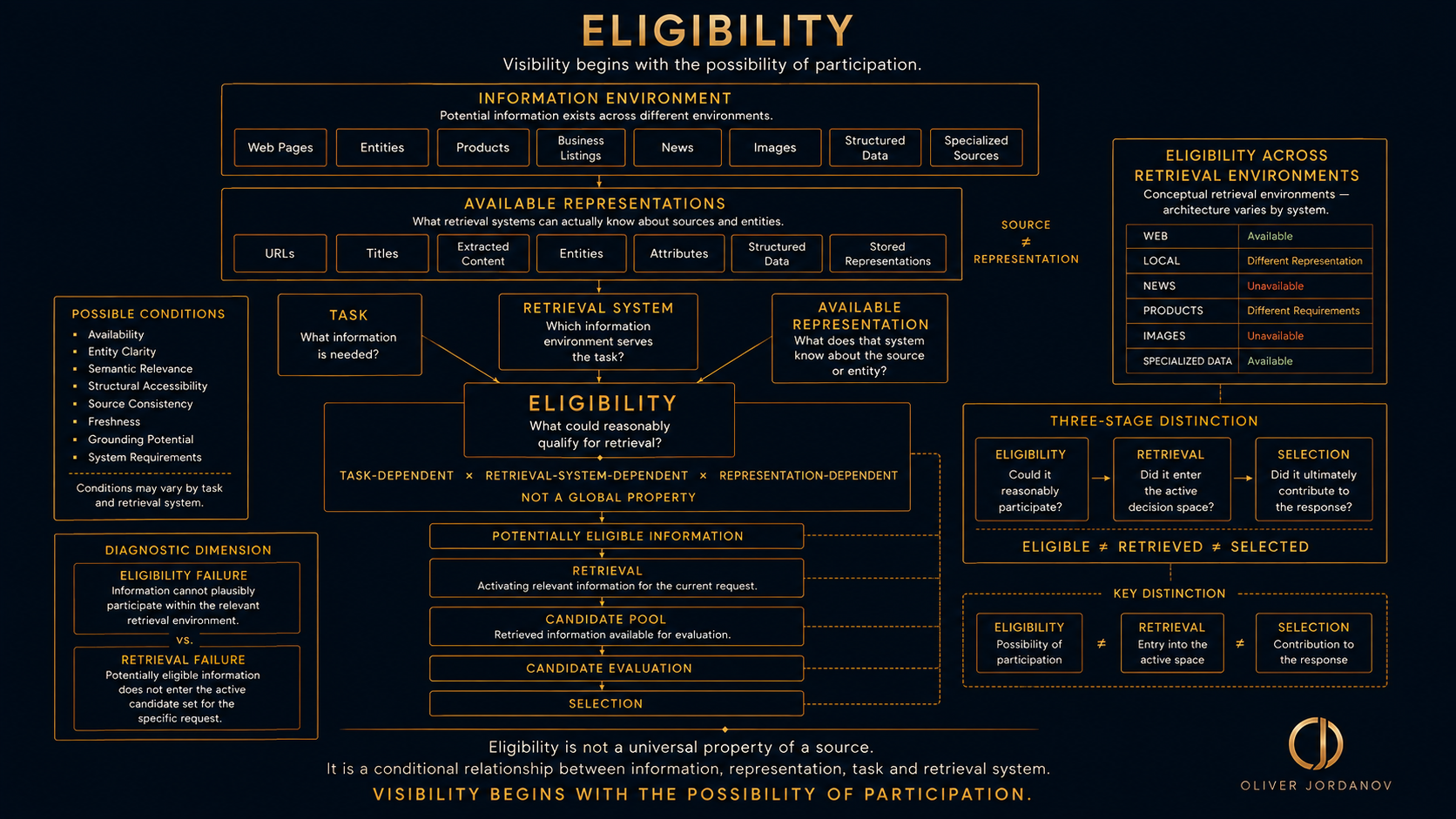
A more useful model is:
Eligibility = Task-Dependent + Retrieval-System-Dependent + Representation-Dependent
This means there may be no single global answer to:
Is this entity eligible?
The better question is:
Eligible for what, through which retrieval environment, based on which available representation?
Task-Dependent Eligibility
Different tasks create different information requirements.
A request for:
the definition of a concept
requires a different candidate space from:
a nearby service provider
or:
a product recommendation
or:
recent developments about a company.
The same source may be highly relevant to one task and unsuitable for another.
Eligibility therefore emerges partly from the relationship between information and the task being performed.
This makes eligibility contextual rather than absolute.
Retrieval-System-Dependent Eligibility
AI-mediated search should not necessarily be understood as one universal retrieval system.
Different tasks may rely on different information environments.
Conceptually, these may include:
Web
Local
News
Products
Images
Specialized Data
Each environment may use different:
- sources
- ingestion paths
- representations
- freshness requirements
- eligibility conditions
- retrieval mechanisms
An entity that participates successfully in one environment does not automatically participate in another.
This creates an important distinction:
AI visibility is not only about whether information exists. It is about whether that information is available through the retrieval system relevant to the task.
Representation-Dependent Eligibility
AI systems do not necessarily evaluate a live source in its complete form every time information is needed.
Retrieval systems may operate on machine-readable representations of sources.
These representations may contain different combinations of:
- URLs
- titles
- extracted text
- snippets
- entities
- attributes
- structured data
- embeddings
- cached content
- other derived signals
This creates another important distinction:
Source ≠ Machine Representation of the Source
A page may contain excellent information.
But if the relevant retrieval system has an incomplete, ambiguous, outdated or otherwise weak representation of that information, its effective eligibility may be different from what the live page itself suggests.
Eligibility therefore depends not only on what exists at the source.
It also depends on what is available to the system about that source.
Eligibility and Retrieval
Eligibility and Retrieval are closely related but distinct.
Eligibility defines the plausible search space.
Retrieval activates a subset of that space for a specific request.
Conceptually:
Potential Information Space
↓
Available Representations
↓
System- and Task-Specific Eligibility
↓
Retrieval
↓
Candidate Pool
A source can therefore be eligible without being retrieved.
This distinction matters diagnostically.
If information is not present in a response, at least two different failures are possible:
Eligibility Failure
The information never became a viable candidate within the relevant retrieval environment.
Retrieval Failure
The information was potentially eligible but was not retrieved for the specific request.
These are different problems.
They require different explanations and potentially different interventions.
Eligibility Is Not Ranking
Ranking asks:
Which candidate should receive greater priority?
Eligibility asks an earlier question:
Which information can plausibly participate at all?
Retrieval asks another:
Which eligible information should enter the active decision space for this request?
And Selection asks:
Which evaluated candidates should ultimately contribute to the response?
These distinctions matter because visibility failures can occur at every layer.
A source may be:
available but not eligible
eligible but not retrieved
retrieved but poorly evaluated
evaluated but not selected
selected but not cited
Treating all of these outcomes as a ranking problem obscures the actual architecture.
What May Influence Eligibility?
Eligibility is unlikely to depend on one universal set of signals.
The relevant conditions may differ across tasks and retrieval systems.
Potential influences include:
Availability
Can the relevant retrieval environment access or represent the information at all?
Entity Clarity
Can the system establish what entity the information refers to?
Semantic Relevance
Is the information plausibly related to the class of tasks being considered?
Structural Accessibility
Can relevant information be discovered, processed and represented reliably?
Source Consistency
Do important signals reinforce rather than contradict one another?
Freshness
Is the available representation sufficiently current for the task?
Grounding Potential
Can important information be connected to identifiable entities, sources and supporting evidence?
System-Specific Requirements
Does the source satisfy the conditions of the retrieval environment through which it would need to become available?
These should not be interpreted as universal ranking factors.
They describe categories of conditions that may affect whether information can plausibly participate.
Eligibility and Interpretation
Interpretation and Eligibility interact, but they should not be collapsed into one mechanism.
Interpretation concerns the construction of meaning.
Eligibility concerns participation.
A system may need to interpret enough about a source, entity or representation to determine whether it is a plausible candidate.
Later, more detailed interpretation may occur once information has been retrieved.
This means Interpretation should not always be represented as one fixed stage immediately before Eligibility.
Interpretive processes can occur at multiple points within the wider architecture.
The important relationship is:
Poor interpretation can reduce eligibility because uncertainty about what information represents makes participation harder to justify.
Eligibility and Entity Clarity
Entity Clarity reduces uncertainty about identity.
Eligibility determines whether information associated with that entity can plausibly participate within a particular retrieval environment.
The relationship is therefore strong but not deterministic.
Clear entity representation may improve the conditions for eligibility.
But Entity Clarity alone does not guarantee eligibility.
A clearly represented restaurant, for example, may still be unavailable within a particular local retrieval system.
Likewise, a well-defined product may not participate in a shopping environment if the necessary representation or ingestion path is absent.
Entity Clarity answers:
What is this?
Eligibility asks:
Can this participate here?
Eligibility and Grounding
Grounding and Eligibility address different forms of uncertainty.
Grounding connects information to identifiable sources, entities, claims and evidence.
Eligibility determines whether information can plausibly enter a relevant retrieval environment.
Strong grounding may support eligibility where evidence quality or source confidence matters.
But grounding does not guarantee participation.
Likewise, information may technically qualify for retrieval while remaining weakly grounded.
The concepts therefore reinforce one another without being interchangeable.
Eligibility Across Search Systems
This broader model changes how AI visibility should be diagnosed.
The traditional question is often:
How do we optimize this website for an AI system?
But if AI-mediated search can draw from multiple retrieval environments, the more fundamental question becomes:
Through which retrieval system can this entity become available for this task?
That reframes visibility from a page-level optimization problem into a systems problem.
For different tasks, visibility may depend on different representations, ingestion paths and eligibility conditions.
The website remains important.
But it may be only one component of the wider information environment.
Eligibility as a Diagnostic Layer
This distinction creates a more useful diagnostic framework.
When an organization is absent from an AI-mediated search experience, the first question should not automatically be:
Why wasn't it selected?
Earlier failures may have occurred.
A useful diagnostic sequence is:
Is the information represented?
↓
Is it eligible within the relevant retrieval environment?
↓
Was it retrieved for this request?
↓
Did it enter the Candidate Pool?
↓
How was it evaluated?
↓
Was it selected?
↓
Was it used, grounded or cited?
This makes Eligibility one layer within a larger visibility architecture rather than a synonym for visibility itself.
Strategic Implication
Many organizations attempt to improve AI visibility by producing more content or optimizing individual prompts.
Both approaches can matter.
But neither solves a more fundamental problem:
The relevant information must first become available and eligible within the retrieval environment that serves the task.
This means organizations increasingly need to understand not only their content, but also:
- how their entities are represented
- where their information is available
- which retrieval environments matter
- which tasks those environments serve
- how information moves from representation into active retrieval
Visibility therefore begins before ranking.
And increasingly, it begins before retrieval.
Closing Thesis
Eligibility is not a universal property of a website.
It is a conditional relationship between:
information
representation
task
and
retrieval system.
A source can be eligible without being retrieved.
It can be retrieved without being selected.
And it can be selected without becoming visible through citation.
Understanding these distinctions changes the central question of AI visibility.
Not:
How do we make the system choose us?
But first:
Can we become a viable candidate within the information system that serves this task?
Visibility begins with the possibility of participation.
Related Concepts
How AI Selection Works
The overarching framework describing how AI systems make information available, retrieve candidates, evaluate alternatives and construct responses.
Interpretation
How AI systems construct meaning from available information and representations.
Entity Clarity
How consistent entity representation reduces identity uncertainty across information environments.
Retrieval
How eligible information actually enters the active decision process for a specific request.
Candidate Pool
The reduced set of retrieved candidates available for subsequent evaluation.
Candidate Evaluation
How retrieved candidates are evaluated against the interpreted request and competing alternatives.
Grounding
How information and generated claims connect to identifiable sources, entities, evidence and context.
Selection Systems
The broader architecture through which information is retrieved, evaluated, prioritized and selected.