Retrieval
How AI systems activate relevant information for a specific request.
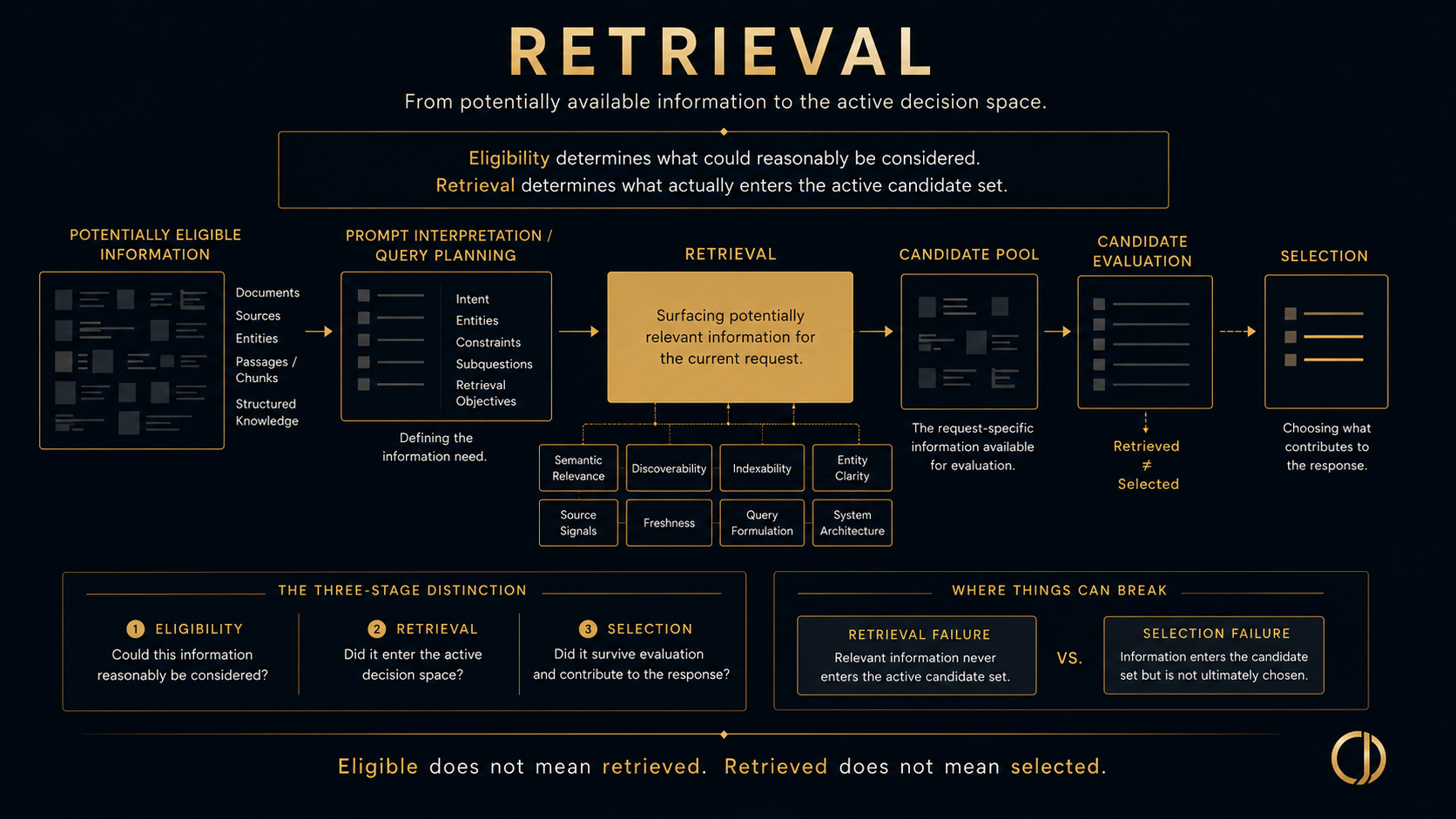
Eligibility determines what could reasonably participate.
Retrieval determines what actually enters the active decision process for a specific request.
But retrieval does not necessarily operate across one universal information environment.
Different tasks may activate different retrieval systems.
And those systems may have access to different representations of the same underlying source or entity.
A webpage may be available through web retrieval.
A business may be represented through local data.
A product may enter through a commerce system.
A recent event may depend on a news environment.
An entity may be represented through structured knowledge.
Retrieval therefore depends not only on relevance.
It depends on the relationship between:
Task
Retrieval System
Available Representation
Information Need
This creates a critical transition:
from information that could participate to representations that actually enter the active decision space.
Definition
Retrieval describes the mechanisms through which AI-mediated search systems surface potentially relevant representations for a particular request, context or information need.
Retrieval reduces a much larger possibility space into a smaller, request-specific Candidate Pool.
It may operate across different retrieval environments and on different units of information, including:
- documents
- sources
- webpages
- passages or chunks
- entities
- products
- business listings
- news items
- images
- structured knowledge
The underlying source and the representation available to a retrieval system are not necessarily identical.
This distinction matters.
Retrieval operates on what the system can access and represent — not simply on everything that exists.
Why Retrieval Exists
AI systems cannot actively evaluate every potentially relevant piece of information for every request.
The information space is too large.
Instead, systems must activate smaller subsets of information that appear useful for the current information need.
Retrieval performs this reduction.
But before information can enter that process, another question may have to be resolved:
Which retrieval environment should serve the task?
A local request may require different information infrastructure from a news request.
A product comparison may activate different representations from a general informational question.
An image request may rely on another retrieval path entirely.
Retrieval should therefore not be understood as a single search across one universal index.
It is better understood as a family of mechanisms that connect information needs with available representations.
Retrieval-System Routing
The same entity can exist across multiple information environments.
But not every environment is equally useful for every task.
Conceptually:
Task / Intent
↓
Retrieval-System Routing
↓
Relevant Information Environment
↓
Available Representations
↓
Candidate Retrieval
A system responding to a request may determine that useful information should come from one or several retrieval environments.
Examples may include:
- general web retrieval
- local or business information
- news
- product information
- images
- structured knowledge
- specialized databases
These categories are conceptual.
Individual AI systems may implement them differently, combine them or rely on external infrastructure.
The durable principle is simpler:
Retrieval depends partly on where the system looks.
An entity can therefore be highly visible in one retrieval environment and effectively absent from another.
Retrieval Is Representation-Dependent
Retrieval systems do not necessarily operate directly on the original source.
They operate on representations available within their information infrastructure.
For a webpage, such a representation might contain:
- URL
- title
- extracted text
- passages or chunks
- entities
- metadata
- structured data
- stored or cached content
Other environments may expose entirely different representations.
A local system may know an entity through business attributes.
A product system may expose price, availability and product characteristics.
A structured knowledge system may represent entities and relationships rather than pages.
This creates an important distinction:
Source ≠ Representation
A source may contain useful information that is missing, outdated or poorly expressed in the representation available to a particular retrieval system.
Conversely, a useful machine representation may allow information to participate without the complete source being processed during every request.
Retrieval is therefore representation-dependent.
Eligibility Is Not Retrieval
Eligibility describes whether information could reasonably qualify within a relevant retrieval environment.
Retrieval describes whether an available representation actually enters the active decision process for the current request.
This creates several possible states.
Information may be:
eligible but not retrieved
because its representation does not sufficiently match the current information need.
It may be:
eligible within one retrieval system but unavailable within another
because the required representation or ingestion path differs.
It may be:
retrieved and evaluated
but later lose during Candidate Evaluation.
Or it may survive evaluation without ultimately contributing to the generated response.
These are different states.
And they represent different visibility problems.
Retrieval Is Not Reading
Retrieval is also not necessarily equivalent to opening or reading the original source.
A retrieval system may initially surface a stored representation.
Another mechanism may subsequently access a richer representation of the source.
That representation may come from:
- previously processed content
- cached source material
- extracted passages
- structured information
- or, depending on the architecture, a new source access
We should therefore avoid assuming a universal sequence such as:
Search → Result → Live Page Read → Answer
A more robust conceptual distinction is:
Discovery / Retrieval
identifies potentially useful representations.
Source Access / Reading
may provide richer information where needed.
The exact interaction varies by architecture.
Retrieval and Stored Representations
Retrieval can operate on information that was processed before the current request.
This introduces an important temporal distinction.
The information available during retrieval may not always be identical to the current state of the original source.
A system may rely on stored representations that are updated through separate discovery, ingestion or refresh processes.
Conceptually:
Source
↓
Processing / Representation
↓
Stored Information Environment
↓
Retrieval
while separately:
Source Change
↓
Discovery / Refresh
↓
Representation Update
This should not be interpreted as a claim about one specific AI system.
It describes a general architectural possibility whenever retrieval operates on stored or indexed information.
For visibility, the implication is important:
Changing a source and changing the representation available to retrieval are not necessarily the same event.
Prompt Interpretation Shapes Retrieval
Retrieval does not occur independently of the request.
Systems must first establish what information is needed.
Prompt Interpretation and Query Planning may identify:
- intent
- entities
- relationships
- constraints
- subquestions
- required evidence
- retrieval objectives
Those interpretations can influence both:
where retrieval occurs
and
what retrieval attempts to surface.
A request may therefore affect Retrieval-System Routing as well as individual retrieval operations.
Query Planning and Fanout
A user prompt does not necessarily correspond to a single retrieval query.
Systems may reformulate, expand or decompose an information need.
A request about the best provider for a particular situation, for example, may require information about:
- available providers
- product characteristics
- suitability
- reputation
- constraints
- comparisons
- supporting evidence
These needs may produce different queries and potentially different retrieval paths.
Some may even depend on different information environments.
The visible prompt is therefore only the beginning of retrieval.
What matters downstream is how the information need is operationalized.
Retrieval Happens at Multiple Levels
Retrieval should not be understood as simply finding webpages.
Different architectures can retrieve different units of information.
Documents
Entire documents that appear relevant to the information need.
Sources
Specific domains, databases or information environments.
Passages or Chunks
Smaller sections containing locally relevant information.
Entities
Representations of people, companies, products, places or concepts.
Structured Knowledge
Information represented through structured attributes and relationships.
Specialized Objects
Products, businesses, news items, images or other task-specific information objects.
These distinctions matter because visibility at one level does not guarantee visibility at another.
A website may be retrievable while a particular claim is not.
An entity may be available through one representation but absent from another retrieval environment.
Retrieval operates on machine-available information structures, not simply URLs.
What Influences Retrieval?
No universal formula determines retrieval.
Different systems use different architectures, indexes, data sources, representations and retrieval mechanisms.
Several conditions may nevertheless influence whether information enters the active process.
Retrieval-System Availability
Does the system have an information environment appropriate for the task?
Representation Availability
Does that environment contain a usable representation of the source, entity or information?
Indexability and Accessibility
Can the information be processed and made available to the relevant infrastructure?
Discoverability
Can the retrieval mechanism locate the representation?
Semantic Relevance
Does the representation correspond sufficiently to the interpreted information need?
Entity Clarity
Can the retrieved information be connected to the intended entity?
Source Signals
Does the source provide useful signals within the current retrieval environment?
Freshness
Is the available representation sufficiently current for the task?
Query Formulation
How has the information need been translated into retrieval operations?
System Architecture
Which retrieval systems, indexes, stores, feeds or knowledge sources are available?
These are not ranking factors.
They are conditions shaping access to the active decision space.
Retrieval Creates the Candidate Pool
The Candidate Pool is not a static collection of all eligible information.
It is constructed for a particular information need.
Retrieval plays a central role in that construction.
Different tasks may activate different retrieval systems.
Different systems may contain different representations.
Different query plans may surface different candidates.
Different retrieval mechanisms may expose different documents, passages, entities or structured objects.
The Candidate Pool is therefore:
request-dependent
retrieval-system-dependent
representation-dependent
and
dynamically constructed.
Retrieval determines which part of the broader possibility space becomes available for evaluation.
Retrieval Failure Is Not One Problem
The expanded model also improves diagnostics.
If relevant information does not enter the Candidate Pool, several different failures may have occurred.
Environment Failure
The relevant retrieval environment was not activated or available for the task.
Representation Failure
The source or entity exists, but no sufficiently useful representation is available within that environment.
Retrieval Failure
A suitable representation exists but is not surfaced for the current information need.
Evaluation Failure
The information is retrieved but performs poorly against competing candidates.
Selection Failure
The candidate survives evaluation but does not ultimately contribute to the response.
These distinctions matter because each problem exists at a different layer.
Improving content quality alone cannot solve every retrieval failure.
Retrieval and AI Visibility
AI visibility is usually observed at the output layer.
Was the organization mentioned?
Was the source cited?
Was the product recommended?
But before any of those outcomes become possible, information must enter the relevant decision space.
The more useful diagnostic sequence is therefore:
Was the relevant retrieval environment available?
↓
Was the entity or source represented within it?
↓
Was that representation eligible for the task?
↓
Was it retrieved?
↓
Did it survive evaluation?
↓
Was it selected?
↓
Was it used or cited?
This turns AI visibility from an output metric into a systems problem.
Relationship to Selection Systems
Retrieval sits within the request-dependent part of the broader Selection Systems architecture.
A useful conceptual model is:
Information Environment
↓
Available Representations
↓
Eligibility
then, for a specific request:
Prompt + Context
↓
Prompt Interpretation / Query Planning
↓
Retrieval-System Routing
↓
Retrieval
↓
Candidate Pool
↓
Candidate Evaluation
↓
Prioritization / Reranking
↓
Selection
↓
Generation
↓
Grounding / Citation
This is not a universal technical pipeline.
Individual systems may combine, repeat or reorder mechanisms.
Multiple retrieval rounds may occur.
Generation may create new information needs.
Grounding may interact with retrieval and source selection.
The durable principle is the distinction between:
availability
representation
retrieval
evaluation
and
selection.
Strategic Perspective
Retrieval changes the central optimization question.
It is not enough to ask:
How do we make this page rank or get cited?
A more fundamental sequence is:
For which tasks should this entity become available?
Which retrieval environments can serve those tasks?
How is the entity represented within those environments?
Can those representations be retrieved for the relevant information needs?
Only then does competition within the Candidate Pool begin.
This is why AI visibility cannot be reduced to page optimization.
It is increasingly a problem of search architecture and information availability.
Closing Thesis
Eligibility creates the possibility of participation.
Representation determines what a retrieval system can know about the source or entity.
Retrieval-System Routing determines where the system looks.
Retrieval determines what enters the active decision space.
Candidate Evaluation determines how well it competes.
Selection determines what ultimately contributes to the response.
These mechanisms are related.
They are not interchangeable.
Being available somewhere is not enough.
The right representation must become available through the right retrieval environment for the right task.
Retrieval is the mechanism that turns that possibility into active consideration.
Related Concepts
Eligibility
Why participation depends on task, retrieval system and available representation.
Interpretation
How meaning can be constructed at representation time and request time.
Candidate Pool
The dynamically constructed set of retrieved information available for evaluation.
Candidate Evaluation
How retrieved candidates compete against the interpreted request and available alternatives.
Selection Systems
The broader architecture through which information is retrieved, evaluated, prioritized and selected.
Grounding
How claims, entities and evidence are connected across the wider information environment.