Grounding
How AI systems connect claims to identifiable evidence through machine-available representations.
AI systems do not connect generated information directly to reality.
They operate through representations.
A source may exist in the information environment, but an AI system can only use the information that becomes available to it through some machine-accessible representation.
That representation may contain a complete document.
Or only part of it.
It may consist of extracted passages, structured attributes, entity records, indexed text, cached content or other system-specific representations.
Grounding therefore depends on more than the existence of a source.
It depends on whether evidence can be connected across a chain:
Source → Representation → Evidence → Claim
This relationship can be understood as evidence lineage.
Grounding reduces uncertainty by preserving meaningful connections between generated claims, the evidence supporting them, the representations through which that evidence becomes available and the underlying sources and entities to which it refers.
As AI systems become increasingly involved in search, synthesis and decision support, grounding becomes part of the evidence architecture behind reliable machine understanding.
Definition
Grounding describes the mechanisms through which AI systems connect information and generated claims to identifiable entities, supporting evidence, machine-available representations, underlying sources and relevant context.
Grounding therefore involves more than identifying where information originated.
It requires preserving enough evidential lineage for a claim to remain:
- identifiable
- verifiable
- attributable
- consistent
- contextually supported
A citation can expose part of this lineage.
Grounding is the broader architecture that makes supported claims possible.
Why Grounding Exists
Generative systems can produce plausible language without establishing that every statement is adequately supported.
A claim can sound correct while being:
- unsupported
- attached to the wrong entity
- derived from an incomplete representation
- based on outdated evidence
- inconsistent with the underlying source
- inappropriate for the current context
Grounding introduces constraints.
It connects generated information to evidence that can support what is being said.
The relevant question is therefore not simply:
Can the system generate an answer?
It is:
What evidence supports this claim, how was that evidence represented to the system, and where did it originate?
From Source to Representation to Evidence
A crucial distinction is often overlooked in discussions of grounding.
The source is not necessarily the representation available to the AI system.
A web page, database record, product feed, document or business listing may exist as an underlying source.
But retrieval and generation systems may interact with representations derived from those sources.
Conceptually:
Source
↓
Machine-Available Representation
↓
Supporting Evidence
↓
Generated Claim
Possible representations may include:
- indexed text
- titles and snippets
- extracted passages or chunks
- cached document content
- structured attributes
- entity records
- feed data
- stored source representations
The exact architecture varies by system.
The durable principle is more important:
Evidence can only support a generated claim to the extent that a usable representation of that evidence becomes available to the decision process.
Grounding therefore depends not only on source quality, but also on representation quality.
Evidence Lineage
Grounding becomes stronger when the relationship between a claim and its underlying evidence remains traceable.
This can be described as evidence lineage.
A simplified lineage might look like:
Underlying Source
↓
Available Representation
↓
Retrieved Evidence
↓
Claim Support
↓
Generated Claim
↓
Citation / Attribution
Each transition introduces a potential failure point.
The source may contain accurate information while the available representation is incomplete.
The representation may contain the relevant information while retrieval surfaces the wrong passage.
The correct evidence may be retrieved while the generated claim overstates what that evidence supports.
And a well-grounded claim may still receive no visible citation.
This is why grounding cannot be evaluated only by asking whether a citation appears.
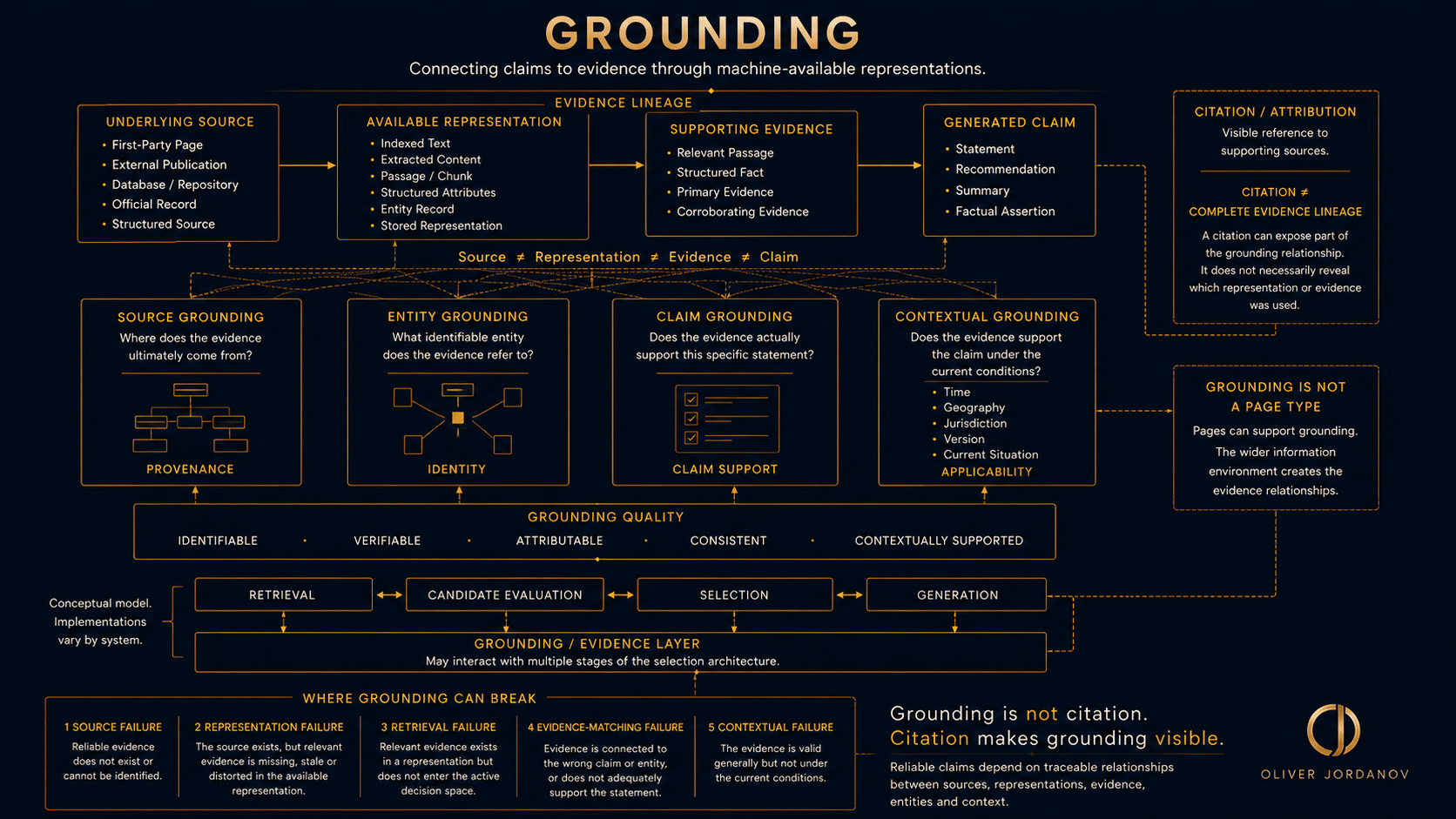
Four Dimensions of Grounding
Evidence lineage describes how support travels through the system.
The four grounding dimensions describe what kind of uncertainty that support resolves.
Source Grounding
Where does the information ultimately come from?
Source Grounding connects evidence to an identifiable origin.
This may include:
- first-party sources
- external publications
- databases
- documentation
- structured repositories
- official records
- specialized data sources
Source Grounding establishes provenance.
But provenance alone does not prove that a source supports every claim derived from it.
Nor does the existence of a source guarantee that the system has access to a sufficiently complete representation of it.
Entity Grounding
What real entity does the information refer to?
Entity Grounding connects information and evidence to identifiable people, organizations, products, places, services or concepts.
This becomes particularly important when:
- names are ambiguous
- multiple entities share similar attributes
- information is distributed across sources
- historical and current representations differ
- relationships between entities are unclear
Entity Grounding and Entity Clarity are closely related.
Entity Clarity reduces ambiguity in identity.
Entity Grounding connects claims and evidence to that identity.
Claim Grounding
What evidence actually supports the specific statement being made?
Claim Grounding operates at the level of assertions.
A source may be relevant to a topic without supporting a particular claim.
A retrieved passage may mention the correct entity without establishing the stated relationship.
A credible document may support a weaker claim than the generated response ultimately makes.
Reliable grounding therefore requires more than topical similarity.
Source relevance is not claim support.
Claim Grounding concerns the correspondence between the evidence available to the system and the statement ultimately generated.
Contextual Grounding
Does the evidence support the claim under the current conditions?
Information can be factually correct and still be wrong in context.
Applicability may depend on:
- time
- geography
- jurisdiction
- product version
- user situation
- conversation context
- specific constraints
Contextual Grounding connects evidence to the conditions under which it remains valid.
A source can therefore be authentic, correctly represented and relevant to a claim while still failing to support its application in the current context.
Grounding Is Representation-Dependent
Grounding quality cannot be inferred from the underlying source alone.
Consider a source containing detailed, accurate and current information.
Different systems may hold different representations of that same source.
One system may have access to:
- a title
- a URL
- a short extracted description
Another may have:
- complete page content
- structured attributes
- entity relationships
- recent updates
A third may not represent the source at all.
The grounding potential of the source therefore differs across those environments.
This creates an important distinction:
Source quality ≠ Representation quality ≠ Evidence quality
All three can matter.
Grounding is consequently dependent on the information actually available to the system, not merely on what exists on the original page.
Grounding Is Not Citation
Grounding and citation are related.
They are not synonymous.
Citation is an observable reference to a source.
Grounding describes the evidential relationships supporting a claim.
A citation may reveal the endpoint of an evidence lineage without exposing the intermediate representations or evidence used by the system.
A system may also cite a credible source while generating a claim that the cited evidence does not adequately support.
Conversely, information may be grounded through retrieved evidence, structured knowledge or stored representations without every supporting reference being displayed.
The distinction remains:
Grounding creates evidential support.
Citation makes some of that support visible.
Citation Is Not Necessarily Evidence Lineage
A visible citation tells the user that a source has been associated with a response.
It does not necessarily reveal:
- which representation of the source was used
- which passage or structured attribute was retrieved
- which evidence supported which claim
- whether other sources contributed
- whether the source was accessed directly or through a stored representation
- how the system resolved conflicting evidence
Citation should therefore be understood as a presentation and attribution mechanism, not a complete map of the underlying grounding process.
This distinction becomes increasingly important when evaluating AI search systems from their visible outputs alone.
Grounding Is Not a Page Type
Grounding is sometimes translated into a content tactic:
Create a dedicated page containing consolidated facts about an organization, product or entity.
Such pages can be useful.
They may improve:
- canonical information
- entity identification
- fact consistency
- structured representation
- evidential accessibility
But a page itself is not grounding.
Grounding emerges from relationships across the wider information environment:
Sources → Representations → Entities → Evidence → Claims → Context
A dedicated page may strengthen those relationships.
It cannot substitute for them.
Grounding is not a page type.
It is an evidential property of the information architecture.
Grounding Across the Selection Architecture
Grounding should not be modeled exclusively as a final step after generation.
Evidence relationships can interact with multiple stages.
Retrieval
The availability and representation of supporting evidence can affect what information enters the active candidate space.
Candidate Evaluation
Candidates may differ not only in semantic relevance, but also in source quality, consistency and evidential support.
Selection
Evidence quality may influence which claims, entities or sources are suitable for inclusion.
Generation
Generation can introduce claims requiring additional evidence or trigger further retrieval.
Citation / Attribution
Supporting sources may become visible to the user through explicit references.
Grounding therefore acts less like one box in a linear pipeline and more like an evidence layer interacting with multiple parts of the selection architecture.
Grounding Failure
The expanded model also gives us a more precise diagnostic framework.
A grounding problem does not necessarily mean that no credible source exists.
Failure can occur at different points.
Source Failure
Reliable supporting information does not exist or cannot be identified.
Representation Failure
The source exists, but the relevant evidence is missing, distorted, stale or inaccessible in the representation available to the system.
Retrieval Failure
The evidence exists in an available representation but does not enter the active decision space.
Evidence-Matching Failure
Relevant evidence is available, but the system connects it to the wrong claim or entity.
Contextual Failure
The evidence supports the general statement but not its application under the current conditions.
Attribution Failure
The claim is adequately supported, but the visible citation or attribution does not accurately expose that support.
This distinction matters strategically.
Not every citation problem is a grounding problem.
And not every grounding problem is a source problem.
Organizational Grounding
Organizations frequently underestimate how difficult their information is to ground.
The problem is rarely simply that information does not exist.
More often, the evidential chain is weak.
Common problems include:
- inconsistent entity descriptions
- conflicting facts across sources
- unclear ownership relationships
- fragmented documentation
- outdated representations
- unsupported claims
- disconnected structured data
- weak external corroboration
- important evidence buried in poorly accessible formats
- historical narratives remaining available alongside current information
Each inconsistency can weaken evidence lineage.
The more uncertainty a system must resolve between source, representation, evidence, entity and claim, the harder reliable grounding becomes.
Grounding and Entity Clarity
Grounding and Entity Clarity solve related but distinct problems.
Entity Clarity asks:
Can the system establish what this entity is?
Grounding asks:
Can claims about that entity be connected to identifiable and contextually appropriate evidence?
An entity can be clearly represented but poorly grounded.
The reverse is also possible.
Substantial evidence may exist around an entity whose identity or relationships remain ambiguous.
Strong machine understanding benefits from both.
Clarity reduces identity uncertainty.
Grounding reduces evidential uncertainty.
Grounding and Retrieval
Retrieval and grounding are also distinct.
Retrieval asks:
What information entered the active decision space?
Grounding asks:
What evidential relationships support the information ultimately used?
Retrieval can surface information that is poorly grounded.
Well-grounded evidence can exist without being retrieved for a particular request.
And retrieval may operate on a representation rather than directly on the underlying source.
This produces an important diagnostic distinction:
Available evidence does not imply retrieved evidence. Retrieved evidence does not imply adequate claim support.
Grounding and AI Visibility
Grounding matters to AI visibility because visibility is not only a question of relevance.
Systems also need information that can be used with sufficient confidence.
Grounding may therefore interact with:
- retrieval reliability
- candidate confidence
- claim support
- source selection
- representation stability
- citation likelihood
- answer reliability
This does not make grounding a deterministic ranking factor.
Nor does stronger grounding guarantee visibility.
It improves the conditions under which information can be identified, supported, verified and safely incorporated into responses.
Building Stronger Grounding
Organizations cannot directly control how proprietary AI systems construct evidence chains.
They can improve the information environment from which those chains are built.
Useful principles include:
Canonical Sources
Maintain reliable first-party reference points for important facts.
Representation Accessibility
Make important information structurally accessible and machine-readable rather than burying critical evidence in difficult formats or ambiguous page structures.
Stable Entity Representation
Use consistent names, attributes and relationships across relevant environments.
Claim-Level Support
Ensure important statements can be connected to evidence that actually supports them.
External Corroboration
Develop credible independent references where appropriate.
Structured Relationships
Make connections between organizations, people, products, services, claims and sources explicit.
Temporal Consistency
Keep information current and distinguish historical facts from present conditions.
Contextual Precision
Make clear where information applies, including geography, jurisdiction, product version or other relevant constraints.
The objective is not to manufacture confirmation.
It is to make legitimate evidence easier to represent, retrieve, connect and verify.
Grounding as Evidence Infrastructure
Grounding should not be viewed as an isolated content tactic.
It is evidence infrastructure.
It connects:
Sources
to
Representations
to
Evidence
to
Entities
to
Claims
to
Context
These relationships help AI systems move from plausible generation toward supported representation.
For organizations, grounding therefore cannot be solved by publishing one additional page.
It emerges from the consistency, accessibility and traceability of the wider information environment.
Strategic Implication
AI visibility discussions often focus on whether a brand receives citations.
That begins too late.
The more fundamental questions are:
Does reliable evidence exist?
Can relevant retrieval systems represent it?
Can that evidence be retrieved?
Can it be connected to the correct entity and claim?
Does it remain valid in the current context?
Citation is one possible observable outcome of that architecture.
Grounding is the underlying evidential capability.
Closing Thesis
AI systems do not connect generated claims directly to reality.
They connect claims to evidence through representations of information.
That creates an evidence lineage:
Source → Representation → Evidence → Claim
Grounding determines how reliably those relationships can be established across entities and contexts.
It therefore cannot be reduced to citation, a final processing stage or a dedicated page.
It is the evidence architecture behind reliable machine understanding.
Grounding is not citation.
Citation makes grounding visible.
Related Concepts
How AI Selection Works
The overarching framework describing how AI systems interpret, retrieve, evaluate and select information.
Retrieval
How retrieval systems activate available representations for a specific request.
Interpretation
How AI systems construct meaning from machine-available representations at different stages.
Entity Clarity
The degree to which an entity can be consistently identified, understood and differentiated.
Candidate Evaluation
How retrieved candidates are evaluated against the current request and competing alternatives.
Selection Systems
How AI systems coordinate evaluation, prioritization and selection across the decision architecture.
Eligibility
The task-, retrieval-system- and representation-dependent conditions that determine whether information can plausibly participate.
Semantic Debt
Accumulated structural inconsistencies that reduce interpretability and machine confidence.