Search Influence
How search systems shape human decisions beyond measurable traffic.
Search is usually measured through observable outcomes.
Rankings.
Clicks.
Sessions.
Conversions.
These metrics remain important.
But they describe only part of what search systems do.
Before a user visits a website, a search system may already have selected, presented and framed information about an organization, product, person or topic.
That exposure can influence what the user knows.
What they consider.
What they trust.
And ultimately what they decide.
This broader decision effect is described here as Search Influence.
Definition
Search Influence describes the effect search-mediated exposure can have on human perception, consideration, trust and decision-making.
It connects two different systems:
machine selection and human decision.
A search system first determines which information, entities or sources become available for presentation.
The resulting exposure may then influence the user — with or without a website visit.
Traffic is therefore one observable outcome of search.
Search Influence describes the broader decision effect.
From Machine Selection to Human Decision
Search Influence does not begin with the click.
It begins further upstream.
A useful conceptual model is:
REPRESENTATION
↓
RETRIEVAL
↓
INTERPRETATION
↓
SELECTION
↓
SEARCH EXPOSURE
↓
AWARENESS
↓
CONSIDERATION
↓
TRUST
↓
DECISION
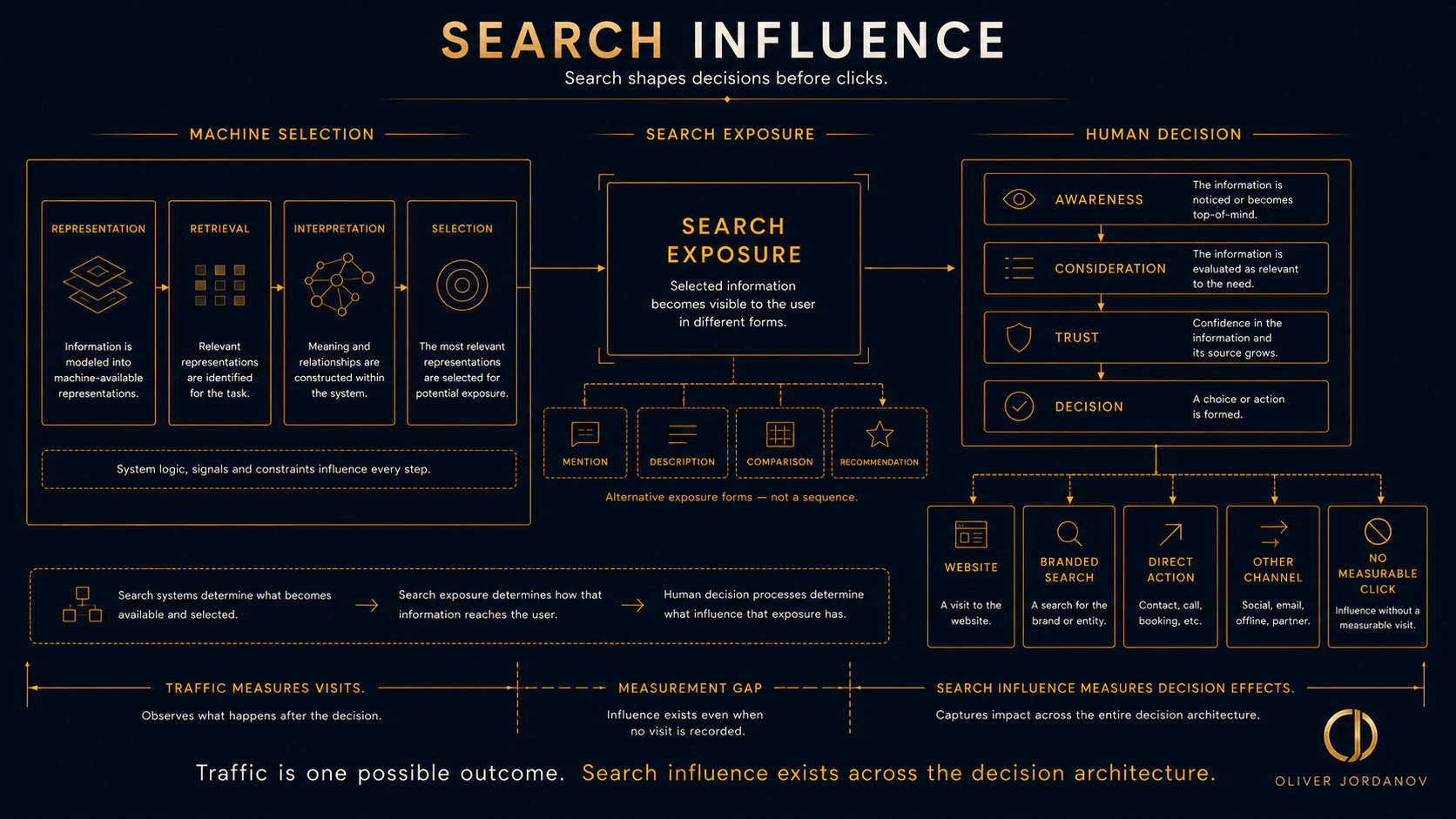
This is a functional model, not a claim that every search system implements the same technical pipeline or that every user moves linearly through every stage.
Individual systems may combine, repeat or reorder mechanisms.
Human decisions may skip stages, occur across multiple interactions or be influenced by several search experiences over time.
The important distinction is structural:
machine systems determine what becomes available for exposure; human users determine what that exposure ultimately means for their decision.
Machine Selection
Before information can influence a user, it must first become available to the search experience.
Search and AI systems do not necessarily operate directly on live pages.
They may operate on machine-available representations such as:
- indexed documents
- extracted passages
- entities
- structured data
- cached content
- stored representations
- specialized search or knowledge sources
Retrieval determines which potentially relevant information enters the active process.
Interpretation establishes meaning within the current task.
Selection determines what contributes to the resulting search experience.
These mechanisms belong to the machine side of Search Influence.
They determine the possibility of exposure.
They do not determine the human response.
Search Exposure
Selection by a machine and selection by a human are not the same event.
Between them lies Search Exposure.
Search Exposure describes the way selected information becomes perceptible to the user within a search-mediated environment.
A brand, entity or source might appear as a:
- mention
- description
- comparison
- recommendation
- citation
- attributed source
- knowledge element
- direct answer component
These forms are not interchangeable.
A brand can be mentioned without being recommended.
It can be described without being compared.
It can appear in a comparison without ultimately being preferred.
It can be cited as evidence without becoming the object of the user's decision.
Search Exposure is therefore not a single presentation format.
It is the functional transition between machine selection and potential human influence.
Exposure Is Not Influence
Being exposed does not guarantee influence.
A user may ignore the information.
They may already know the brand.
They may distrust the source.
They may interpret the exposure differently than expected.
They may encounter competing information elsewhere.
Search Influence therefore should not be inferred simply because an entity appeared in a search result or AI response.
Exposure creates an opportunity for influence.
The effect depends on the user, task, context and surrounding information.
This distinction prevents visibility metrics from being mistaken for business outcomes.
Human Decision
Once information becomes visible to the user, a different decision system begins.
Search exposure can contribute to:
Awareness
The user becomes aware of an entity, brand, product or perspective.
Consideration
The entity enters or strengthens its position within the user's consideration set.
Trust
Repeated, credible or contextually appropriate exposure may affect perceived legitimacy, expertise or confidence.
Decision
The user may eventually choose, reject, investigate or act upon the information.
These effects do not require an immediate website visit.
A user may remember a brand and search for it later.
They may include it in a shortlist.
They may validate an existing preference.
They may make a decision directly within the search experience.
Or their perception may change without producing any immediately observable action.
Machine Selection Is Not Human Selection
This distinction is central to Search Influence.
A search system may select an organization for inclusion in an answer.
That does not mean the user will select that organization.
Likewise, an organization may receive prominent exposure without persuading the user.
Three different questions therefore need to be separated:
Machine Selection
Was the entity or information selected by the system?
↓
Search Exposure
How was it presented to the user?
↓
Human Decision
What effect, if any, did that exposure have on the user's decision?
Being selected by a machine is not the same as being presented persuasively to a human — and neither guarantees being selected by the human.
Recommendation Is One Form of Exposure
Recommendations are particularly visible examples of Search Influence.
But they should not define the concept.
Search systems influence decisions through much more than explicit recommendations.
Consider a user researching several providers.
A search system may repeatedly surface one organization as:
- a relevant entity
- a cited expert
- a comparison candidate
- a source of supporting evidence
- an established provider within a category
None of these exposures necessarily constitutes a recommendation.
Yet together they may influence familiarity, perceived legitimacy and consideration.
Search Influence therefore includes recommendation, but is not dependent on it.
The Measurement Gap
Search Influence creates a fundamental measurement problem.
Web analytics primarily observe interactions with owned digital properties.
Search Influence can occur before such interaction — or without it entirely.
A search exposure might result in:
- an immediate website visit
- a later branded search
- inclusion in a consideration set
- increased familiarity
- changed perception
- trust formation
- direct selection within a search or AI interface
- a later decision through another channel
- no observable action despite a change in perception
Only some of these outcomes create a directly attributable session.
This creates a gap between observable interaction and actual decision influence.
The absence of a click therefore does not demonstrate the absence of influence.
But the presence of exposure does not prove influence either.
Measurement must distinguish between the two.
Search Influence Is Not Traffic
Traffic and Search Influence describe different phenomena.
Traffic is an observable outcome.
It tells us that a user reached a digital property.
Search Influence is a decision effect.
It describes how search-mediated information may shape perception and behavior.
Sometimes the two coincide:
Search Exposure → Website Visit → Conversion
Sometimes they do not:
Search Exposure → Awareness → Later Branded Search
or:
Search Exposure → Consideration → Decision through another channel
or even:
Search Exposure → Changed Perception → No immediately measurable action
Traffic remains valuable.
It simply captures only the portion of Search Influence that produces an observable website interaction.
Search Influence and AI Visibility
Search Influence is not synonymous with AI Visibility.
AI Visibility describes whether and how entities, sources or information become visible within AI-mediated environments.
Search Influence asks a broader question:
What effect can search-mediated exposure have on human decisions?
That applies across:
- traditional search results
- featured snippets
- knowledge panels
- AI Overviews
- AI assistants
- conversational search
- other search interfaces
AI did not create Search Influence.
Search systems have long shaped awareness, consideration and trust before users reached websites.
AI-mediated search makes the distinction more important because more interpretation, synthesis, comparison and decision support can now occur inside the search experience itself.
The distance between influence and traffic can therefore become larger.
Relationship to the Search Architecture
Search Influence sits downstream from the machine-side concepts in this framework.
Representation describes what information becomes machine-available.
Retrieval describes what enters the active information space for a specific task.
Interpretation describes how meaning is constructed from available information.
Selection describes what ultimately contributes to the search experience.
Search Influence begins where those machine-side processes become capable of affecting human perception.
Conceptually:
Machine Availability
Representation
↓
Retrieval
↓
Interpretation
↓
Selection
↓
Human Exposure
Search Exposure
↓
Human Decision
Awareness
↓
Consideration
↓
Trust
↓
Decision
This makes Search Influence a bridge between Search Systems and Decision Architecture.
Strategic Implications
This model changes the question organizations should ask about search performance.
The question is not only:
Did search generate traffic?
It is also:
Where and how did search shape the decision process?
That requires separating several dimensions of performance:
Was the organization available to the relevant retrieval system?
Was it retrieved for relevant tasks?
Was it selected?
How was it exposed?
In what contexts did that exposure occur?
Did subsequent demand, branded search, consideration or conversion behavior change?
Not every dimension can be measured with equal confidence.
That limitation should be made explicit rather than hidden behind attribution models.
Search Influence is therefore not an argument for replacing conventional analytics.
It is a framework for understanding what those analytics cannot fully observe.
Closing Thesis
Search does more than distribute traffic.
It mediates information between machines and people.
Machines retrieve, interpret and select.
Search interfaces expose.
Humans perceive, evaluate and decide.
These are related processes, but they are not the same process.
That distinction is the foundation of Search Influence.
Traffic is an observable outcome.
Search Influence is a decision effect.
Understanding modern search therefore requires measuring what can be observed while recognizing the influence that may occur beyond the click.
Related Concepts
How AI Selection Works
The broader architecture through which information becomes available, evaluated and selected within AI-mediated systems.
Retrieval
How potentially eligible information enters the active decision space for a specific request.
Interpretation
How systems construct meaning from available representations and request context.
Selection Systems
How competing candidates are evaluated and selected for contribution to a response.
Grounding
The mechanisms that connect AI-generated outputs to verifiable information.
Entity Clarity
The degree to which an entity can be consistently identified, understood and differentiated across information environments.
Eligibility
The conditions that determine whether an entity can be considered for selection.