E-Commerce Migration
How to migrate platforms, URLs, data and search signals without turning a technical rebuild into an organic search problem.
An e-commerce migration is rarely just a platform change.
A new commerce system can alter the technical and semantic relationships search engines have accumulated over years. That makes migration a search architecture problem.
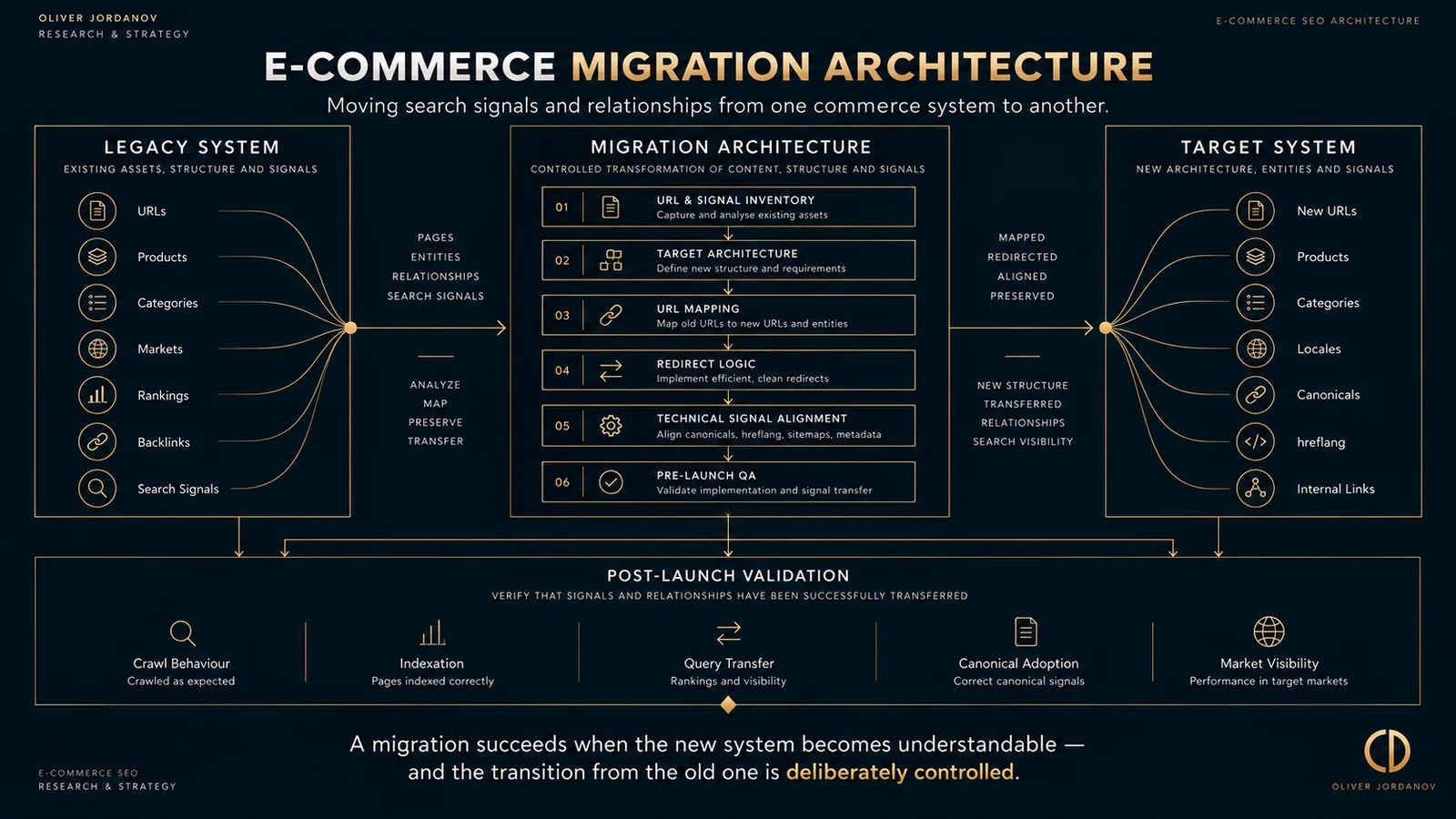
The objective is not to preserve every element of the old website. It is to understand which signals carry value, determine where they belong in the new system and control the transition from one architecture to another.
What an E-Commerce Migration Actually Changes
A platform change can alter URLs, products, categories, internal links, faceted navigation, market and locale structures, canonicals, hreflang, structured data, indexation controls, XML sitemaps, tracking, business data and historical redirects. A technically successful platform migration can therefore still be an unsuccessful search migration.
Why E-Commerce Migrations Fail
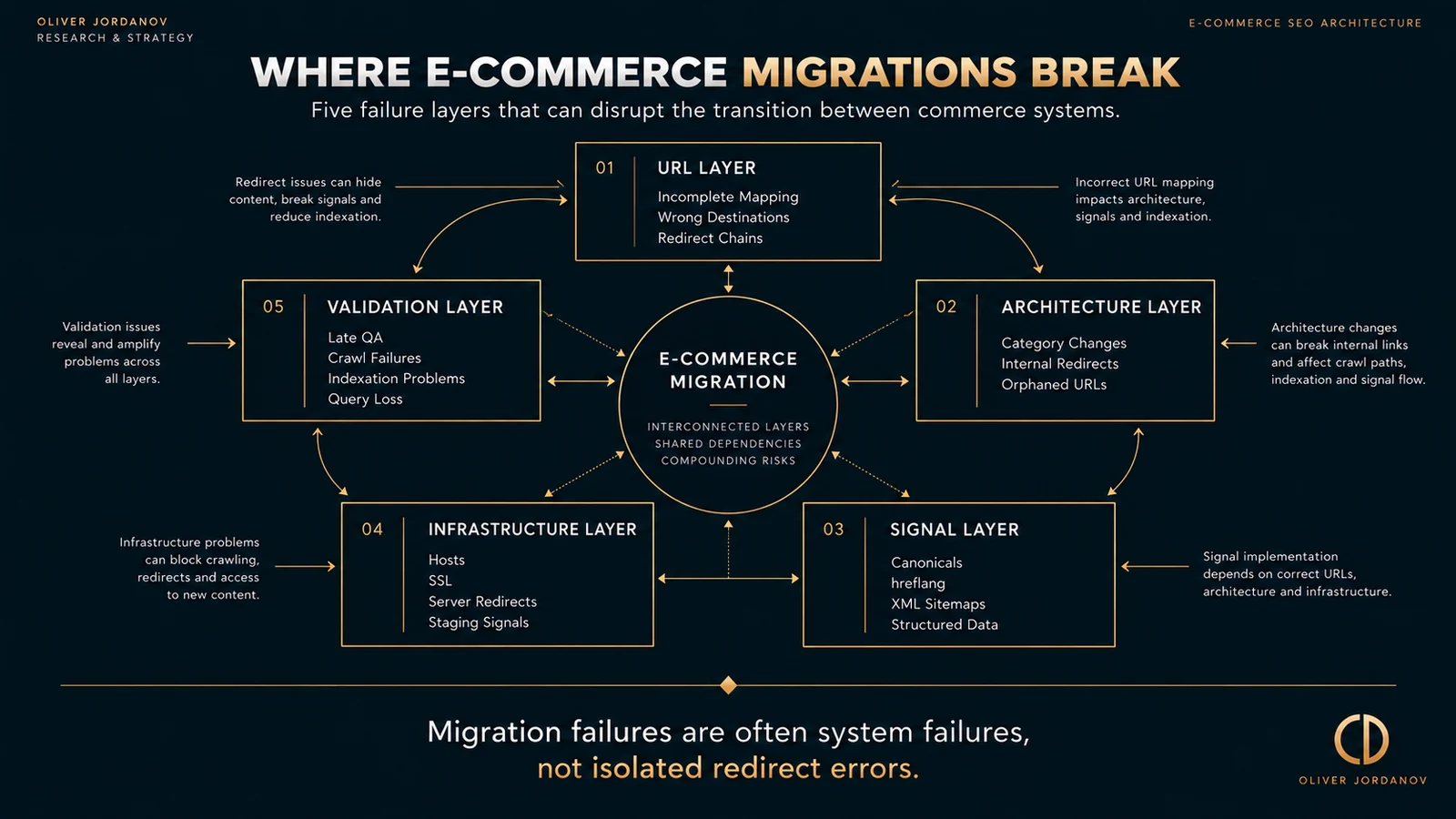
Migration problems rarely originate from one catastrophic mistake. More often, several individually reasonable decisions interact badly.
Incomplete URL Mapping
Legacy URLs disappear without an explicit destination. This often affects discontinued products, old categories, editorial landing pages, campaign URLs and historic locale structures. Inventory the old system before the new one becomes authoritative.
Redirects Follow Templates Instead of Meaning
Large migrations need automation, but technical similarity does not guarantee semantic equivalence. Redirect architecture needs rules, search-value prioritization and exceptions.
Server-Level Redirect Behaviour Is Underestimated
Redirect logic can be correct on paper and still fail because the request never reaches the layer where it was implemented. Application redirects, .htaccess, hosting rules, SSL handling, caches and upstream server configuration can behave differently. Test real requests across representative paths, hosts, protocols and trailing-slash variants.
Information Architecture Changes Without Search Mapping
Categories consolidate, products move, markets change and filters appear or disappear. These decisions alter relationships search engines have learned between URLs, topics and entities.
Canonicals Contradict the Migration
Redirects, canonicals, internal links and sitemaps should describe the same target architecture. Conflicting signals can undermine an otherwise correct URL migration.
International Signals Drift
Locale changes affect redirects, hreflang, canonicals, internal links, sitemaps and historical signals. Similar market variants should not be treated mechanically when pricing, shipping, legal context or assortment differ.
Internal Links Continue Describing the Old System
A 301 preserves a route; it does not fix internal architecture. Redirect inlinks should be updated directly to final destinations wherever possible.
Valuable Historical URLs Are Treated as Technical Debris
Old URLs may still carry backlinks, rankings, demand or citations. An obsolete URL and an obsolete URL with valuable signals are different migration cases.
Host and Staging Signals Leak
Staging hosts, alternate www/non-www variants, test URLs and development signals can survive launch. A migration is not complete until search engines receive one coherent version of the new system.
SEO QA Starts Too Late
SEO QA should begin with the target search architecture, not only with a pre-launch checklist.
The Migration Architecture
Platform Migration, Data Migration and SEO Migration
Platform Migration
The commerce application changes. The platform determines technical capabilities and constraints, but not the correct search architecture by itself.
Data Migration
Products, customers, orders and inventory move into the new environment. Product data can also influence URLs, structured data, variants and category relationships.
SEO Migration
Legacy URLs, rankings, internal and external links, canonicals, international signals, structured data, crawl directives and sitemap structures need to survive or be deliberately transformed. SEO migration is the search layer of the same system change.
URL and Redirect Strategy
A redirect matrix represents how the old information system maps into the new one. Common relationships include one-to-one mappings, many-to-one consolidations, removals without equivalent, locale transformations and changed product or category identities.
Redirects at Scale
Large migrations can involve tens of thousands of redirects. Manual mapping alone becomes impractical; pure automation is equally risky. A better approach combines pattern-based generation, search-value prioritization and exception QA.
International E-Commerce Migration
International systems add relationships that single-market migrations do not have. QA should validate locale structure, hreflang, canonicalization, internal linking, redirects and sitemaps together. A page can migrate correctly while the international system around it breaks.
E-Commerce Migration Checklist
Before Development Is Finalized
- inventory indexable URLs and search performance
- identify backlink-bearing URLs
- document canonicals, hreflang and sitemaps
- define the target URL architecture
- document category, product, market and locale changes
Before Launch
- complete URL mapping and redirect rules
- review high-value exceptions
- crawl staging
- validate status codes, canonicals, robots, hreflang and structured data
- test internal links and navigation
- prevent staging indexation
Within the First 72 Hours
- check crawl activity
- review 404 and soft-404 patterns
- validate representative redirect classes
- watch indexation and abrupt ranking changes
- verify international paths and locale variants
During Stabilization
- monitor redirect errors and chains
- monitor indexation and canonical adoption
- compare legacy and new URLs
- track query transfer
- monitor product, category and market visibility
- investigate losses before making further structural changes
Migration QA Should Test Relationships
Redirect: Does the old URL reach the intended destination?
Canonical: Does the destination identify itself correctly?
Internal Linking: Does the site link directly to the final URL?
hreflang: Do international equivalents reference the final architecture?
Sitemap: Is the canonical destination represented correctly?
A migration becomes robust when these systems agree.
How to Measure an E-Commerce Migration
Traffic alone is a poor migration diagnostic. Measure URL transition, query transfer, canonical adoption, crawl behaviour, market and locale transition, and category/product visibility.
A Real International E-Commerce Migration
In one international e-commerce project, two interconnected commerce environments were migrated across multiple markets and locales. The work required approximately 33,000 consolidated redirects alongside URL changes, locale changes, canonicals, hreflang, redirect architecture and launch QA.
The challenge was not generating thousands of redirects. It was ensuring that the different technical signals described the same target architecture.
→ View the International E-Commerce Migration Case Study
When External Migration Support Makes Sense
The risk changes when a migration involves significant organic revenue, thousands of indexable URLs, multiple countries or languages, platform changes, major URL restructuring, complex product inventories, several technical teams or a fixed launch deadline.
My work typically focuses on migration architecture, technical SEO strategy and quality assurance.
Closing Perspective
An e-commerce migration changes the system through which products, categories, markets and information become discoverable.
The central challenge is not “How do we preserve every old URL?” It is: How do we move from one search architecture to another without losing the signals and relationships that still matter?
The migration succeeds when the new system becomes understandable on its own — and the transition from the old one has been deliberately controlled.