Candidate Pool
Why AI systems never evaluate the entire web.
Modern AI systems do not evaluate every available document before generating a response.
Instead, they progressively reduce the available information until only a limited number of candidates remain.
This reduced set is the Candidate Pool.
Every later decision depends on its quality.
Definition
A Candidate Pool is the request-specific collection of entities, documents, passages, claims or other information that has become available for evaluation through retrieval.
Candidates may originate from different retrieval systems and may be represented in different forms.
The Candidate Pool is therefore not a single uniform result set. It is a dynamically constructed decision space shaped by the current task, available representations and retrieval architecture.
Selection does not begin with the entire information environment.
It begins with the candidates that have actually entered the active decision space.
Why Candidate Pools Exist
The amount of available information is effectively unlimited.
No modern AI system can evaluate everything for every request.
Instead, systems continuously reduce complexity.
Information that fails earlier stages never reaches the Candidate Pool.
As a result, many visibility problems occur before selection even begins.
Reduction Before Selection
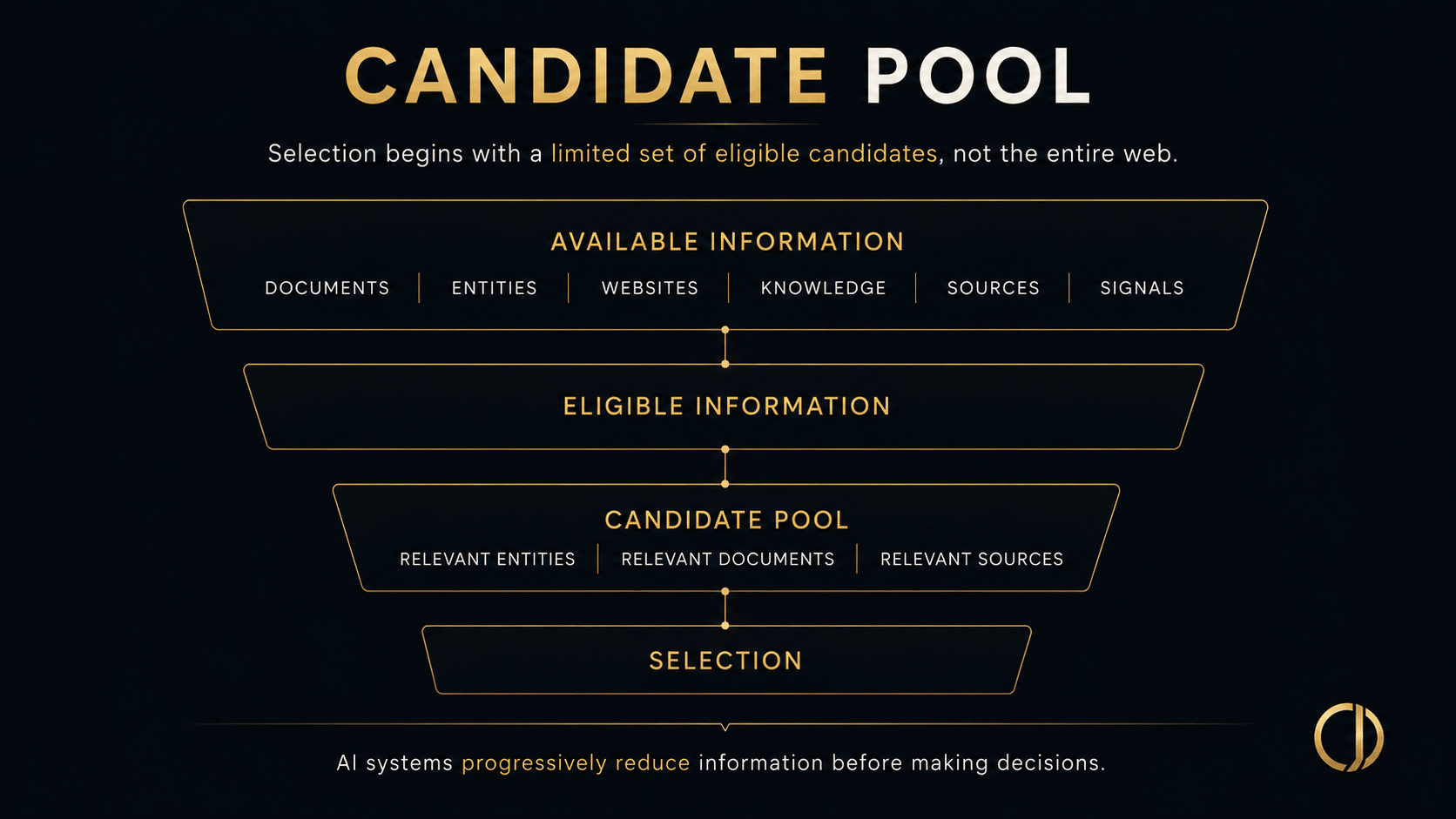
The Candidate Pool represents a reduction process.
Information moves through several stages before entering it.
Signals
↓
↓
Entity Clarity
↓
Eligibility
↓
Candidate Pool
Only then can selection begin.
Not Every Eligible Entity Enters the Pool
Eligibility does not guarantee participation.
Multiple additional factors influence whether information becomes part of the Candidate Pool.
These may include:
- topical relevance
- source quality
- retrieval mechanisms
- semantic relationships
- available context
- confidence signals
Candidate Pools therefore remain dynamic rather than fixed.
Why Candidate Pools Matter
Many organizations focus exclusively on improving rankings.
However, ranking assumes that information is already under consideration.
Candidate Pools explain why many organizations remain invisible despite producing high-quality content.
If information never enters the Candidate Pool, it cannot be selected.
Candidate Pools Continuously Change
Unlike traditional indexes, Candidate Pools are assembled dynamically.
Different prompts may produce different candidate pools.
Different AI systems may construct different pools.
Different contexts may include or exclude different entities.
Selection therefore begins from a moving rather than static foundation.
Relationship to the Concepts Library
Candidate Pool follows Eligibility.
Eligibility determines whether information may participate.
Candidate Pool determines which eligible information actually becomes available for selection.
Selection then evaluates competing candidates.
Grounding connects the chosen response back to verifiable sources.
Strategic Perspective
Improving AI visibility is not only about becoming eligible.
It is about consistently entering the Candidate Pool across many different retrieval and selection scenarios.
Organizations that repeatedly appear in Candidate Pools dramatically increase their probability of being selected.
Closing Thesis
Selection does not start with the internet.
It starts with a remarkably small set of candidates.
The quality of AI visibility therefore depends not only on being correct, but on repeatedly becoming part of the Candidate Pool.
Related Concepts
How AI Selection Works
The overarching framework describing how AI systems interpret, evaluate and select information.
Selection Systems
How AI systems compare and prioritize competing candidates before generating a response.
Eligibility
The conditions that determine whether an entity can be considered for selection.
Entity Clarity
The degree to which an entity can be consistently identified, understood and differentiated across information environments.
Prompt Interpretation (Coming Soon)
How AI systems use prompts to prioritize candidates within the candidate pool.
Context (Coming Soon)
How conversation history, user intent and situational factors influence candidate prioritization.
Selection (Coming Soon)
How AI systems compare competing candidates before generating the final response.
Grounding
The mechanisms that connect AI-generated outputs to verifiable information.