Rebuilding Jodano: An Ongoing Case Study in Entity Clarity
How I am transforming a decade-old, multi-topic website into a focused financial information platform—and what the process reveals about semantic debt, information architecture and machine interpretation.
| Project | Jodano.de |
|---|---|
| Type | Ongoing case study |
| Focus | Entity clarity and information architecture |
| Started | 2026 |
| Current phase | Monitoring and external validation |
| Role | Founder, strategy and information architecture |
I founded Jodano.de in 2016.
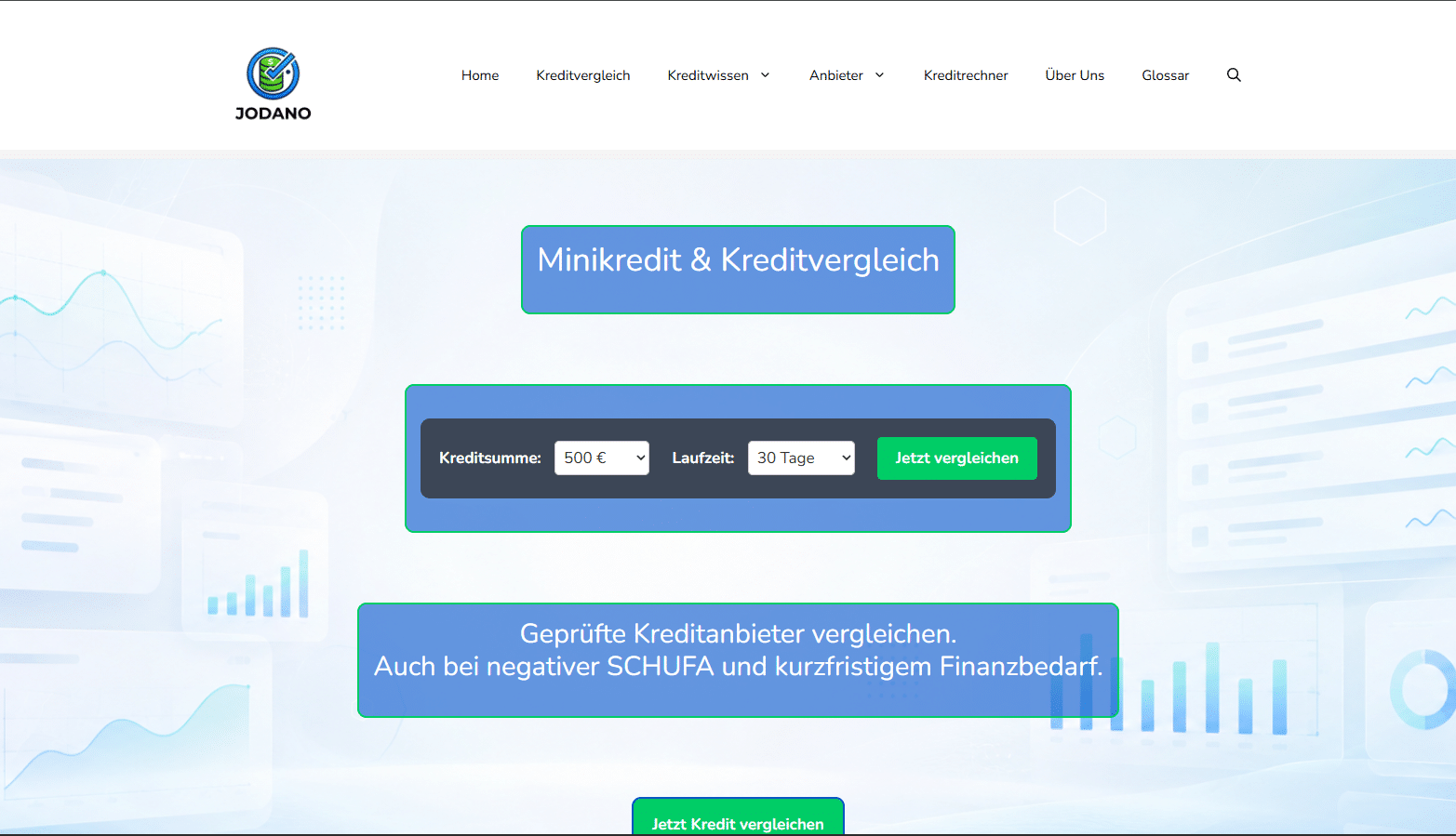
Today, Jodano is a German-language credit comparison and financial information platform. It focuses primarily on small loans, short-term financing and helping consumers understand the costs, requirements and risks involved.
But that is not what the website had consistently communicated throughout its history.
Like many long-running web projects, Jodano had accumulated different versions of itself.
New topics had been added. Earlier business ideas had left traces. Content had expanded in several directions. Sections had been reorganized, abandoned or replaced. Individual pages could still attract traffic, but the website as a whole no longer expressed one coherent identity.
The problem was not simply outdated content.
It was ambiguity.
This ongoing case study documents how I am reducing that ambiguity—and whether a more coherent information system ultimately changes how users, search engines and AI systems interpret the platform.
When a website carries too much history
Older websites rarely become unclear because of one major mistake.
They become unclear gradually.
A new category is added because it appears commercially promising. An existing article begins ranking for an adjacent topic. A landing page is created for a temporary campaign. Old URLs remain accessible because they still attract links, impressions or occasional traffic.
Each decision may appear reasonable in isolation.
Over time, however, the website stops functioning as one information system. It becomes a collection of decisions made at different times and under different assumptions.
That was the situation with Jodano.
The domain had been associated with finance for years, but its precise role was no longer sufficiently clear. It contained material from different phases of the project, overlapping search intents and numerous URLs that no longer supported its future direction.
A visitor entering through one recently updated page might understand the current purpose of the website.
A search engine or AI system examining the domain as a whole encountered a less consistent picture.
That difference became the starting point of the rebuild.
The first decision was subtraction
The conventional response to limited visibility is often to publish more:
More articles. More landing pages. More keyword variations. More FAQs.
For Jodano, that would have increased the underlying problem.
Before creating new content, I needed to decide what the website should represent—and which parts of its history no longer belonged to that identity.
The new focus became deliberately narrow:
- credit information for consumers in Germany
- small and short-term loans
- financing options in difficult situations
- comparisons of a limited selection of providers
- clear explanations of costs, requirements and risks
Topics outside this system were removed, consolidated or redirected where a relevant successor existed.
This was not a conventional relaunch. There was no attempt to replace the entire website at once.
It was a controlled reduction.
Every existing URL had to justify its role in the future information system.
From page inventory to intent architecture
The next step was to stop treating every page as interchangeable “SEO content.”
Different pages needed different responsibilities.
I reorganized the core of Jodano around four functional layers.
1. Problem and information pages
These pages address situations such as a temporary financial shortfall, an urgent need for funds or questions about the application process.
Their purpose is not to reproduce an entire credit guide. They help users understand a specific situation and identify an appropriate next step.
2. Core comparison pages
Pages about small loans and related financing options form the central commercial layer.
They explain requirements, possible costs and alternatives before introducing a limited selection of providers.
3. Provider pages
Provider pages support users who are already evaluating a particular company.
Rather than acting as generic “review” pages, they need to explain:
- what distinguishes the provider
- which products it offers
- who may find the offer relevant
- which costs and conditions apply
- which limitations users should understand
4. Navigation and decision pages
Category pages, calculators, FAQs and the main comparison page connect the other layers.
They do not all need to rank for the same commercial searches. Their role is to help users navigate the system and make a more informed decision.
The intended journey is straightforward:
Problem → possible solution → suitable providers → external application
A website does not become coherent merely by covering a collection of related keywords.
It becomes coherent when every important page has a defined role within a larger decision system.
Defining page ownership
Jodano had accumulated pages that approached similar needs from slightly different angles.
From a traditional keyword perspective, keeping every variation can appear attractive. Each URL might capture another search query.
From a system perspective, excessive overlap creates uncertainty:
- Which page defines the main subject?
- Which page should be selected for a particular intent?
- Which page should receive the strongest internal signals?
- Which URL represents Jodano’s primary answer?
The rebuild therefore involved consolidating related content and assigning clearer ownership to important subjects.
The main small-loan page owns the general topic.
Amount-specific pages address searches with sufficiently distinct expectations, such as loans of €500, €1,000 or €1,500.
A separate page addresses the more specific subject of small loans in connection with SCHUFA-related difficulties.
Pages concerning urgent payouts or temporary financial shortfalls act as contextual entry points rather than competing general comparison pages.
This reduced the number of URLs while increasing the clarity of the remaining architecture.
In many information systems, removing a weak distinction is more valuable than creating another page.
Rebuilding the internal journey
Internal linking also needed to reflect the new architecture.
Links were no longer added simply because two pages contained related words. They were used to express the intended relationship between information, evaluation and action.
The basic pattern became:
- informational pages lead to the relevant core topic
- core pages introduce suitable providers
- provider pages lead toward comparison or application
- calculators and FAQs provide decision support where additional context is needed
Calls to action were made more explicit as well.
A label such as “Learn more” says little about what happens next. Labels such as “Compare providers” or “Calculate monthly payments” describe the next action more precisely.
This may appear to be a minor conversion detail, but it also contributes to the semantic structure of the website.
Navigation labels, headings, internal links and page purposes should all describe the same underlying system.
Separating information from persuasion
Financial websites carry a particular responsibility.
Commercial pages can easily become too certain:
Fast approval. Easy access. Fair solutions. Uncomplicated borrowing.
But credit is not uncomplicated for everyone.
A comparison platform should make both its commercial model and its limitations visible.
As part of the rebuild, broad marketing claims are being replaced with more precise explanations:
- Jodano is not a bank or lender.
- It does not approve or issue loans.
- Its comparisons do not cover the entire market.
- Providers make their own acceptance decisions.
- Product availability and conditions can change.
- Some outbound links generate affiliate commissions.
- Small loans can become expensive through short repayment periods or optional services.
This language is less promotional.
It is also more credible.
In financial information, trust is not created by claiming complete independence or universal fairness. It comes from explaining how the system works, where commercial interests exist and what the platform cannot promise.
The deeper question: What is Jodano?
During the rebuild, another issue became visible.
The name “Jodano” is not unique.
Unrelated companies and brands use the same name in other countries and industries. A former Cypriot company previously connected to me also carried the Jodano name, although it is no longer involved in the website and is currently being dissolved.
This creates an entity-disambiguation problem.
Without sufficient context, a system encountering the name “Jodano” may have several possible interpretations. The website can be found through research, but the correct entity may not always be selected confidently from the name alone.
The solution is not to repeatedly describe every unrelated organization.
It is to establish a sufficiently distinct identity for the current platform:
Jodano.de is a German-language credit comparison and financial information platform founded by Oliver Jordanov in 2016 and currently operated by Ashwood Summit LLC.
This statement connects the essential attributes:
- the exact name and domain
- the type of platform
- its language and market
- its founder
- its founding year
- its current operator
These attributes are now being aligned across the website, its About page, legal information, structured data, official profiles and external references.
On my personal About page, I identify Jodano as a project I founded and continue to develop. On Jodano, the corresponding About page identifies me as its founder and editorial lead.
The relationship is therefore expressed in both directions.
This does not eliminate every alternative interpretation of the name. It creates a stronger basis for selecting the correct entity when the surrounding context is German consumer finance.
Entity clarity is not a schema property
Structured data is part of this work, but it is not the entire solution.
An entity graph can connect the website, its operator, its founder and its official profiles. It can state the language, geographical market and founding date.
But structured data cannot repair a fundamentally contradictory website.
Entity clarity emerges from agreement between multiple elements:
- visible descriptions
- editorial responsibility
- legal information
- page topics
- internal architecture
- author profiles
- external references
- structured data
- historical and current organizational relationships
If an About page describes an anonymous independent team, the legal notice names a different organization and an external company profile presents an outdated business model, additional schema does not resolve the contradiction.
The information itself must first become consistent.
Markup can then reinforce that consistency.
What has been implemented
The project has already moved through its main structural phase.
Work completed or largely completed includes:
- narrowing Jodano to a defined credit-related subject area
- removing or redirecting content that no longer supports that focus
- consolidating overlapping search intents
- defining ownership for the principal commercial topics
- separating informational, comparison and provider-page responsibilities
- rebuilding the internal linking structure
- revising important page titles and descriptions
- improving the clarity of calls to action
- making editorial and commercial limitations more explicit
- identifying historical and external entity inconsistencies
The website now has a substantially clearer architecture than it had before the project began.
However, architectural completion is not the same as demonstrated impact.
That is why this remains an ongoing case study.
What the AI visibility data is showing
The first AI visibility data is now making an important distinction visible.
Jodano is not simply being ignored by AI systems.
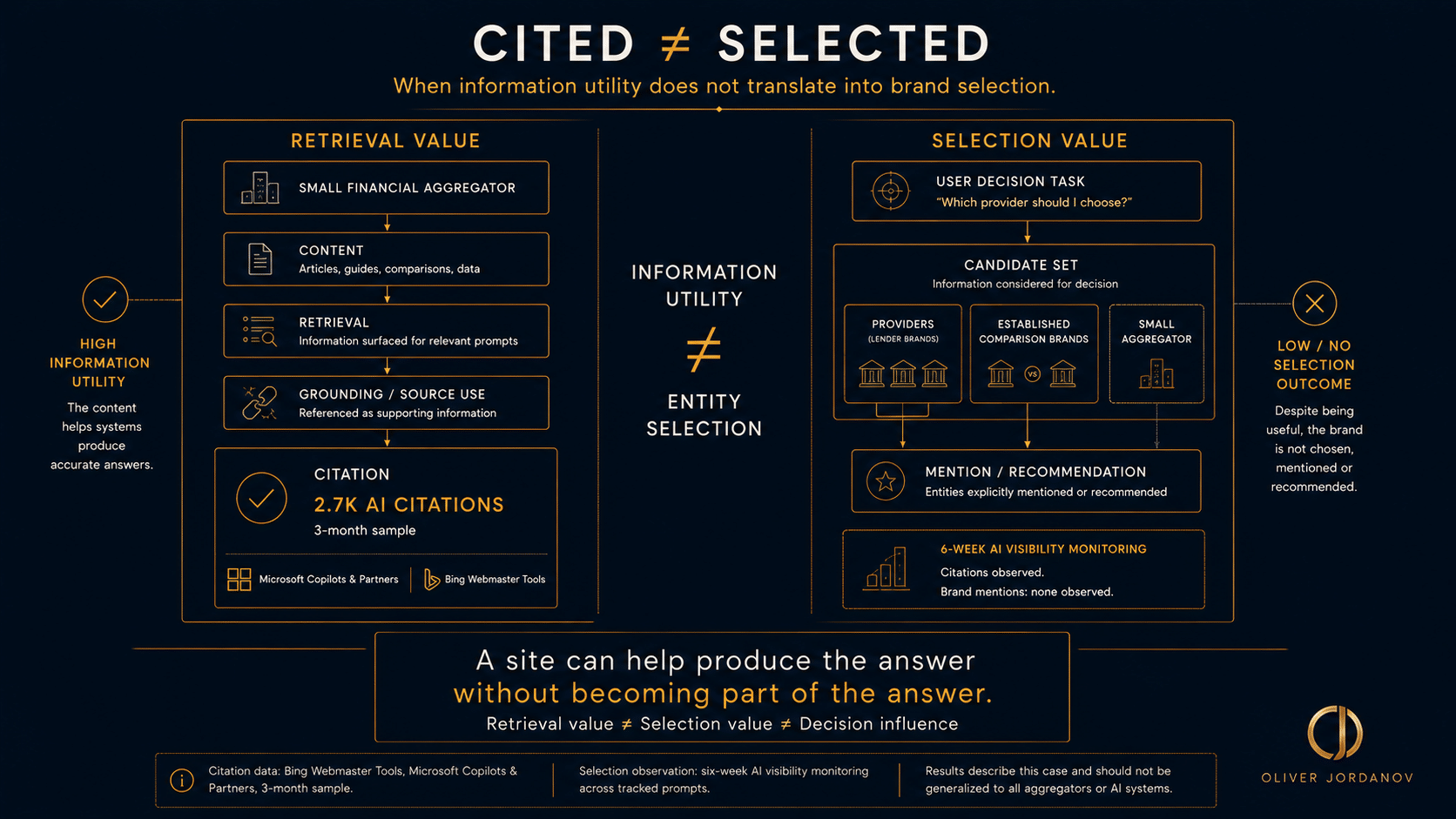
During a three-month period, Bing Webmaster Tools reported approximately 2,700 citations of Jodano across Microsoft Copilots and partners. The number of cited pages also remained relatively consistent throughout the observation period.
A separate six-week AI visibility measurement showed a similar pattern from another perspective. Jodano accumulated citations, and citation visibility increased as I continued investing in the platform.
But something important did not happen:
Jodano itself was not mentioned as a brand across the monitored prompts.
This distinction matters because citation and selection represent different forms of visibility.
When successful optimization may target the wrong layer
This changes how I evaluate the project.
The original question was whether a clearer architecture, stronger entity definition and better-focused content could make Jodano more understandable and useful to search and AI systems.
There are now indications that this is happening.
The harder question is whether additional investment can realistically move the platform from being used as a source to being selected as an entity.
That is particularly important for the economics of an aggregator.
Publishing more useful content may generate more citations. Improving provider information may make the platform an even better source for AI-generated comparisons.
But if the eventual recommendation continues to select the provider itself—or one of a small number of established comparison brands—the commercial return from increasing citation visibility may remain limited.
Put differently:
More content can make a website a better source for somebody else's recommendation.
This does not demonstrate that aggregators as a category cannot succeed in AI Search. Established comparison brands in the same market clearly can be selected.
It does suggest that information utility alone may not be enough for a smaller aggregator to cross the gap from retrieval to selection.
For Jodano, that insight is now influencing the investment decision. Rather than assuming that more content and more citations will eventually solve the problem, I am becoming considerably more selective about where further development is likely to create actual decision influence.
What the rebuild has reinforced so far
Although the measurement phase is still underway, the work has already reinforced several principles that extend beyond this particular website.
Websites accumulate semantic debt
Every abandoned topic, overlapping page, outdated profile and unexplained organizational change increases the effort required to interpret a website correctly.
This debt can remain invisible while individual pages continue to attract traffic.
More content can make a system weaker
Content volume is not the same as topical clarity.
A smaller set of pages with distinct responsibilities may be easier to understand and select than a larger collection of partially competing answers.
Information architecture is also positioning
An organization can describe itself clearly in its marketing copy while communicating something different through its website structure.
Categories, URLs, templates and internal links reveal what the system considers important.
Commercial transparency supports interpretation
Clear statements about ownership, editorial responsibility, affiliate relationships and market coverage are useful to visitors.
They also provide machines with more precise information about what an organization is and how it operates.
Identity requires external confirmation
A website cannot establish its identity entirely by referring to itself.
Founder-controlled websites and official profiles are useful starting points. Over time, independent and contextually relevant references are needed to provide stronger confirmation.
What I am monitoring next
The next phase is not primarily about producing more pages.
It is about observing how search engines, AI systems and users respond to the new consistency.
The monitoring phase includes:
- which pages are selected for Jodano’s core topics
- whether old thematic associations continue to surface
- how branded searches develop
- whether canonical page ownership becomes more stable
- how search engines and AI systems describe Jodano
- whether the correct Jodano entity is selected consistently
- which external references contribute to entity recognition
- whether the smaller architecture creates clearer user journeys
- how visibility, engagement and commercial performance develop over time
- whether citation growth begins to translate into brand mentions
- whether Jodano enters candidate sets alongside providers or established comparison platforms
Where useful, this case study will be updated with crawl data, search performance, AI visibility observations and concrete examples from the consolidation process.
The goal is not to attribute every movement to the rebuild. Search performance is influenced by many external factors, and entity recognition cannot be measured through one metric alone.
The aim is to document the development honestly: what changed, which assumptions informed the work and what the systems appear to do in response.
The project is not finished
Search systems retain historical signals.
External profiles do not update simultaneously. Old associations can persist. Entity recognition cannot be forced by changing one About page or adding one structured-data object.
The website itself is also not static. Provider information changes, new search behavior emerges and individual pages will continue to require refinement.
But the foundation is now clearer.
Before the rebuild, Jodano contained several possible versions of itself.
Today, it is becoming one defined information system:
A German credit information and comparison platform with a clear subject, a transparent operator and an identifiable editorial owner.
That may sound like a basic requirement.
For many mature websites, achieving it is the real work.