How AI Selection Works
Understanding how AI systems progressively reduce information into what can contribute to a response.
Many discussions about AI visibility begin with prompts.
How should a question be phrased?
Which model produces which answer?
How can a brand become part of that answer?
These questions matter.
But prompting is only one part of a larger decision architecture.
Before a specific request is processed, information must already be interpretable, entities must be sufficiently clear and information must be realistically available for consideration.
Then a second process begins.
The request is interpreted.
Relevant information is retrieved.
A Candidate Pool is constructed.
Candidates are evaluated and prioritized.
Information is selected.
A response is generated and, where applicable, connected to supporting evidence.
AI selection is therefore not a single ranking event.
It is a coordinated architecture for progressively reducing uncertainty.
Why Selection Matters
AI systems operate across information environments far larger than what can be actively considered for every request.
They cannot evaluate every document, entity, passage, source and claim equally every time an answer is generated.
The decision space must be reduced.
But this reduction does not happen in one step.
Different mechanisms answer different questions:
Can the information be understood?
Can the entity be identified?
Could the information realistically be considered?
Should it be retrieved for this request?
How well does it satisfy the information need?
Should it contribute to the response?
These are related decisions.
They are not the same decision.
Understanding AI selection therefore requires separating the architecture into distinct layers.
The Selection Architecture
A useful conceptual model consists of two connected layers.
The first describes the information environment and its prerequisites.
The second describes the request-dependent selection process.
This distinction matters.
Not every mechanism begins when a user submits a prompt.
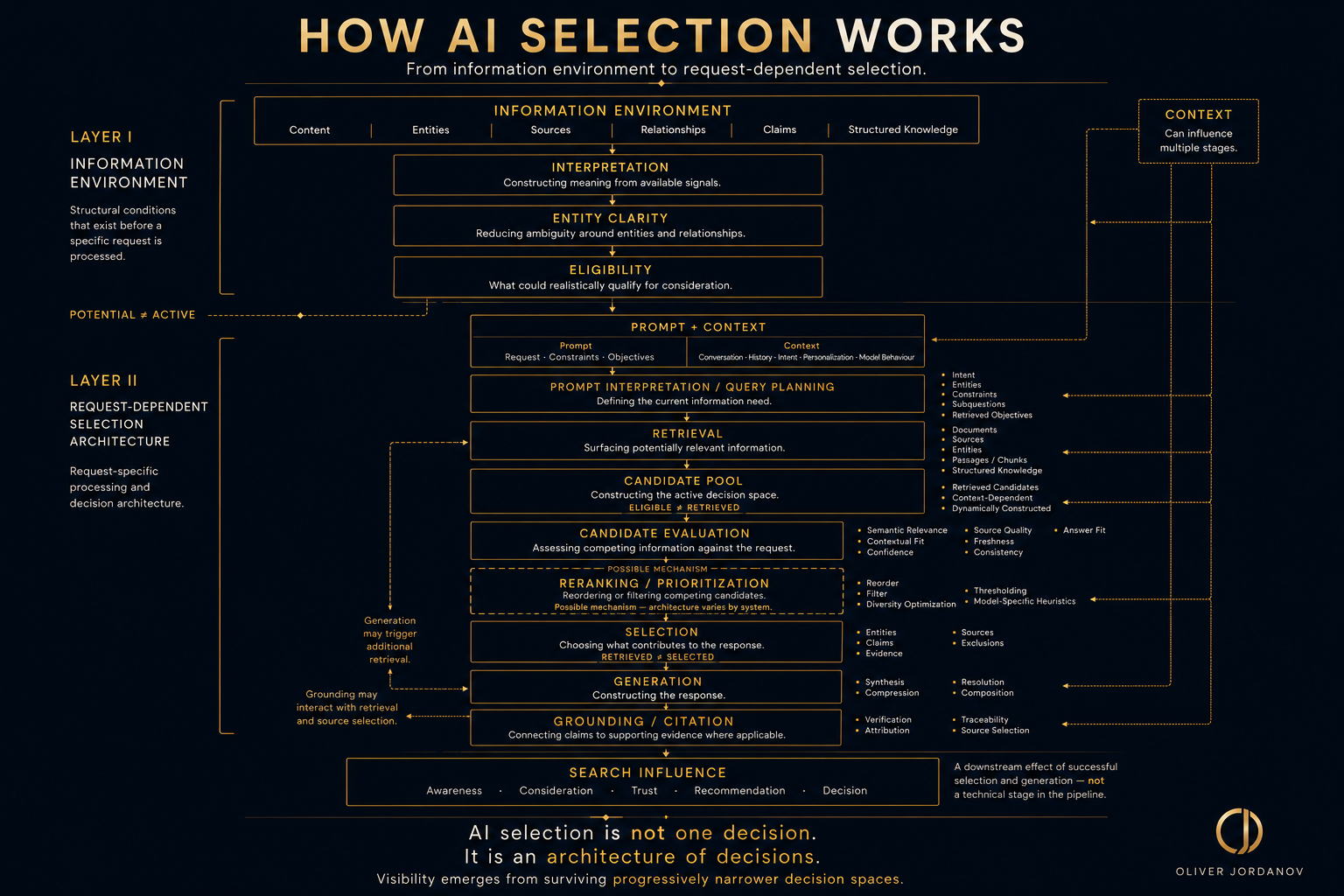
Layer I · Information Environment
AI systems operate within broader information environments containing documents, entities, sources, relationships, claims and structured knowledge.
These environments provide the signals from which systems can construct representations and establish potential candidates.
Interpretation
Before information can meaningfully participate in later decisions, systems must construct meaning from available signals.
Interpretation involves establishing representations of:
- entities
- attributes
- relationships
- context
- claims
- concepts
Interpretation transforms fragmented signals into structures that can become useful for later processing.
Entity Clarity
Interpretation becomes more reliable when entities can be consistently identified and differentiated.
Clear naming, coherent relationships, stable attributes and consistent positioning reduce ambiguity.
Entity Clarity therefore reduces the uncertainty involved in determining what an entity is and how information relates to it.
Eligibility
Even understandable information does not automatically become relevant to every possible decision.
Eligibility describes whether information can realistically qualify for consideration within a given information environment.
It may be influenced by factors such as interpretability, accessibility, consistency, confidence and available evidence.
Eligibility therefore defines a possibility space.
But possibility is not retrieval.
An eligible source or entity may never enter the active decision process for a particular request.
This is where the second layer begins.
Layer II · Request-Dependent Selection
A concrete request introduces a new set of conditions.
Prompt and context shape the current information need and influence which parts of the broader information environment become relevant.
The system now moves from potential availability toward an active decision space.
Prompt + Context
A request does not exist in isolation.
Its interpretation may be influenced by:
- the explicit prompt
- conversation history
- constraints
- previous turns
- user intent
- personalization
- system behavior
Context may influence several later stages rather than functioning as one isolated step in the pipeline.
Prompt Interpretation / Query Planning
Before relevant information can be retrieved, the system must determine what information is actually needed.
This may involve identifying:
- intent
- entities
- constraints
- subquestions
- retrieval objectives
Complex requests may be decomposed into multiple information needs.
Prompt Interpretation therefore helps determine what the system should attempt to retrieve.
Retrieval
Eligibility determines what could reasonably be considered.
Retrieval determines what actually enters the active information process for a specific request.
Depending on the architecture, retrieval may surface:
- documents
- sources
- entities
- passages or chunks
- structured knowledge
Retrieval therefore reduces a broad possibility space into information that can actively participate in the current decision.
Eligible does not mean retrieved.
Candidate Pool
Retrieved information forms a request-specific Candidate Pool.
This is the active decision space from which later evaluation can occur.
The Candidate Pool is therefore not necessarily a static collection of previously known entities.
It can be dynamically constructed according to the request, retrieval process, context and system architecture.
Its composition matters because later decisions can only operate on information that has become available to them.
Candidate Evaluation
Retrieval establishes availability.
Candidate Evaluation establishes competitive fit.
Retrieved candidates may be assessed according to dimensions such as:
- semantic relevance
- contextual fit
- confidence
- source quality
- freshness
- consistency
- diversity
- answer shape
Evaluation may occur at Source-, Document-, Entity-, Passage-/Chunk- or Claim-level.
A particularly important distinction emerges here:
Being about the topic is not the same as answering the request.
A candidate can therefore be eligible and retrieved while still performing poorly against competing alternatives.
Prioritization / Reranking
Some architectures may further reorder, filter or prioritize candidates after retrieval or evaluation.
Reranking is one possible mechanism for doing so.
It should not be treated as a universal stage implemented identically by every AI system.
More broadly, this layer represents mechanisms that alter the relative priority of competing candidates according to the current task.
Evaluation and prioritization may also be combined or repeated.
Selection
Selection determines what information ultimately contributes to the response.
This may involve selecting:
- entities
- claims
- evidence
- passages
- sources
- exclusions
Selection is therefore not synonymous with retrieval.
Nor is it synonymous with evaluation or reranking.
A candidate may be retrieved.
It may evaluate strongly.
And it may still not become part of the final response.
Generation
Selected information must still be transformed into an answer.
Generation may involve:
- synthesis
- compression
- resolution
- composition
This creates another important distinction.
The generated response is not simply a list of retrieved candidates.
It is a constructed output.
Depending on the system architecture, generation may also expose new information needs and trigger additional retrieval or evaluation.
Grounding / Citation
Generated claims may be connected to supporting evidence and identifiable sources.
Grounding can support:
- verification
- attribution
- traceability
But Grounding should not be understood as universally occurring only after every other stage has finished.
In some architectures, retrieval, source selection, generation and grounding may interact.
Citation is therefore an observable output of some grounding processes, not the complete definition of Grounding itself.
The Architecture Is Not Strictly Linear
The framework can be represented sequentially because doing so makes its functional distinctions easier to understand.
But that does not mean every AI system follows one fixed pipeline.
Systems may:
- perform multiple retrieval rounds
- decompose requests into subqueries
- evaluate candidates at several levels
- rerank information repeatedly
- retrieve additional evidence during generation
- combine retrieval and grounding
- allow context to influence multiple stages
The framework therefore describes decision functions, not a proprietary implementation.
Its purpose is to distinguish the questions AI systems must solve rather than claim that every system solves them in exactly the same order.
Where Visibility Can Fail
This architecture also provides a more useful way to diagnose AI visibility.
An organization may fail because its information is poorly interpreted.
Its entity may remain ambiguous.
It may fail to become eligible.
Eligible information may not be retrieved for the relevant request.
Retrieved information may perform poorly during Candidate Evaluation.
A strong candidate may still lose during Selection.
Selected information may contribute to generation without becoming an explicit citation.
These outcomes can look similar from the outside:
The organization does not appear.
But they represent fundamentally different problems.
AI visibility therefore cannot be diagnosed from the final output alone.
Why Prompts Explain Less Than They Appear To
Prompts matter.
But their role is more nuanced than simply determining which existing entity wins.
A prompt can influence:
- interpretation of the information need
- query planning
- retrieval
- Candidate Pool composition
- evaluation
- prioritization
- generation
This means prompts can affect much more than the final ranking of an already fixed Candidate Pool.
At the same time, prompts operate within an information environment whose earlier conditions already matter.
A prompt cannot reliably retrieve information that is inaccessible to the relevant system.
It cannot eliminate persistent entity ambiguity.
And it cannot guarantee that an organization will be competitive once retrieved.
AI visibility therefore emerges from the interaction between structural prerequisites and request-dependent decisions.
Relationship to Search Influence
Selection is not necessarily the end of the business effect.
An entity that becomes part of an AI-generated response may influence:
- awareness
- perception
- consideration
- trust
- comparison
- recommendation
- subsequent search behavior
- decision making
These effects may occur without a measurable referral visit.
Search Influence describes this broader consequence.
The selection architecture explains how information reaches the response.
Search Influence explains what that presence can do once it gets there.
Relationship to the Concepts Library
The Concepts Library explores individual mechanisms within this framework.
Interpretation explains how systems construct meaning from signals.
Entity Clarity describes how consistently identifiable representations reduce ambiguity.
Eligibility defines the conditions under which information can realistically qualify for consideration.
Retrieval explains how potentially relevant information enters the active decision process.
Candidate Pool describes the request-specific information space available for evaluation.
Candidate Evaluation explains how retrieved candidates are assessed against the request and competing alternatives.
Selection Systems describes the broader architecture of retrieval, evaluation, prioritization and selection.
Grounding examines how generated information becomes connected to supporting evidence.
Search Influence describes how successful visibility can affect decisions even without measurable traffic.
Semantic Debt explains how accumulated structural inconsistencies can weaken several of these mechanisms at once.
Together, these concepts describe AI visibility as an interconnected system rather than an isolated optimization tactic.
Strategic Perspective
AI visibility is often approached as a content problem.
Publish more.
Mention the right entities.
Optimize prompts.
Track citations.
Those activities may matter.
But the architecture suggests a more fundamental objective:
Reduce uncertainty across the decision system.
Make entities easier to interpret.
Make information easier to qualify.
Make relevant knowledge retrievable.
Make retrieved information more competitive.
Make claims easier to support.
The objective is not simply to produce more information.
It is to make useful information survive progressively narrower decision spaces.
Closing Thesis
AI systems do not move directly from information to answers.
They progressively reduce uncertainty.
First, information must become understandable and realistically available for consideration.
Then a specific request transforms that possibility space into an active decision space.
Information is retrieved.
Candidates are evaluated.
Priorities emerge.
Information is selected.
Responses are generated and, where applicable, grounded in supporting evidence.
AI selection is therefore not one decision.
It is an architecture of decisions.
And visibility emerges from surviving that architecture.