From Fragmented Search Signals to a Search & AI-Ready Hospitality Architecture
How technical consolidation, information architecture and intent clustering created a stronger foundation for organic and AI visibility.
Case Study · Hospitality · Technical SEO · Information Architecture · AI Visibility
Client anonymized. Work performed as part of an agency consulting engagement. Project details have been generalized to protect confidential information.
The Situation
An established hospitality brand operated a premium apartment property in a competitive leisure destination.
The website had already accumulated substantial digital assets:
- commercial apartment pages
- destination and travel content
- wellness and service information
- editorial content
- multilingual sections
- strong existing brand demand
The problem was not a lack of content.
It was fragmentation.
Technical signals were inconsistent.
Commercial and informational content had grown without a sufficiently clear hierarchy.
Valuable existing assets were only loosely connected to the site's primary transactional intent.
And new content opportunities needed to be evaluated without allowing the website to expand beyond its legitimate topical territory.
The objective was therefore not to publish more.
It was to turn an existing collection of pages into a more coherent search system.
The Challenge
The project combined several problems that are often treated separately.
Technical Ambiguity
Legacy host and domain signals created unnecessary uncertainty for search engines.
The work included:
- host consolidation
- redirect cleanup
- crawl and indexation controls
- legacy staging signals
- technical verification
- performance monitoring
- post-implementation validation
Before expanding the content architecture, these competing technical signals needed to be reduced.
Fragmented Information Architecture
The site contained commercially valuable apartment pages alongside substantial destination, service and editorial content.
But these assets did not yet form a sufficiently explicit search architecture.
The central question became:
Which page should represent the primary commercial intent — and how should supporting content reinforce it?
Topical Expansion
Hospitality websites naturally intersect with broader informational needs.
Potential guests do not search only for accommodation.
They also investigate:
- activities
- local attractions
- travelling with pets
- wellness
- different travel situations
- destination-specific questions
This creates an architectural challenge.
Expand too little and valuable demand remains uncovered.
Expand too far and the website begins competing in topics that no longer reinforce its core purpose.
The goal was therefore:
Topical expansion without topical overreach.
The Architecture
Rather than optimizing pages independently, the project established a central commercial hub surrounded by tightly related intent clusters.
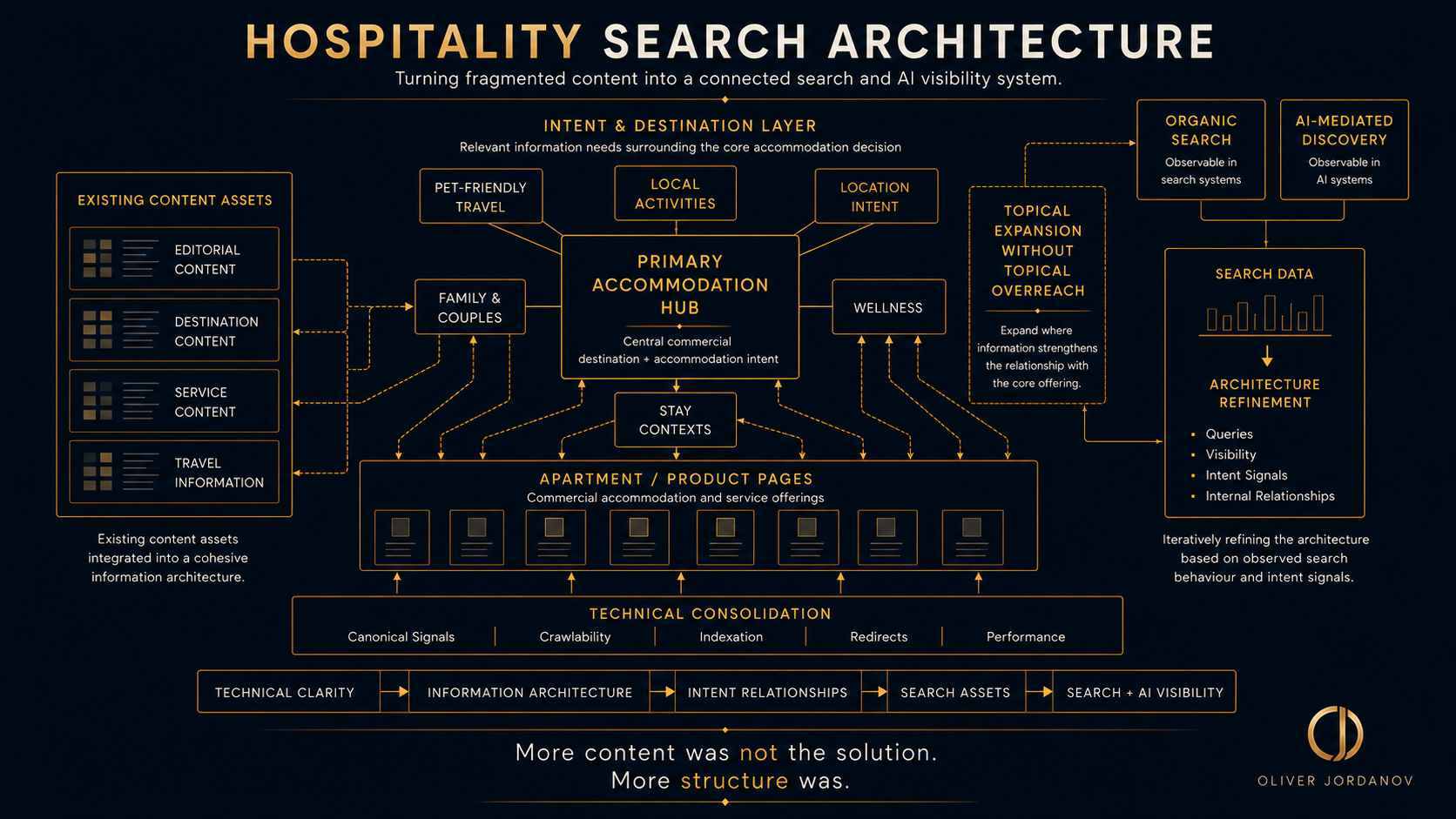
At the center:
Primary Accommodation Hub
Around it:
Apartment / Product Pages
and:
Intent & Destination Clusters
These clusters addressed relevant adjacent information needs such as:
- pet-friendly travel
- location-specific travel intent
- couples and family travel
- wellness
- activities
- destination discovery
- other relevant stay contexts
The architecture was reinforced through systematic internal linking.
Conceptually:
Commercial Hub
↓
Intent & Destination Clusters
↓
Apartment / Product Pages
with supporting connections from existing editorial content back into the commercial architecture.
The objective was not merely stronger internal linking.
It was to make the relationship between destination, intent, accommodation and commercial relevance structurally explicit.
An Iterative Implementation
This was deliberately not a big-bang restructuring.
The architecture was introduced progressively.
1. Technical Consolidation
↓
2. Primary Commercial Hub
↓
3. Information Architecture
↓
4. Initial Intent Cluster
↓
5. Product Integration
↓
6. Internal Linking Architecture
↓
7. Existing Content Integration
↓
8. Search Data Validation
↓
9. Controlled Cluster Expansion
↓
10. Search + AI Visibility Monitoring
This allowed each stage to generate information for the next.
Instead of designing the complete system around assumptions, the architecture could evolve against observable search behavior.
Search Data as an Architecture Signal
The central commercial page was not treated as a finished asset after publication.
Once sufficient data became available, real search queries were analyzed to understand how Google was interpreting the page.
Emerging non-brand demand showed relationships around:
- accommodation + destination
- apartment + destination
- pet-friendly accommodation
- location attributes
- capacity
- pricing-related searches
Not every query was already performing in top positions.
That distinction mattered.
Rather than prematurely treating low click-through rates as a snippet problem, the focus remained on improving:
- relevance
- content depth
- internal relationships
- architectural support
Search Console therefore became more than a reporting interface.
It became a feedback mechanism for the information architecture.
Topical Expansion Without Topical Overreach
One of the clearest early results came from a newly developed local activities and destination asset.
Within a few months, the page had become one of the site's strongest organic search assets.
It began gaining visibility not only for specific activity-related searches but also across broader destination-related demand.
That raised an important strategic question:
How far should a hospitality website expand into destination content?
The answer was not:
Publish everything that can rank.
The page worked because the information need remained directly relevant to prospective guests.
Someone evaluating accommodation also needs to understand what they can do during their stay.
That relationship justified the expansion.
Creating generic destination content without the same connection would have crossed a different boundary.
The principle became:
Expand topical coverage where it strengthens the user's relationship with the core offering — not merely because additional search volume exists.
From Search Asset to AI Source
The same architecture was monitored beyond traditional organic search.
AI-performance data provided an additional signal: some of the newly developed or strengthened pages were not only gaining search visibility.
They were also being selected as sources in AI-driven search experiences.
Early observations included:
Local Destination / Activities Cluster
32 citations
Approximately 38% citation share within the monitored query environment.
Pet-Friendly Accommodation Cluster
6 citations
Approximately 20–21% citation share within the monitored query environment.
These observations do not establish that the architecture alone caused AI citation.
They do show something strategically interesting.
Pages designed around clear user intent, coherent topical relationships and useful information were becoming valuable assets in both traditional search and AI-mediated discovery.
Search and AI Visibility Are Not Separate Architectures
The project illustrates why I increasingly avoid treating traditional SEO and AI visibility as isolated disciplines.
The same underlying improvements can support both environments:
Clearer Information Architecture
↓
Stronger Semantic Relationships
↓
Better Internal Discovery
↓
More Explicit Intent Coverage
↓
Stronger Search Assets
↓
Potential Retrieval and Citation Opportunities
The exact mechanisms differ between search and AI systems.
But both benefit from information that is easier to discover, interpret and contextualize.
Technical SEO as Uncertainty Reduction
The technical work also reinforced a broader principle.
Redirects, competing hosts, staging environments and inconsistent indexation signals may appear to be isolated technical issues.
Architecturally, they create something more fundamental:
ambiguity.
Which host is canonical?
Which URL represents the resource?
Which environment should be crawled?
Which signals should systems trust?
Technical SEO therefore became the first layer of the wider architecture.
Before expanding topical relevance, the system itself needed clearer boundaries.
The Outcome
Within the observed project period:
- organic impressions showed sustained growth
- organic clicks increased alongside visibility
- non-brand search demand began expanding
- newly developed pages became independent search assets
- destination content achieved strong early organic visibility
- intent-specific content began appearing as sources in AI-driven search
- legacy technical ambiguity was substantially reduced
- the central hub-and-cluster architecture was largely implemented
The project remains iterative.
The next phase focuses on validation, content refinement, internal-link QA and continued Search + AI Visibility monitoring.
The significance of the project is therefore not a single traffic number.
It is the transition from a fragmented website toward a more coherent information system.
Beyond Content: Building Durable Signals
The next strategic layer extends beyond the website itself.
Hospitality brands frequently invest in:
- partnerships
- influencer activity
- campaigns
- PR
- social distribution
These activities are often treated as temporary campaign assets.
A more integrated model asks whether those investments can also create durable:
- authority signals
- external references
- links
- entity relationships
- source visibility
The principle is simple:
PR investments should not remain isolated campaign assets.
Where appropriate, they can contribute to the wider search and information environment around the brand.
What This Case Demonstrates
The project did not begin with a demand for more content.
It began by asking how an existing digital ecosystem could become more coherent.
The resulting approach combined:
Technical SEO
to reduce competing infrastructure signals.
Information Architecture
to establish clear relationships between commercial and informational assets.
Intent Clustering
to organize demand around meaningful user needs.
Internal Linking
to operationalize those relationships.
Search Data
to validate and refine the architecture.
AI Visibility Monitoring
to observe how the same information assets perform beyond traditional organic search.
Together, these mechanisms turned SEO from a collection of page-level optimizations into a connected system.
Closing Perspective
More content was not the solution.
More structure was.
The project shows how technical consolidation, intent architecture and controlled topical expansion can turn existing content into stronger search assets.
It also provides an early indication of something increasingly important:
Information designed to be useful, discoverable and structurally coherent can create value across both traditional search and AI-mediated discovery.
The objective is not to optimize separately for every interface.
It is to build an information environment strong enough to participate across them.
Related Concepts
How AI Selection Works
A conceptual framework for how information moves from interpretation and eligibility through retrieval, evaluation and selection.
Retrieval
How potentially relevant information enters the active decision process for a specific request.
Eligibility
Why information must first become a viable candidate before it can participate in later selection processes.
Grounding
How claims and information connect to identifiable sources, entities, evidence and context.
Semantic Debt
How accumulated structural inconsistencies increase uncertainty across information systems.