
Why machines cannot trust what they cannot identify.
Core Concept · AI Visibility Systems · Entity Architecture
Before AI systems can interpret information, they must first establish what an entity actually is.
Only then can it become eligible for selection, grounding and ultimately visibility.
This sounds obvious.
Yet many organizations create significant ambiguity around their own entities.
Products are described differently across websites.
Services change names depending on the audience.
Company positioning shifts across platforms.
Expertise is fragmented across disconnected profiles, pages and references.
Humans can often resolve these inconsistencies.
Machines struggle.
As AI systems increasingly rely on interpretation and synthesis rather than simple retrieval, entity clarity becomes a foundational requirement for visibility.
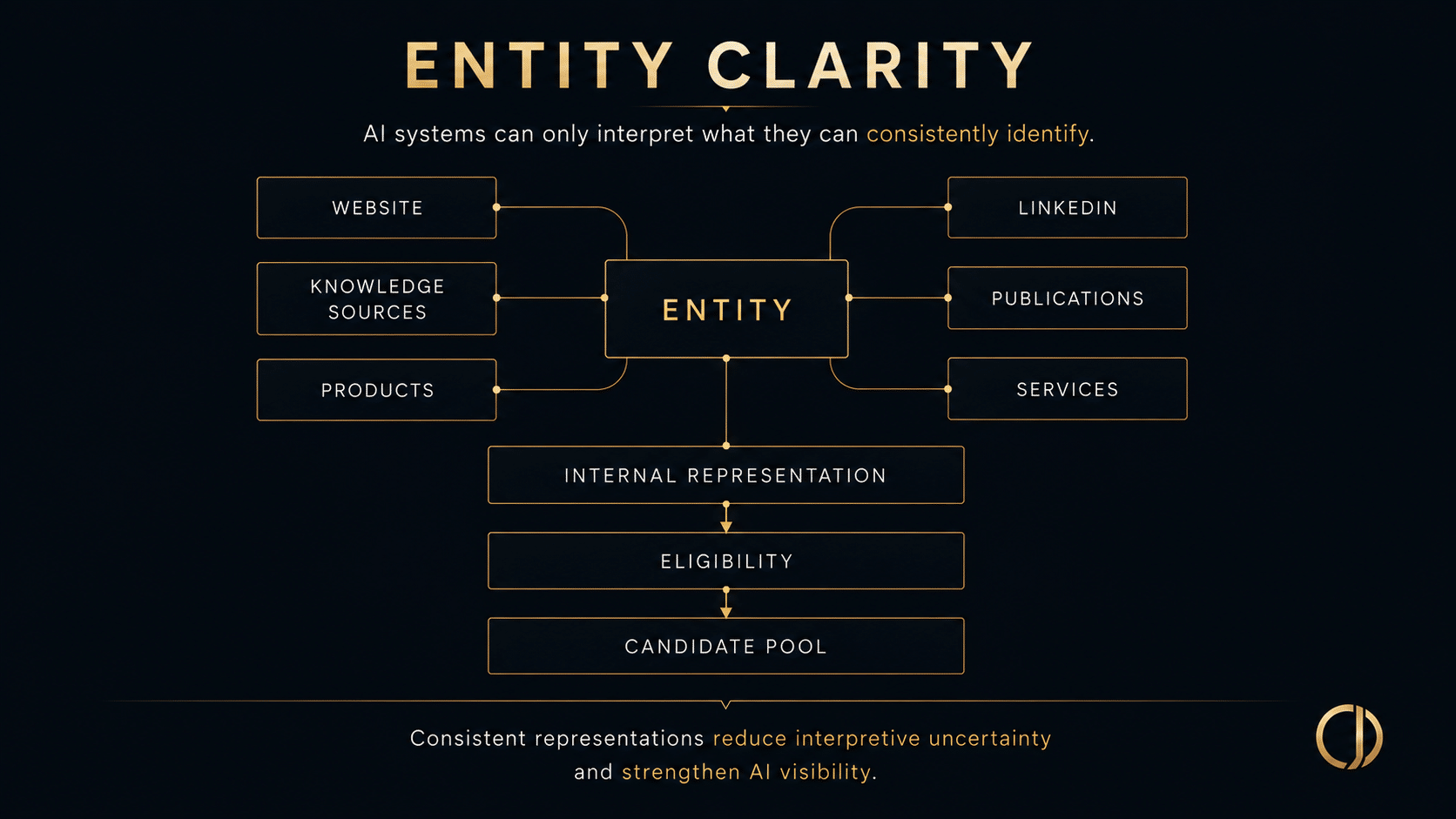
Definition
Entity clarity describes the degree to which an entity can be consistently identified, understood and differentiated across information environments.
An entity may be:
- a person
- a company
- a product
- a service
- a concept
- a location
- an organization
The clearer the entity representation, the easier it becomes for systems to establish confidence in what the entity is and how it relates to other information.
Why Entity Clarity Matters
Modern AI systems do not simply retrieve documents.
They construct internal representations of entities, relationships and context before making decisions.
To do so, they continuously evaluate:
- identity
- relationships
- context
- attributes
- relevance
- confidence
This process becomes significantly more difficult when entities appear fragmented, inconsistent or ambiguous.
Entity clarity reduces uncertainty.
It allows systems to spend less effort resolving identity and more effort understanding meaning.
Sources of Entity Ambiguity
Entity ambiguity often develops gradually.
Common causes include:
Inconsistent Naming
The same entity is described differently across websites, profiles or platforms.
Conflicting Positioning
Different messages create uncertainty about what the entity actually represents.
Fragmented Digital Presence
Important information is distributed across disconnected sources without clear relationships.
Unclear Relationships
Products, services, people and organizations lack explicit connections.
Historical Drift
Past positioning continues to coexist with newer narratives.
Humans Tolerate Ambiguity
Humans are remarkably effective at resolving ambiguity.
We infer meaning from context.
We connect incomplete information.
We fill gaps automatically.
Machines operate differently.
They require stronger signals to establish confidence.
The less clarity available, the greater the interpretive effort required.
This often results in weaker retrieval confidence and less stable internal representations.
Entity Clarity and AI Visibility
Entity clarity supports every later stage of AI decision making.
Clear entity representations reduce interpretive uncertainty, improve eligibility and increase the probability of entering the candidate pool before selection even begins.
Without sufficient clarity, visibility may become unstable regardless of content quality.
Entity Clarity and Grounding
Grounding and entity clarity are closely related but distinct.
Grounding focuses on the connection between information and reality.
Entity clarity focuses on the consistency of the entity representation itself.
An entity may be well grounded but poorly defined.
Likewise, an entity may be clearly defined but weakly grounded.
Strong AI visibility often requires both.
Symptoms of Low Entity Clarity
Organizations with low entity clarity may observe:
| Symptom | Possible Cause |
|---|---|
| Inconsistent AI descriptions | Fragmented entity representation |
| Unstable citations | Conflicting contextual signals |
| Weak knowledge graph presence | Unclear relationships |
| Contradictory summaries | Identity ambiguity |
| Fluctuating visibility | Inconsistent references |
These issues are often interpreted as content problems.
In reality, they may originate at the entity layer.
Improving Entity Clarity
Improvement typically requires consistency rather than volume.
Key principles include:
Stable Naming
Use consistent terminology across platforms and environments.
Explicit Relationships
Clearly define connections between entities.
Narrative Alignment
Reduce conflicting descriptions and positioning.
Structural Consistency
Maintain coherent information architecture across systems.
Canonical References
Create reliable reference points that reinforce entity understanding.
The objective is not greater visibility alone.
The objective is greater interpretability.
Strategic Implication
As AI systems increasingly operate through interpretation and synthesis, clear entity representation becomes a competitive advantage.
Organizations that reduce ambiguity make it easier for systems to establish confidence, build relationships and construct reliable internal representations.
Entity clarity therefore influences far more than discoverability.
It influences understanding itself.
Closing Thesis
Before AI systems can recommend an entity, they must first identify it.
Before they can identify it, they must construct a coherent representation of it.
Entity clarity reduces the uncertainty of that representation.
In AI-driven search, clarity is not a branding exercise.
It is part of the decision architecture.
Related Concepts
How AI Selection Works
The overarching framework describing how AI systems interpret, evaluate and select information.
Interpretation
How AI systems construct meaning before evaluating entities and information.
Eligibility
The conditions that determine whether an entity can be considered for selection.
Grounding
How AI-generated responses become connected to identifiable sources and verifiable information.
Search Influence
How search systems shape interpretation, consideration and selection before measurable traffic occurs.
Semantic Debt
Accumulated structural inconsistencies that reduce interpretability and machine confidence.
Selection Systems
How AI systems compare and prioritize competing candidates before generating a response.
Entity Clarity
The degree to which an entity can be consistently identified, understood and differentiated across information environments.
Ownership (Coming Soon)