
Three small experiments exploring when AI Search introduces commercial solution categories, concrete companies and provider recommendations.
AI Search Research Note 001 · AI Search Lab · September 2026
AI visibility is often measured where brands become visible.
Mentions.
Citations.
Recommendations.
But commercial relevance may begin earlier.
An AI system can introduce a commercial solution category while the user is still trying to understand a problem.
Only later may that category turn into concrete companies, comparisons and eventually a justified provider selection.
I ran three small experiments to examine where these transitions occur.
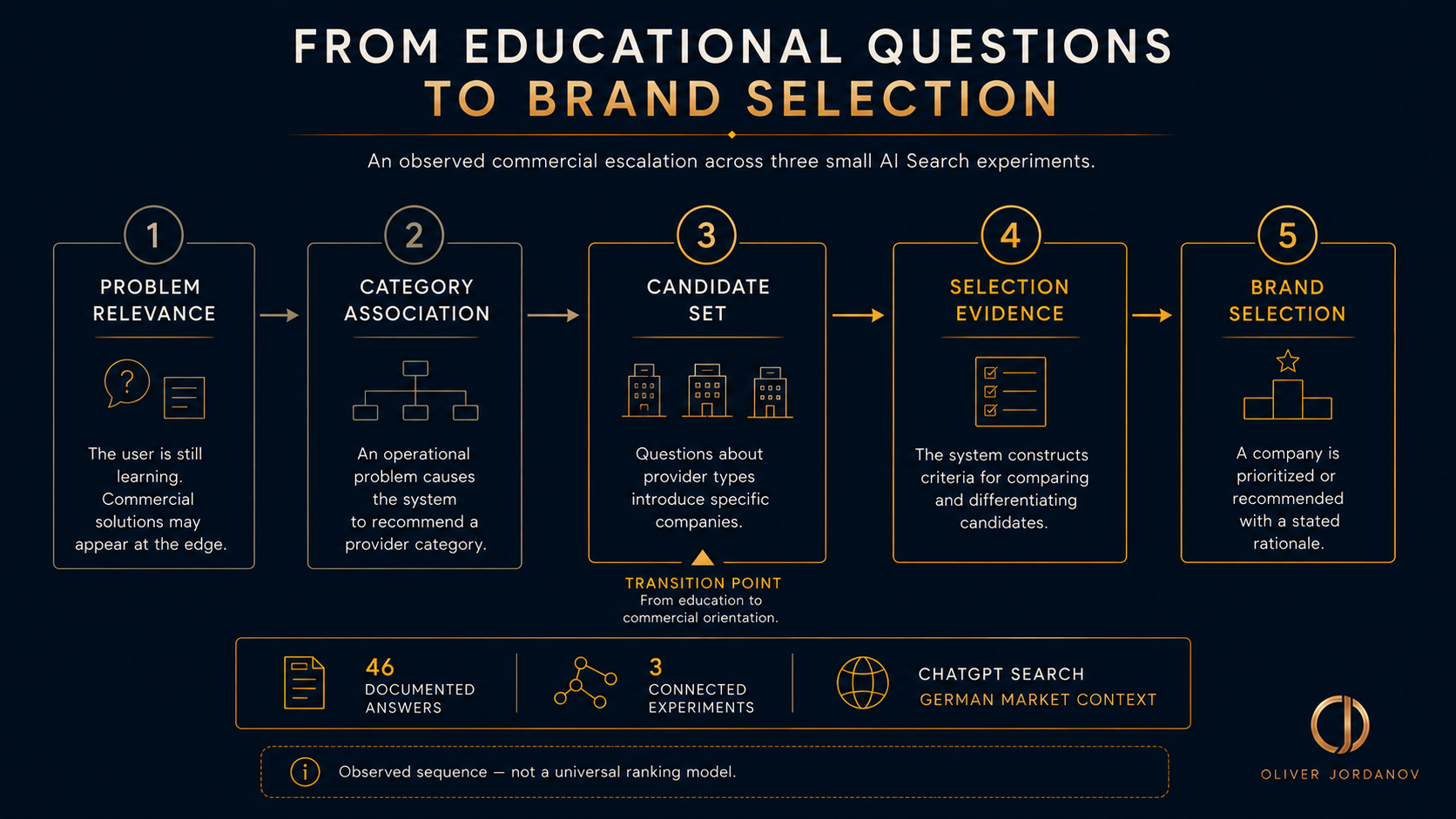
Across 46 documented responses, the observed pattern was:
PROBLEM RELEVANCE
↓
CATEGORY ASSOCIATION
↓
CANDIDATE SET
↓
SELECTION EVIDENCE
↓
BRAND SELECTION
This Research Note documents what happened, what can reasonably be inferred from it — and what remains untested.
It is not a scientific paper or a claim about universal AI Search behavior.
It is a controlled observation intended to generate better questions for subsequent experiments.
Research Note 001
3 experiments · 46 documented responses · Collected 3 September 2026
Key Finding
Across the three experiments, commercial relevance emerged progressively.
Educational questions
Commercial categories appeared before the user explicitly asked for providers.
Operational problem questions
A commercially relevant provider class became a recommended practical solution.
Provider-type questions
Concrete companies entered the response and formed a Candidate Set.
Comparison and fit questions
Companies were prioritized and the reasoning behind their selection became explicit.
The important transition was therefore not simply:
Informational → Commercial
It was a sequence of increasingly specific forms of commercial visibility.
A company can be relevant to the category without entering the Candidate Set.
It can enter the Candidate Set without being selected.
And it can be selected for reasons that are not visible in conventional traffic data.
Why This Question Matters
Many AI Visibility analyses begin with observable brand outcomes.
Was the company mentioned?
Was its website cited?
Was it recommended?
Those are important measurements.
But they begin relatively late in the decision process.
For companies, an earlier question may be equally important:
At what point does an AI system decide that the user’s problem has a commercial solution at all?
A user researching self-employment, for example, may initially ask about requirements, responsibilities or operational setup.
The user has not yet asked:
Which provider should I use?
But the system may already introduce a provider category because it interprets that category as relevant to solving the underlying problem.
I refer to this transition as Commercial Emergence.
The Three Experiments
The research followed a deliberately small sequence:
SMALL EXPERIMENT
↓
OBSERVATION
↓
NOTE
↓
NEXT QUESTION
Each experiment addressed one uncertainty created by the previous experiment.
Experiment 001 — Commercial Emergence in the Journey
Research Question
When do commercial solution categories or providers emerge during an educational conversation, even though the user did not initially ask for them?
Setup
Four conversations.
Six sequential prompts per conversation.
24 documented responses.
The prompts moved from general orientation toward increasingly operational questions about becoming an independent financial and insurance intermediary.
Observation
Commercial solution categories appeared in:
24 / 24 responses
During the more operational Turns 4–6, infrastructure and cooperation partners were recommended in:
12 / 12 responses
Only one response reached the level at which concrete target companies appeared.
That response mentioned:
- Fonds Finanz
- Jung, DMS & Cie.
- BCA
- blau direkt
No response produced a Brand Selection.
Brand Selection: 0 / 24
What changed across the journey?
During the earlier orientation stages, commercial infrastructure appeared with varying intensity.
Once the questions became operational, the pattern stabilized.
The system no longer merely acknowledged that commercial infrastructure existed.
It increasingly presented a relevant provider class as part of the practical solution.
OBSERVATION
Commercial Emergence occurred before explicit provider questions.
Its strongest and most consistent form appeared when the user moved from understanding the profession toward solving organizational and operational problems.
Next Question
Was this caused by the new operational question itself?
Or had the accumulated conversation context created the commercial transition?
That led to Experiment 002.
Experiment 002 — Journey vs. Standalone
Research Question
Do the same operational questions produce Commercial Emergence without the preceding conversation?
Setup
Three operational questions from Experiment 001 were repeated independently.
Each question was tested four times in a new conversation.
12 standalone responses.
Observation
At least a clear category recommendation occurred in:
Journey: 12 / 12
Standalone: 11 / 12
All twelve standalone responses contained commercial solution categories.
The two most operational question types reached the category-recommendation level in every standalone run.
But:
Concrete target company: 0 / 12
Brand Selection: 0 / 12
Inference
INFERENCE
For these specific operational prompts, accumulated conversation context was not a necessary condition for recommending a commercial solution category.
The operational question itself was sufficient to reproduce almost the same category-level pattern.
This does not fully isolate the influence of the system’s own generated response structure.
But it does show that the commercial transition was not exclusively an artifact of a long conversation.
Business Relevance
This makes individual problem-oriented questions strategically interesting.
A commercial Discovery Moment can occur even when the user does not arrive through a long conversational journey.
The relevant unit of analysis is therefore not only:
Which provider prompts mention our brand?
It is also:
Which operational problems cause our category to become part of the answer?
Experiment 003 — Commercial Escalation Ladder
Experiment 003 moved one step further.
If operational questions introduce the category, what causes concrete companies and eventually Brand Selection to appear?
Research Question
How does provider visibility change as the user moves from an operational information need toward an explicit provider decision?
Setup
Five increasingly decision-oriented prompt stages.
Each stage was replicated twice in a new conversation.
10 documented responses.
The stages represented:
S0 — Operational Baseline
↓
S1 — Selection Criteria
↓
S2 — Provider Types
↓
S3 — Companies to Compare
↓
S4 — Companies That Fit
Observation
The escalation pattern replicated identically in both runs.
| Stage | Observed Outcome |
|---|---|
| S0 | Category recommendation |
| S1 | Category recommendation + criteria |
| S2 | Concrete companies / Candidate Set |
| S3 | Candidate Set + justified selection |
| S4 | Three recommendations + favorite |
Concrete target companies appeared in:
6 / 10 responses
Candidate Sets appeared in:
6 / 10 responses
Brand Selection with an explicit Selection Rationale appeared in:
4 / 10 responses
Most importantly, the system did not require the final explicit fit question to begin prioritizing companies.
Already at S3 — Which companies should I compare? the responses contained prioritization and Selection Rationale.
No Stable Winner Emerged
The experiments did not reveal one consistently preferred company.
Five companies appeared repeatedly:
| Company | Runs with Mention | Observed Selection Pattern |
|---|---|---|
| Fonds Finanz | 5 | Present in all four P6 responses; never the sole favorite |
| BCA | 5 | Broadly replicated; favorite in one final-fit run |
| blau direkt | 5 | Broadly replicated; frequently positioned as a technology option |
| Jung, DMS & Cie. / JDC | 4 | Presented as an all-round / liability umbrella option |
| Netfonds / NFS | 4 | Investment-oriented option; favorite in one final-fit run |
This matters.
The experiment does not support the conclusion that one company was systematically preferred.
Instead, selection changed with the interpreted fit between provider characteristics and the decision context.
The Observed Commercial Escalation
Across all three experiments, a broader transition became visible.
| User Task | Observed System Response | Business Interpretation |
|---|---|---|
| Orientation | Commercial categories appear at the edges | Connect problems and use cases with the category |
| Operational implementation | Provider class becomes a recommended solution | Establish Category Association |
| Selection criteria | Evaluation logic becomes explicit | Provide verifiable Selection Evidence |
| Provider types | Concrete companies form a Candidate Set | Establish clear entity, role and differentiation |
| Comparison / selection | Companies are prioritized with rationale | Provide differentiated evidence for specific use cases |
This suggests a useful working model:
PROBLEM RELEVANCE
↓
CATEGORY ASSOCIATION
↓
CANDIDATE SET
↓
SELECTION EVIDENCE
↓
BRAND SELECTION
This is an observed pattern within this experiment.
It should not be interpreted as a universal funnel or a mandatory sequence implemented by AI systems.
Three Different Levels of AI Visibility
One implication of these observations is that AI Visibility should not be treated as one state.
At minimum, the experiments suggest separating several measurement layers.
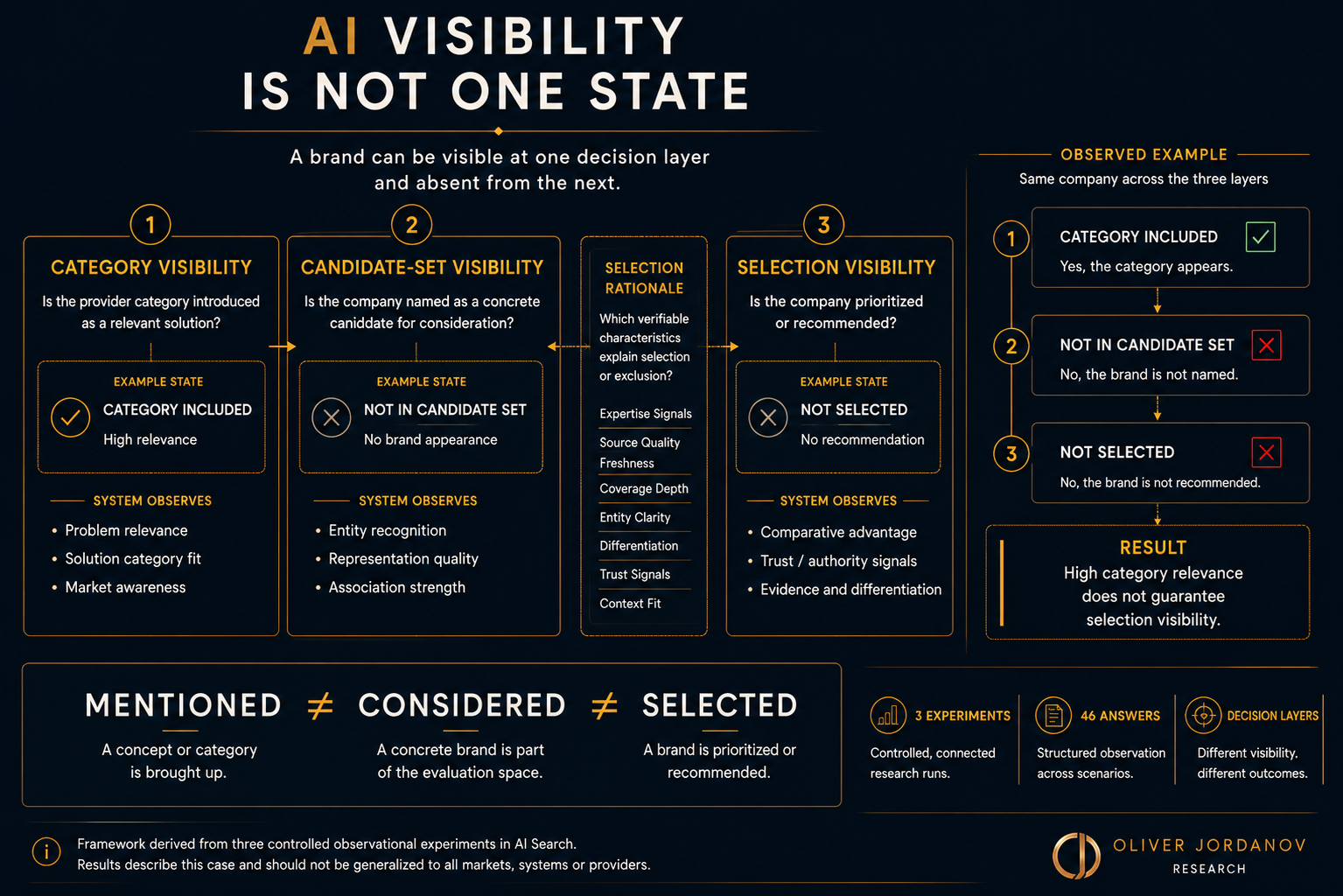
Category Visibility
Does the system introduce the relevant provider category as a solution?
A company can benefit from category relevance even before brands are named.
Candidate-Set Visibility
Does the company become one of the concrete candidates considered?
This is a materially different state.
The category can be highly relevant while a specific company remains absent.
Selection Visibility
Is the company prioritized or recommended among the available candidates?
Candidate inclusion does not guarantee selection.
Selection Rationale
Which characteristics are used to justify selection or exclusion?
This may be the most strategically useful layer.
Selection Rationale exposes the criteria through which providers are differentiated in the response.
That creates potential hypotheses for subsequent measurement and intervention.
Observation, Inference and Hypothesis
A central principle of the AI Search Lab is to keep these levels separate.
Observation
What was actually visible in the documented responses?
Across this experiment:
- commercial categories appeared before explicit provider questions
- operational questions produced category recommendations consistently
- the standalone control largely reproduced this behavior
- provider-type questions introduced concrete companies
- comparison questions produced prioritization and Selection Rationale
- no stable company won across all selection runs
These are observations.
Inference
What interpretation is reasonably supported by those observations?
INFERENCE
For the tested operational prompts, accumulated conversation history was not required for Commercial Emergence.
INFERENCE
AI Visibility can usefully be measured at different stages:
Category → Candidate Set → Selection → Selection Rationale
INFERENCE
The commercial transition can occur while the user is still expressing an operational problem rather than explicitly requesting a provider.
These interpretations are consistent with the observed responses.
They are not causal proofs.
Hypothesis
What should be tested next?
HYPOTHESIS
Companies may increase their Candidate-Set and Selection relevance when first-party and external sources consistently establish:
- which users they serve
- which problems they solve
- which use cases they fit
- how they differ from alternatives
- which selection criteria they satisfy
The current experiments did not test whether changing this information causes different Brand Selection outcomes.
That requires intervention experiments.
Practical Implications for Companies
The results do not provide an optimization formula.
They do provide a more precise way to investigate commercial AI visibility.
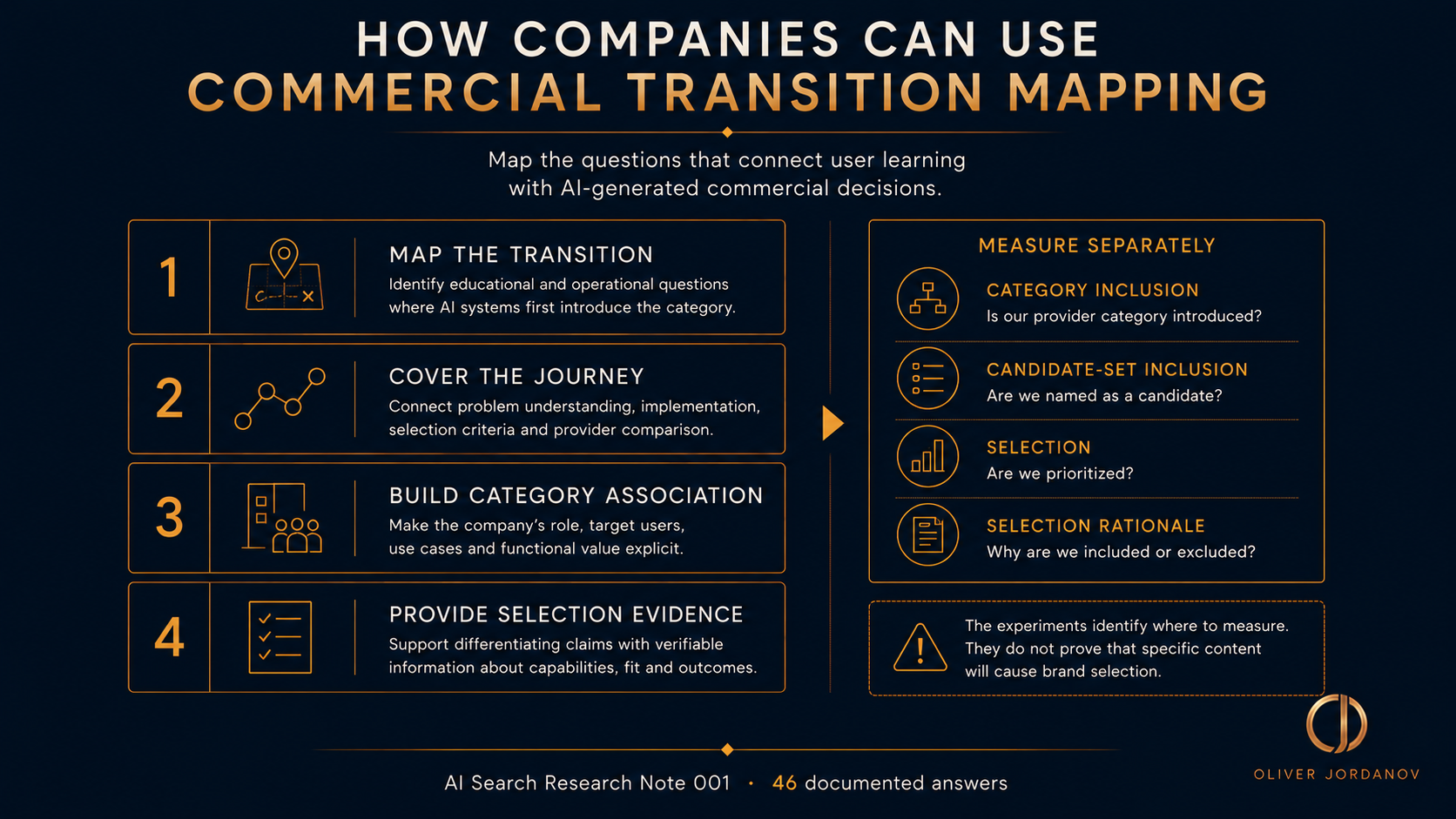
1. Commercial Transition Mapping
Do not map only conventional keywords or explicit provider questions.
Map the educational and operational questions at which AI systems begin introducing your solution category.
The useful question becomes:
Where does an informational problem become commercially actionable inside the AI response?
These transition points may identify commercially relevant demand earlier than conventional bottom-of-funnel prompt tracking.
2. Rethink the Top of Funnel
Top-of-funnel questions are not necessarily commercially neutral.
A user can still be describing a problem while the AI system has already recognized a commercial solution class.
That creates a transition zone between:
Problem Understanding
and
Commercial Discovery
For AI Visibility analysis, that boundary may be more useful than a simple informational/commercial keyword classification.
3. Build Journey Coverage
The observed sequence suggests that useful information should support more than direct provider comparison.
A complete decision environment may need to connect:
Problem Understanding
↓
Operational Implementation
↓
Selection Criteria
↓
Provider Categories
↓
Comparison
This does not mean creating one page for every prompt.
It means building an information architecture capable of supporting the full decision logic.
4. Strengthen Category Association
Before a company can compete for selection, the system needs to understand where the company belongs.
Organizations should make clear:
- their role
- target audience
- functional purpose
- relevant problems
- use cases
- scope of service
The objective is not keyword repetition.
It is a coherent relationship between:
Problem → Category → Entity
5. Build Selection Evidence
Generic positioning may establish category membership.
It may not be sufficient for Brand Selection.
In the observed responses, provider selection was justified through differentiating characteristics.
For this market, these included criteria such as:
- product access
- regulatory model
- technology
- integrations
- support
- costs
- portfolio rights
- specialization
- specific operating scenarios
Companies can examine which criteria repeatedly appear during AI-mediated comparison and determine whether those characteristics are supported by verifiable information.
That information may exist across first-party and external sources.
The hypothesis that improving such evidence changes Selection remains to be tested.
A More Precise Measurement Model
Instead of asking only:
Are we visible in AI Search?
measure the stages separately.
| Measurement Layer | Question |
|---|---|
| Category Inclusion | Is our provider category introduced as a solution? |
| Candidate-Set Inclusion | Are we named as a concrete candidate? |
| Selection | Are we prioritized or recommended? |
| Selection Rationale | Which characteristics justify our inclusion or exclusion? |
This creates a much more diagnostic view of AI Visibility.
A brand can be strong at one layer and absent at the next.
That distinction matters when deciding what to investigate or change.
What This Research Does Not Show
These experiments do not demonstrate:
- that every educational journey becomes commercial
- that provider-type questions always produce concrete brands
- that the observed companies are permanently preferred
- that specific content changes cause Brand Selection
- which ranking or selection factors caused the observed outputs
- that the observed escalation represents a universal AI Search architecture
The results should therefore be treated as a directed observation, not a ranking-factor study or causal experiment.
Limitations
The observations are limited to:
- one market: independent financial and insurance intermediation in Germany
- one shared persona
- German-language prompts
- ChatGPT Search in a logged-out incognito context
- one collection date: 3 September 2026
- a small, non-representative sample of 46 responses
- qualitative coding by one researcher
- no independent intercoder validation
- incomplete systematic capture of Fan-Out Queries and retrieval paths
For the technically verified initial run, unauth-mweb, free-unauth and web_mobile_unauth were recorded.
For later runs, the visible responses were fully documented, but model and Fan-Out data could not be reliably verified separately for every run.
Experiment 003 also deliberately introduced increasingly explicit provider questions.
It therefore measures response structure and escalation, not the natural probability that Brand Selection will occur without provider-oriented prompting.
Current search results, product changes or model routing may also affect brand mentions and recommendations.
Methodology
The research used a shared persona:
Several years of experience in financial distribution at a German bank, planning to become self-employed as an independent intermediary for financial investments and insurance.
Three experiments were conducted:
| Experiment | Structure | Responses | Primary Comparison |
|---|---|---|---|
| 001 | Four conversations × six sequential prompts | 24 | Journey stages and replication |
| 002 | Three operational questions × four new chats | 12 | Journey vs. standalone |
| 003 | Five escalation stages × two new chats | 10 | Category → Candidate Set → Selection |
| Total | Three sequential experiments | 46 | Descriptive qualitative coding |
Responses were coded using a proximity scale:
P0 — No Commercial Emergence
P1 — Peripheral commercial relevance
P2 — Target-adjacent category mentioned
P3 — Category functionally explained
P4 — Category recommended
P5 — Concrete target company mentioned
P6 — Concrete company recommended or prioritized
Additional coding captured Candidate Sets, Brand Selection and Selection Rationale.
The analysis followed a simple rule:
OBSERVATION
Only visible response content and documented frequencies.
INFERENCE
A plausible interpretation consistent with the observations but not causally established.
HYPOTHESIS
An open proposition requiring a subsequent experiment.
Research Note 001
3 experiments · 46 documented responses · Collected 3 September 2026
The Next Research Question
The next useful step is not simply generating more prompt variations.
The stronger question is:
Which selection criteria and sources support the observed Candidate-Set and Brand-Selection decisions?
That leads to several follow-up questions:
- Which selection criteria recur across more runs, models and collection dates?
- Which sources support Candidate-Set and Brand-Selection statements?
- How stable is Candidate-Set composition for identical prompts?
- How strongly do explicit target-group or business-model characteristics affect selection?
- Can a controlled change to first-party information alter Candidate-Set or Selection outcomes?
- Do similar transitions occur in other markets?
The logical next experiment is therefore to identify recurring Selection Criteria and the sources used to support them before testing a controlled content intervention.
Closing Perspective
These three experiments do not provide a universal theory of AI Search.
They show a narrower but practically useful pattern.
Commercial solution categories can emerge while a user is still asking educational or operational questions.
Operational questions can reproduce this transition without accumulated conversation context.
And as decision specificity increases, responses can move from:
Category
to
Candidate Set
to
justified Brand Selection.
For companies, this expands the useful scope of AI Visibility analysis.
Relevant visibility does not begin only when users name a provider or ask for the “best” company.
It can begin earlier — with the problems, tasks and decision criteria from which an AI system constructs commercial relevance.
That suggests a broader working model:
Problem Relevance
↓
Category Association
↓
Candidate Set
↓
Selection Evidence
↓
Brand Selection
The practical implication is not that companies should optimize for a fixed sequence of prompts.
It is that each transition represents a different visibility problem.
A company may be strongly associated with a category but absent from the Candidate Set.
It may enter the Candidate Set but lack the evidence required for selection.
And it may be selected under one set of criteria while losing under another.
Understanding those transitions requires measuring them separately.
The next research step is therefore not to generate more prompt variations.
It is to investigate the Selection Criteria and sources behind the observed recommendations.
Only after those mechanisms are better understood does a controlled content intervention become a useful experiment.
AI Visibility is not one state.
It is a sequence of increasingly consequential forms of consideration and selection.