
How AI systems construct meaning across representation and request time.
Core Concept · AI Visibility Systems · Machine Understanding
AI systems do not operate on information as humans encounter it.
They operate on representations.
Before information can become useful within an AI-mediated search process, systems must construct meaning from available signals.
But this does not necessarily happen once.
Some interpretation occurs when information is processed, represented and connected within an information environment.
Other interpretation occurs when a specific request creates a new information need.
This creates an important distinction:
Representation-Time Interpretation
and
Request-Time Interpretation
Understanding the difference helps explain why the same source, entity or piece of information can be represented one way within a system yet interpreted differently across tasks and contexts.
Interpretation is therefore not simply a stage before selection.
It is a recurring mechanism through which systems reduce uncertainty and construct meaning.
Definition
Interpretation describes the processes through which AI-mediated systems construct meaning from available signals, representations and context.
These processes may operate at different moments.
At representation time, systems may extract, classify, associate and structure information into machine-usable representations.
At request time, systems interpret the current information need and evaluate retrieved information in relation to that request.
Interpretation therefore connects two different problems:
What does this information represent?
and
What does this information mean for the current task?
These questions are related.
They are not identical.
Why Interpretation Exists
Information rarely arrives as a complete and unambiguous representation of reality.
Systems encounter fragments:
Different names.
Different sources.
Different descriptions.
Different relationships.
Different contexts.
Different representations.
A page may describe an organization one way.
A business listing may describe it another way.
Structured data may expose specific attributes.
External sources may reinforce or contradict those descriptions.
Retrieval may surface only part of the available information.
Interpretation helps systems construct meaning from these incomplete observations.
Without interpretation, signals remain signals.
They do not yet form a usable representation.
Two Timescales of Interpretation
A useful conceptual distinction is between interpretation that contributes to stored or available representations and interpretation that occurs during a specific request.
These mechanisms should not be treated as necessarily separate technical modules.
They describe two different functional moments within the wider search architecture.
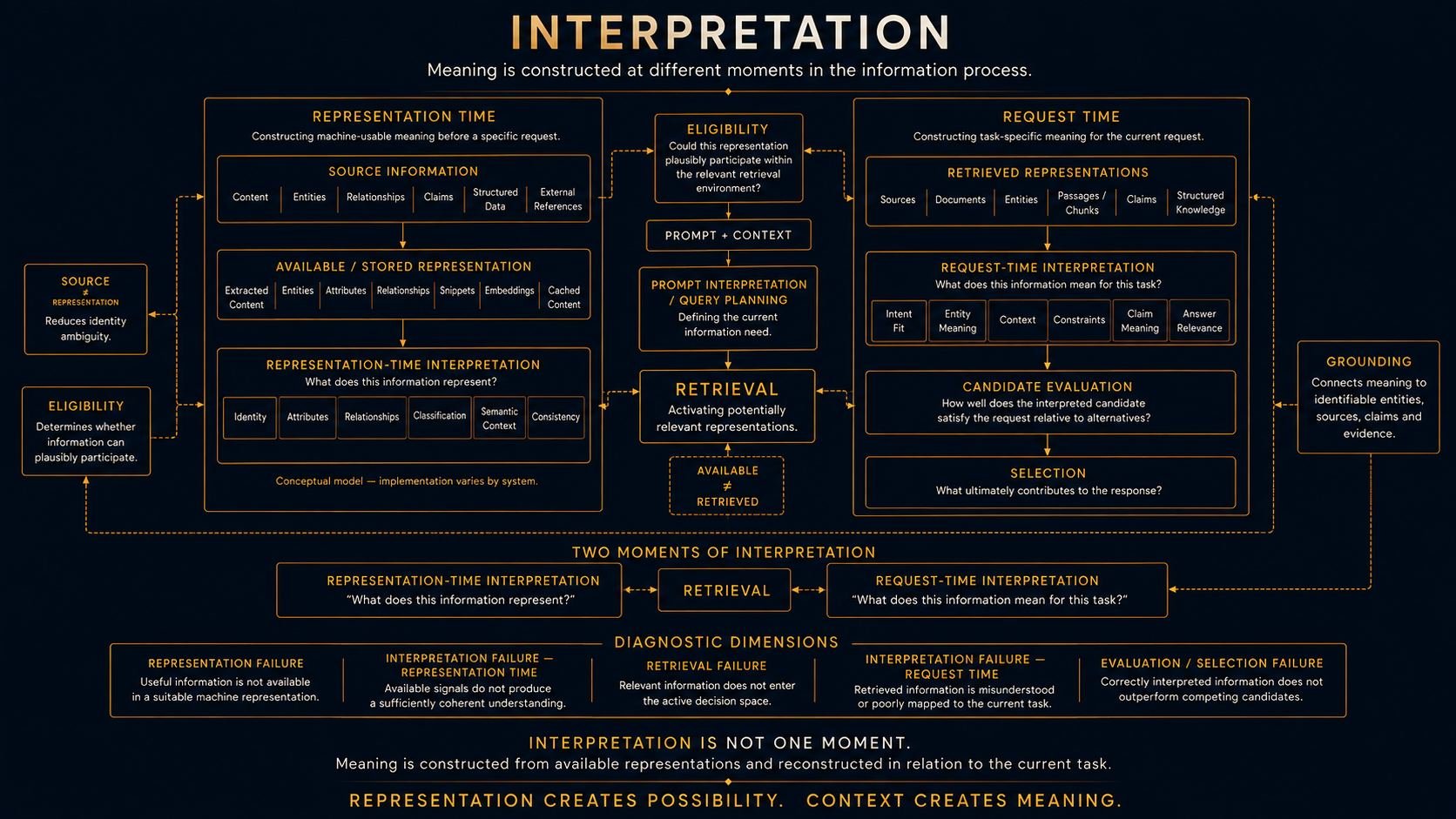
Representation-Time Interpretation
Before a specific user request exists, information may already have been processed into machine-usable representations.
Depending on the system, these representations may include combinations of:
- extracted content
- entities
- attributes
- relationships
- classifications
- structured data
- embeddings
- snippets
- cached content
- other derived signals
At this level, interpretation helps answer questions such as:
What is this information about?
Which entity does it describe?
Which attributes and relationships can be identified?
How does it relate to other known information?
Which signals reinforce or contradict one another?
The result is not necessarily one complete or permanent understanding.
It is an available machine representation that can support later retrieval and reasoning.
This creates an important distinction:
Source ≠ Representation ≠ Interpretation
The source provides information.
A representation makes some form of that information available to a system.
Interpretation constructs meaning from what is available.
Request-Time Interpretation
A specific request introduces a different interpretive problem.
The system must now determine:
- what the user is asking
- which entities are involved
- which constraints matter
- what context changes the information need
- what kind of evidence would satisfy the request
- how retrieved candidates relate to that need
This is Request-Time Interpretation.
It may begin with Prompt Interpretation or Query Planning.
But it does not necessarily end there.
Retrieved documents, passages, entities or other representations may themselves require interpretation in relation to the current task.
A source that is broadly about the right topic may still fail to answer the actual request.
A candidate that appears weak in one context may become highly relevant in another.
Request-Time Interpretation therefore helps transform retrieved information into task-specific meaning.
Representation Is Not the Source
This distinction becomes especially important in AI-mediated search.
Systems do not necessarily encounter a live page in its complete form every time they need information.
They may operate on representations derived from that source.
These representations can be:
partial
compressed
structured
cached
derived
or otherwise transformed.
The information available to the system may therefore differ from the information visible on the live source.
This means interpretation depends not only on what an organization publishes.
It also depends on what representation of that information is available at the moment interpretation occurs.
Interpretation and Retrieval
Interpretation and Retrieval interact.
They should not be modeled as a simple universal sequence:
Interpretation → Retrieval
or:
Retrieval → Interpretation
Both relationships may exist at different functional moments.
Representation-Time Interpretation can help create information structures that later support retrieval.
Request-Time Interpretation can help define the information need that drives retrieval.
Retrieved information can then require further interpretation before Candidate Evaluation and Selection.
A more useful conceptual relationship is:
Available Representations
↓
Prompt + Context
↓
Request Interpretation / Query Planning
↓
Retrieval
↓
Retrieved Representations
↓
Task-Specific Interpretation and Evaluation
The exact architecture varies by system.
The enduring principle is that retrieval determines what information becomes active, while interpretation determines what that information means.
Interpretation and Entity Clarity
Entity Clarity reduces uncertainty about identity.
Interpretation constructs meaning from the signals available about that identity.
The two concepts therefore reinforce one another.
Clear naming, stable attributes, explicit relationships and consistent positioning can make interpretation easier.
But Entity Clarity should not be treated as a mandatory technical stage that always follows Interpretation.
Instead:
Entity Clarity describes a property of the representation.
Interpretation describes the process through which meaning is constructed from available information.
Poor Entity Clarity increases interpretive uncertainty.
Strong Entity Clarity reduces it.
Interpretation and Eligibility
Our earlier model treated Interpretation as something that necessarily happened completely before Eligibility.
That is too simple.
Eligibility asks whether information can plausibly participate within a particular task and retrieval environment.
Answering that question may require some degree of interpretation.
But Eligibility also depends on:
- the task
- the retrieval system
- the available representation
- system-specific conditions
Representation-Time Interpretation may therefore influence whether information becomes understandable enough to qualify.
Request-Time Interpretation may influence whether that representation is relevant to the current information need.
Interpretation supports Eligibility.
It should not be treated as one universal gate immediately preceding it.
Interpretation and Candidate Evaluation
Retrieval creates opportunity.
Interpretation helps establish meaning within that opportunity.
Once candidates have entered the active decision space, systems may need to determine not merely whether they concern the topic, but how they relate to the interpreted request.
This distinction matters.
Topic relevance is not answer relevance.
A retrieved passage may discuss the correct entity yet fail to answer the question.
A source may contain useful evidence but apply to the wrong context.
A claim may appear relevant but conflict with stronger evidence.
Candidate Evaluation builds on these interpretations to compare competing information.
Interpretation therefore helps determine what a candidate means.
Candidate Evaluation determines how well that candidate performs relative to the current request and alternatives.
Interpretation and Grounding
Interpretation constructs meaning.
Grounding constrains that meaning through identifiable sources, entities, claims, evidence and context.
The relationship can operate in both directions.
Grounded information can improve interpretation by providing stronger reference points.
Interpretation can also determine which entities, claims and relationships require grounding.
Grounding therefore should not be treated simply as something that happens after interpretation or generation.
Both mechanisms may interact throughout the wider architecture.
Why More Content Is Not Enough
Organizations often respond to visibility problems by publishing more.
More pages.
More articles.
More keywords.
But additional information does not automatically improve interpretation.
It can also create:
- competing descriptions
- ambiguous entities
- inconsistent attributes
- contradictory claims
- fragmented representations
- semantic debt
The relevant question is therefore not:
How much information exists?
It is:
What meaning can systems reliably construct from the representations available to them?
Quantity expands the information environment.
Clarity improves interpretation.
Interpretation as a Diagnostic Layer
The distinction between representation-time and request-time interpretation creates a more precise diagnostic model.
When a system misunderstands an organization, product or concept, we can ask:
Representation Problem
Is the relevant information available to the system in a useful form?
Representation-Time Interpretation Problem
Does the available representation support a coherent understanding of the entity, attributes and relationships?
Retrieval Problem
Did the relevant representation enter the active decision space?
Request-Time Interpretation Problem
Was the retrieved information understood correctly in relation to the current task?
Evaluation Problem
Was correctly interpreted information nevertheless outperformed by competing candidates?
These are different failure modes.
Treating all of them as a content or ranking problem hides the underlying architecture.
Strategic Perspective
Interpretation changes the optimization problem.
Organizations do not merely need to publish information that humans can understand.
They increasingly need to create information environments from which machines can construct stable and useful representations.
And those representations must remain meaningful when activated within different requests and contexts.
This connects:
Semantic Architecture
to
Machine Representation
to
Retrieval
to
Request-Time Understanding
to
Selection.
Interpretability therefore becomes a property of the wider information system rather than of any individual page.
Relationship to the Concepts Library
Interpretation sits across several layers of the AI Visibility Architecture.
Semantic Debt describes structural inconsistencies that increase interpretive uncertainty.
Entity Clarity describes how consistently an entity can be identified and differentiated.
Eligibility describes whether information can plausibly participate within a particular task and retrieval environment.
Retrieval describes how information enters the active decision space for a specific request.
Candidate Evaluation describes how retrieved information competes against the interpreted request and available alternatives.
Grounding connects interpretation and generated claims to identifiable entities, sources and evidence.
Selection Systems describes the wider architecture through which retrieval, evaluation, prioritization and selection interact.
Interpretation is therefore not simply the first box in this architecture.
It is a mechanism that can operate across multiple stages.
Closing Thesis
AI systems do not simply retrieve information and then understand it.
Nor do they necessarily interpret everything once before retrieval begins.
Meaning can be constructed at different moments.
Before a request, systems may already operate on interpreted representations of sources, entities and relationships.
During a request, those representations must be interpreted again in relation to intent, context and competing information.
This gives us a more useful distinction:
Representation-Time Interpretation asks:
What does this information represent?
Request-Time Interpretation asks:
What does this information mean for this task?
AI visibility depends on both.
Because machines cannot select information reliably without meaning.
And meaning depends on both what has been represented and how that representation is interpreted in context.
Related Concepts
How AI Selection Works
The overarching framework describing how AI systems interpret, evaluate and select information.
Search Influence
How search systems shape interpretation, consideration and selection before measurable traffic occurs.
Semantic Debt
Accumulated structural inconsistencies that reduce interpretability and machine confidence.
Grounding
The mechanisms that connect AI-generated outputs to verifiable information.
Entity Clarity
The degree to which an entity can be consistently identified, understood and differentiated across information environments.
Eligibility
The conditions that determine whether an entity can be considered for selection.
Selection Systems
How AI systems compare and prioritize competing candidates before generating a response.
Ownership (Coming Soon)