
How AI systems coordinate retrieval, representation, evaluation and selection under changing context.
Core Concept · AI Visibility Systems · Decision Architecture
AI systems do not select information through one ranking decision.
A request may activate different retrieval systems.
Those systems may operate on different representations of the same source or entity.
Initial retrieval may surface only limited information.
Promising candidates may then become available through richer representations.
Candidates may be evaluated, prioritized, combined or excluded.
And further decisions can occur during generation and grounding.
The precise architecture differs between systems.
The more durable principle is:
Selection is not a single decision. It is a coordinated architecture of retrieval, representation, evaluation and prioritization.
Definition
Selection Systems describe the interacting mechanisms through which AI-mediated search systems make information available, retrieve candidates, evaluate competing representations and determine what ultimately contributes to a response.
This process does not necessarily operate on one index, one representation or one fixed Candidate Pool.
A useful conceptual model is:
Task / Intent
↓
Retrieval-System Routing
↓
Representation Retrieval
↓
Candidate Pool
↓
Representation Enrichment
↓
Candidate Evaluation
↓
Prioritization / Reranking
↓
Selection
↓
Generation / Grounding
This is a functional model.
It is not a claim that every AI system implements these mechanisms in this order.
Systems may combine stages, repeat retrieval, evaluate candidates during retrieval, access richer representations earlier, or trigger additional retrieval during generation.
What matters is the distinction between the decisions being made.
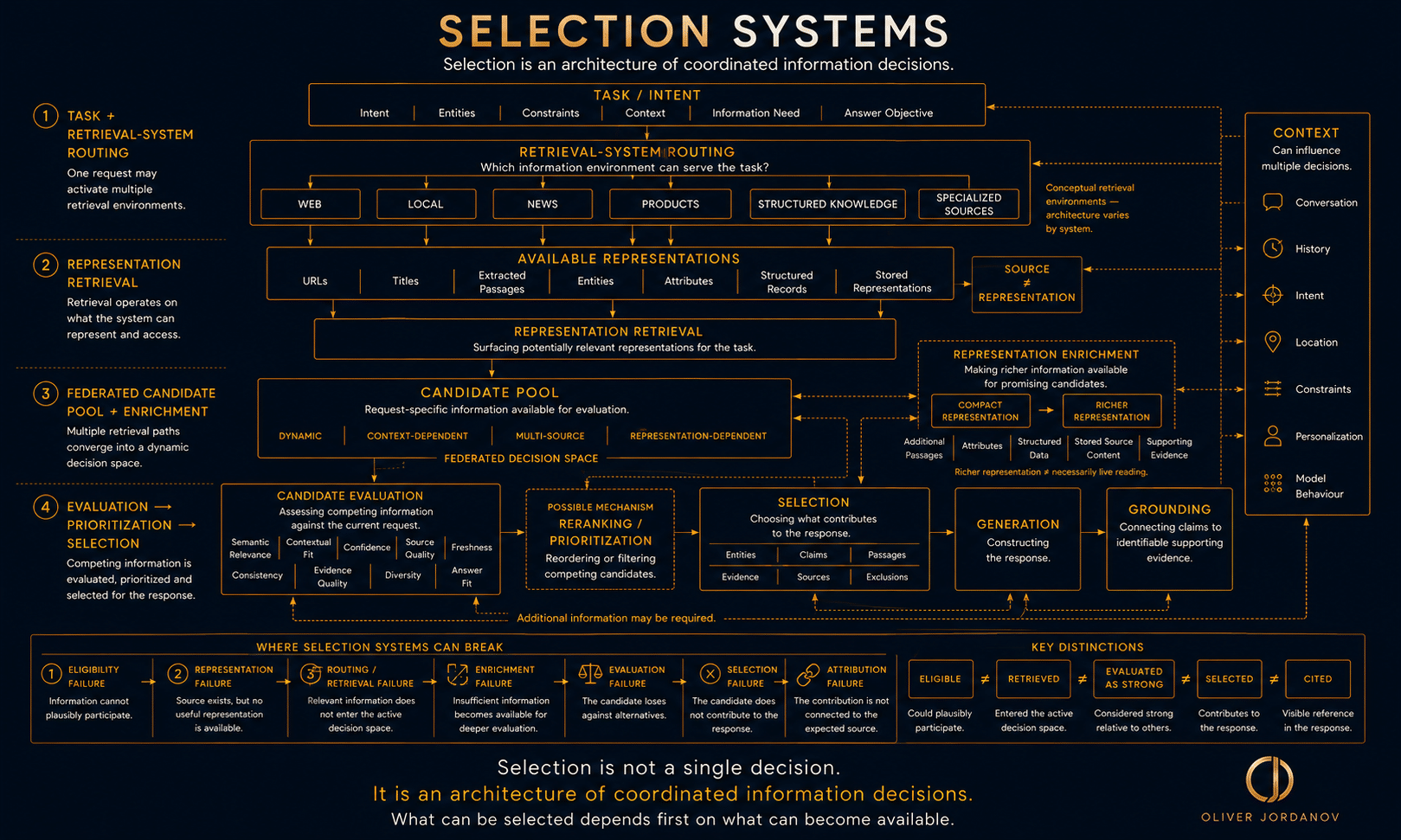
Selection Can Span Multiple Retrieval Systems
AI-mediated search should not automatically be understood as one retrieval system operating over one universal information space.
Different tasks may depend on different retrieval environments.
These can conceptually include:
- web information
- local or business information
- news
- products
- images
- structured knowledge
- specialized databases
- conversational or stored context
A request may activate one environment.
Another may require several.
The same entity can therefore be available through one retrieval path while absent from another.
This introduces an important layer before candidate evaluation:
Retrieval-System Routing
The immediate question is not only:
Which information is relevant?
It may first be:
Which information environment can provide useful candidates for this task?
Selection Systems therefore begin with the architecture through which information can become available.
Eligibility Is Not Global
This also changes how Eligibility relates to Selection Systems.
Eligibility should not be treated as a permanent binary property of a source or entity.
Information may be potentially eligible within one retrieval environment but unavailable within another.
Eligibility can therefore depend on:
- task
- retrieval system
- available representation
- system requirements
- information freshness
- structural accessibility
- semantic relevance
A business could, conceptually, be well represented in a web environment while poorly represented in a local or product environment.
A source may be eligible for one task but irrelevant to another.
Eligibility defines the possibility of participation.
Selection Systems determine what happens when a particular task activates particular information environments.
Retrieval-System Routing
Before candidates can compete, the system must have some mechanism for obtaining them.
The interpreted request can influence which retrieval environments are useful.
A local request may require different information than a general informational request.
A product comparison may require attributes that ordinary web representations do not provide.
A current-events question may require information with different freshness characteristics.
Routing therefore connects:
Task
to
Relevant Retrieval Environment(s)
to
Available Representations
This does not require a single explicit routing component in every implementation.
It describes the functional problem that any multi-source search architecture must solve:
Where should useful information for this task come from?
Retrieval Operates on Representations
Retrieval does not necessarily operate directly on live webpages or complete source documents.
Search systems can work with machine-available representations.
Depending on the environment, these might include:
- URLs
- titles
- extracted passages
- indexed snippets
- entities
- attributes
- structured records
- embeddings
- cached content
- stored source representations
This distinction matters.
Source ≠ Representation
A source may contain highly relevant information that is absent from the representation available to a particular retrieval system.
Conversely, a compact representation may contain enough information to make the source retrievable without exposing its complete contents during initial discovery.
Retrieval therefore depends not only on what exists at the source.
It depends on what the relevant system can represent and retrieve.
Candidate Pools Can Be Federated
Once retrieval occurs, candidates become available for evaluation.
But there does not need to be one universal Candidate Pool.
Different retrieval systems may contribute different candidate types.
One may surface webpages.
Another may surface entities.
Another may return products or business records.
Another may provide passages or structured facts.
The active decision space can therefore be understood as a federated Candidate Pool assembled for the current task.
Conceptually:
Retrieval Environment A
Retrieval Environment B
Retrieval Environment C
↓
Request-Specific Candidate Pool
The pool is therefore:
- dynamically constructed
- context-dependent
- representation-dependent
- potentially multi-source
This helps explain why apparently similar requests can produce substantially different information environments.
Representation Enrichment
Initial retrieval does not necessarily provide every piece of information required for evaluation.
A candidate may first become visible through a compact representation.
If it appears sufficiently relevant, the system may gain access to a richer representation.
Conceptually:
Compact Representation
↓
Candidate Retrieval
↓
Representation Enrichment
↓
Richer Evaluation
Enrichment could involve additional passages, attributes, structured information, cached source content or other available evidence.
The important principle is not the implementation.
It is the distinction between:
the representation sufficient to discover a candidate
and
the representation available when evaluating that candidate more deeply.
These do not have to be identical.
Representation Enrichment Is Not Necessarily Live Reading
This distinction prevents another conceptual mistake.
A richer representation should not automatically be interpreted as a fresh visit to the live source.
Systems may operate on previously stored, cached, extracted or otherwise maintained representations.
A possible architecture is therefore:
Discovery Representation
↓
Candidate Retrieval
↓
Stored Richer Representation
↓
Evaluation
while a separate process may update those representations over time.
Whether a particular system uses live retrieval, cached representations, stored source memory or combinations of these is an implementation question.
The durable principle is simpler:
Information availability and information freshness are separate properties.
Candidate Evaluation
Once candidates and sufficient representations are available, they can be evaluated against the current information need.
Evaluation may occur at different levels:
- source
- document
- entity
- passage or chunk
- claim
- structured record
Possible considerations include:
- semantic relevance
- contextual fit
- confidence
- source quality
- consistency
- freshness
- evidence quality
- diversity
- answer fit
A candidate can therefore be:
eligible
and
retrieved
and
represented in sufficient detail
and still lose during Candidate Evaluation.
This is a different failure mode from never being available or retrieved at all.
Prioritization and Reranking
Some architectures may reorder, filter or prioritize candidates after retrieval or evaluation.
Reranking is one possible mechanism.
It is not synonymous with Selection Systems as a whole.
A highly prioritized passage may support one claim.
A different source may provide stronger evidence.
An entity may survive evaluation without ultimately being mentioned.
And generation may change which information becomes useful.
Prioritization therefore describes competition within the active decision space.
It does not by itself determine the final response.
Selection Happens at Multiple Levels
There may be no single object that an AI system “selects.”
Different mechanisms can operate on different units.
A system may:
retrieve a source,
evaluate a passage,
extract a claim,
associate the claim with an entity,
use the entity in a comparison,
and cite another source that supports the same statement.
Selection can therefore concern:
- entities
- claims
- passages
- evidence
- sources
- exclusions
- citations
This distinction is fundamental.
Document retrieval does not equal entity selection.
Entity selection does not equal source selection.
Source selection does not equal citation.
Visibility emerges from the interaction between these decisions.
Context Operates Across the Architecture
Context is not one box between Candidate Pool and Selection.
It can influence the entire request-dependent architecture.
Relevant context may include:
- conversation history
- previous turns
- user intent
- location
- constraints
- personalization
- task framing
- model behavior
Context can affect:
Retrieval-System Routing
Which information environments become relevant?
Retrieval
Which representations become candidates?
Representation Enrichment
Which candidates require additional information?
Candidate Evaluation
What constitutes a strong fit?
Selection
Which information contributes to the response?
Generation and Grounding
How should selected information be expressed and supported?
Context therefore acts across Selection Systems rather than occupying one fixed stage.
Grounding Can Influence Selection
Grounding should not be treated only as the final attachment of citations.
A candidate may be more useful if its claims can be connected to identifiable and verifiable evidence.
Evidence requirements can influence Candidate Evaluation.
Source provenance can affect selection.
Additional retrieval may be triggered to support a generated claim.
Citation may expose only one part of a broader evidence lineage.
Grounding can therefore interact with Retrieval, Candidate Evaluation, Selection and Generation.
This is why:
Grounding ≠ Citation
Citation makes part of the grounding relationship visible.
Selection Systems Are Iterative
The architecture should not be interpreted as a one-way funnel.
A system may retrieve information.
Evaluate it.
Identify missing evidence.
Retrieve again.
Access richer representations.
Generate part of an answer.
Identify another information need.
Retrieve again.
Or seek stronger grounding for a claim.
A more realistic abstraction is therefore:
retrieve → evaluate → enrich → select → generate
with possible feedback loops between these functions.
The system progressively constructs a sufficiently useful information state for the task.
Diagnosing Selection Failure
This expanded architecture makes failure diagnosis more precise.
An organization can fail because:
Eligibility Failure
The information cannot plausibly participate in the relevant retrieval environment.
Representation Failure
The source exists, but the available machine representation does not adequately expose the relevant information.
Routing Failure
The retrieval environment containing the information is not activated or useful for the task.
Retrieval Failure
The information is potentially eligible but never enters the active Candidate Pool.
Enrichment Failure
The candidate is discovered, but insufficient information becomes available for deeper evaluation.
Evaluation Failure
The candidate is retrieved but performs poorly relative to alternatives.
Selection Failure
The candidate survives evaluation but does not ultimately contribute to the response.
Grounding / Attribution Failure
The information contributes to the answer but is not connected to the expected source or citation.
These are different problems.
Treating all of them as “ranking” obscures where visibility was actually lost.
Why Selection Systems Matter
Selection Systems explain why AI visibility can vary even when the underlying source does not change.
Different tasks may activate different retrieval environments.
Different systems may possess different representations.
Different representations may expose different information.
Different candidate pools may therefore emerge.
Candidates may receive different levels of enrichment.
Context may alter evaluation.
And grounding requirements may change which evidence ultimately survives.
The observable response is therefore downstream of several interacting decision systems.
There is no requirement for one universal score to explain the outcome.
Strategic Perspective
A traditional optimization question asks:
How do we rank higher?
A Selection Systems perspective asks:
Where can the entity become available?
How is it represented there?
Which tasks activate that retrieval environment?
Can the representation make it retrievable?
Does richer information become available when required?
Does it survive Candidate Evaluation?
Can its claims be grounded?
Does it ultimately contribute to the response?
This is a more useful diagnostic model for AI-mediated search.
It separates availability from retrieval.
Retrieval from evaluation.
Evaluation from selection.
And selection from attribution.
Relationship to the Concepts Library
Selection Systems connect several layers of the wider framework.
Interpretation distinguishes how meaning can be constructed from stored representations and how requests are interpreted at decision time.
Entity Clarity reduces ambiguity around entities and relationships.
Eligibility describes whether information can plausibly participate for a particular task, representation and retrieval system.
Retrieval explains how relevant retrieval environments and representations become part of the active decision space.
Candidate Pool describes the request-specific information available for evaluation.
Candidate Evaluation explains how competing candidates are assessed.
Grounding connects claims through representations to identifiable evidence and sources.
Search Influence describes how machine selection and search exposure can influence human decisions.
Together, they describe AI visibility as an information and decision architecture rather than a ranking event.
Closing Thesis
AI systems do not simply search a universal information space and choose the best result.
They may operate across multiple retrieval environments.
Those environments expose different representations.
Retrieval constructs a request-specific Candidate Pool.
Promising candidates may become available through richer representations.
Evaluation, prioritization, grounding and generation can further change what survives.
The implementation varies by system.
The underlying Search Principle is more durable:
Selection depends on what the system can access, how that information is represented, which retrieval environment serves the task, and how the resulting candidates perform within the active decision space.
Selection is therefore not a single decision.
It is an architecture of coordinated information decisions.
Related Concepts
How AI Selection Works
The overarching framework for information availability, retrieval, evaluation, selection and grounding.
Interpretation
How AI systems construct meaning from representations and interpret requests at decision time.
Eligibility
Why participation depends on task, retrieval system and available representation.
Retrieval
How retrieval-system routing and representation-dependent retrieval construct the active Candidate Pool.
Candidate Evaluation
How retrieved candidates compete against the current information need and available alternatives.
Grounding
How claims connect through representations and evidence to identifiable sources.
Search Influence
How machine selection becomes search exposure and can influence human decisions.