
How AI systems assess competing candidates after retrieval and before selection.
Core Concept · AI Selection · Decision Architecture
Retrieval determines what enters the active decision space.
Candidate Evaluation determines how the information within that space is assessed.
Once potentially relevant information has been retrieved, AI systems still face another problem:
Which candidates best satisfy the current request?
Being retrieved is not enough.
A document may be relevant to the general topic but fail to answer the specific question.
A source may be authoritative but poorly suited to the current context.
A passage may contain useful information but provide weaker evidence than competing passages.
An entity may be clearly represented but not fit the user’s actual objective.
Candidate Evaluation describes this intermediate decision layer.
It sits between being available for consideration and being selected for use.
Definition
Candidate Evaluation describes the mechanisms through which retrieved information is assessed against the interpreted request, context and available alternatives.
Evaluation can occur at different levels, including:
- sources
- documents
- entities
- passages or chunks
- claims
Different candidates may therefore compete for different roles within the same response.
A source may provide evidence.
A passage may answer a specific subquestion.
An entity may become a recommendation candidate.
A claim may support a generated statement.
Candidate Evaluation determines how well those candidates satisfy the current information need.
It does not necessarily determine the final response.
Why Candidate Evaluation Exists
Retrieval is intentionally broader than final selection.
Its purpose is to surface potentially useful information.
But potentially useful is not the same as sufficiently useful.
A Candidate Pool may contain several sources discussing the same topic.
It may contain contradictory evidence.
Some candidates may answer only part of the request.
Others may be highly relevant but poorly suited to the required answer.
AI systems therefore need mechanisms for distinguishing between information that is merely available and information that is useful for the current task.
Candidate Evaluation performs this comparison.
Conceptually:
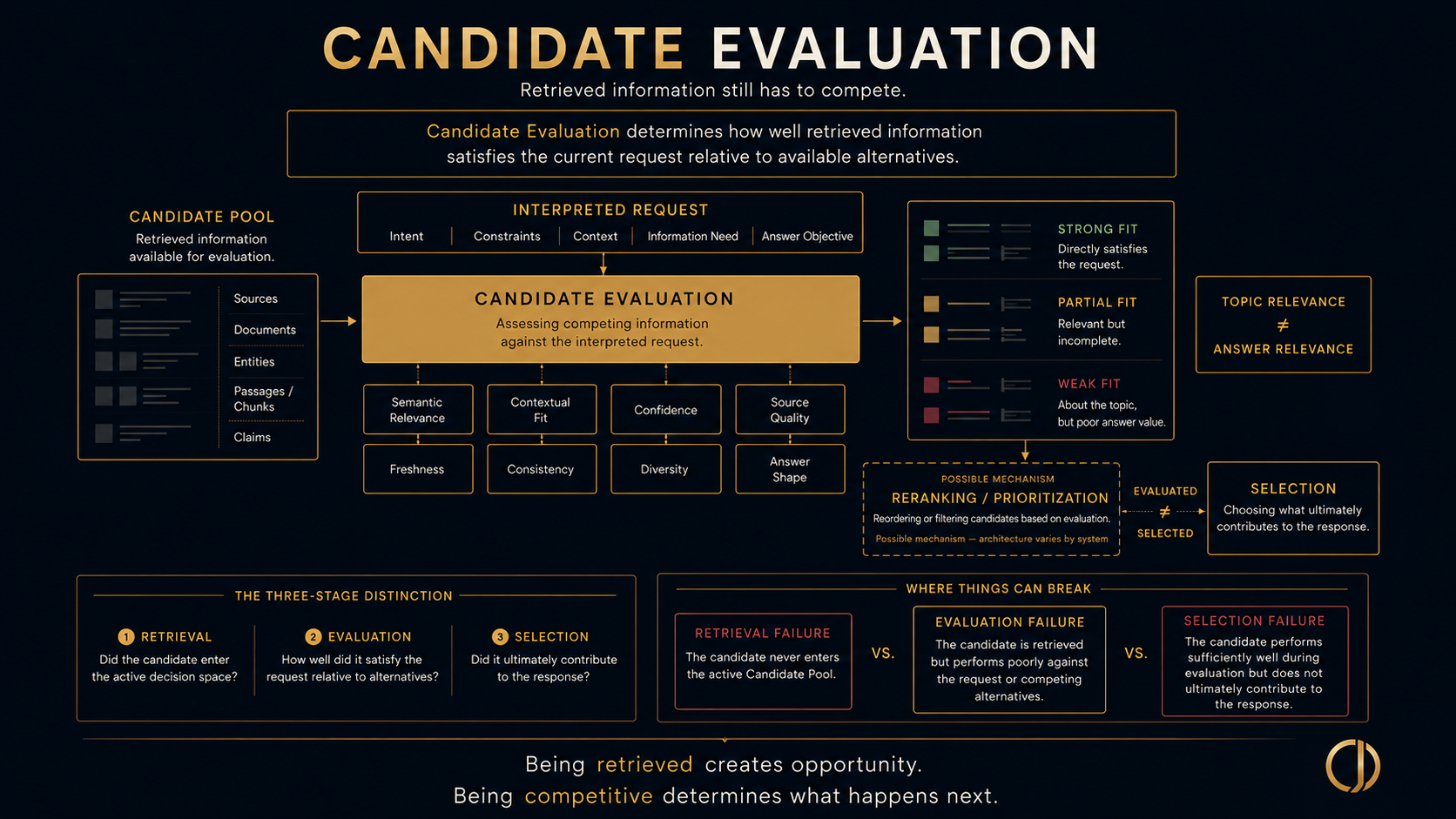
Evaluation reduces the decision space further.
Topic Relevance Is Not Answer Relevance
One of the most important distinctions within Candidate Evaluation is the difference between being about the topic and answering the request.
Consider two pieces of information about the same entity.
One may provide a broad description of the organization.
Another may directly address the specific capability, comparison or constraint contained in the user’s request.
Both are semantically related.
But they do not provide the same answer value.
Candidate Evaluation therefore involves more than topical similarity.
Systems may need to determine whether information:
- addresses the actual question
- satisfies relevant constraints
- provides sufficient evidence
- fits the expected answer
- resolves the information need
This distinction becomes particularly important for complex or comparative requests.
Being relevant to the topic creates possibility.
Being relevant to the answer creates utility.
Evaluation Happens at Multiple Levels
There is no single universal object called a candidate.
Depending on the architecture and task, evaluation may operate at different levels.
Source-Level Evaluation
Is the source appropriate for the current information need?
Document-Level Evaluation
Does the document provide sufficiently relevant information?
Entity-Level Evaluation
Does the entity satisfy the criteria implied by the request?
Passage- or Chunk-Level Evaluation
Does a specific section contain information that directly contributes to the answer?
Claim-Level Evaluation
Is an individual statement sufficiently relevant, consistent or supportable to contribute to generation?
These levels may interact.
A strong source can contain a weak passage.
A highly relevant passage can exist within a less prominent source.
An entity may be selected based on evidence distributed across multiple documents.
Candidate Evaluation should therefore not be reduced to ranking webpages.
What May Influence Candidate Evaluation?
No universal evaluation formula exists across AI systems.
Different architectures may evaluate candidates differently.
Possible considerations include:
Semantic Relevance
How closely does the candidate correspond to the interpreted information need?
Contextual Fit
Does the candidate fit the specific constraints, conversation and objective?
Confidence
How strongly can the system rely on the candidate within the current task?
Source Quality
Does the information environment provide useful signals of reliability or authority?
Freshness
Is recency important for the request being answered?
Consistency
Does the candidate align with other available evidence, or does it introduce unresolved contradictions?
Diversity
Would including the candidate improve the breadth or balance of the available information?
Answer Shape
Does the candidate provide information in a form that can effectively contribute to the required response?
These should be understood as possible dimensions of evaluation.
They are not a universal list of ranking factors.
Reranking Is a Mechanism, Not the Concept
Some retrieval architectures use reranking mechanisms to reassess candidates after initial retrieval.
A reranker may reorder candidates according to their estimated relevance or usefulness for the current request.
This makes reranking one possible implementation of Candidate Evaluation or prioritization.
But the two concepts are not interchangeable.
Candidate Evaluation describes the broader decision problem:
How useful is each candidate for the current information need?
Reranking describes one possible technical mechanism for acting on that evaluation.
Different systems may use different approaches.
Some may combine retrieval and evaluation.
Others may perform several evaluation rounds.
Candidate Evaluation is therefore the architectural concept.
Reranking is one possible mechanism within it.
Retrieved Does Not Mean Competitive
A candidate can successfully pass several earlier stages and still fail during evaluation.
It may be:
interpretable
↓
eligible
↓
retrieved
↓
and still be assessed as weaker than competing candidates.
This distinction matters for AI visibility.
Increasing discoverability may improve Retrieval.
Improving Entity Clarity may improve Interpretation.
Strengthening eligibility may increase the situations in which information can participate.
But none of these guarantees that the candidate will perform well once compared against alternatives.
Candidate Evaluation introduces competition into the architecture.
Candidate Evaluation Is Not Selection
Evaluation and Selection are closely related but distinct.
Evaluation asks:
How well does this candidate satisfy the current information need?
Selection asks:
Which information will actually contribute to the response?
A highly evaluated candidate may still not appear.
Generation may require only part of the available evidence.
Another candidate may provide complementary information.
Diversity requirements may change the final composition.
Source selection and citation mechanisms may make additional decisions.
The final answer may synthesize information from several candidates rather than choose a single winner.
Candidate Evaluation therefore informs Selection.
It does not necessarily determine it.
Candidate Evaluation and AI Visibility
AI visibility is usually observed only after these decisions have occurred.
An organization is recommended.
A product is mentioned.
A source is cited.
Or nothing appears at all.
Candidate Evaluation reveals another possible failure layer.
An entity may be:
- clearly interpreted
- eligible
- successfully retrieved
- present in the Candidate Pool
and still fail to appear because competing candidates better satisfy the request.
This creates an important diagnostic distinction.
Retrieval Failure
Relevant information never enters the active Candidate Pool.
Evaluation Failure
Information is retrieved but performs poorly against the request or competing candidates.
Selection Failure
Information performs sufficiently well during evaluation but does not ultimately contribute to the generated response.
These failures may look identical at the output layer.
They are not the same problem.
The Competitive Nature of Candidate Evaluation
Eligibility is largely about participation.
Retrieval is about access to the active decision space.
Candidate Evaluation introduces a different condition:
relative performance.
A candidate is no longer assessed only in isolation.
Its usefulness can depend on what else is available.
A strong candidate may perform well in one Candidate Pool and poorly in another.
A source may become more or less useful as the prompt changes.
Newer evidence may alter the relative strength of existing information.
Different retrieval results may therefore produce different evaluation outcomes even for the same entity.
AI visibility is partly relational.
The strength of a candidate depends not only on its own characteristics, but also on the alternatives against which it is evaluated.
Relationship to Selection Systems
Candidate Evaluation sits within the broader Selection Systems architecture.
The immediate sequence can be understood as:
Retrieval
↓
Candidate Pool
↓
Candidate Evaluation
↓
Reranking / Prioritization
↓
Selection
Retrieval determines what becomes available.
The Candidate Pool defines the active decision space.
Candidate Evaluation assesses the candidates within that space.
Reranking or other prioritization mechanisms may reorder them.
Selection determines what ultimately contributes to the response.
This sequence is conceptual rather than universal.
Different AI systems may combine, repeat or reorder these mechanisms.
The important distinction is functional:
Retrieval creates opportunity. Evaluation establishes competitive fit. Selection determines participation in the response.
Strategic Perspective
Candidate Evaluation changes the optimization question again.
It is not enough to ask:
Can this information be found?
The next question is:
Once found, is it actually one of the strongest candidates for this request?
This moves AI visibility beyond discoverability.
Organizations must not only create retrievable information.
They must create information that survives comparison.
That can mean providing clearer evidence.
Answering specific information needs more directly.
Reducing ambiguity.
Maintaining current information.
Establishing stronger relationships between claims and entities.
And making information useful within the context in which decisions are being made.
The objective is not simply to enter the Candidate Pool.
It is to become competitive within it.
Closing Thesis
Eligibility determines whether information can reasonably participate.
Retrieval determines whether it enters the active decision space.
Candidate Evaluation determines how well it competes within that space.
Selection determines what ultimately contributes to the response.
These are different stages of the same architecture.
A candidate can be eligible.
It can be retrieved.
It can be relevant.
And it can still lose.
Visibility therefore depends not only on being available.
It depends on being competitive within the information set from which the answer is constructed.
Related Concepts
Selection Systems
The broader architecture through which AI systems retrieve, evaluate, prioritize and select information.
Retrieval
How potentially relevant information enters the active decision process for a specific request.
Candidate Pool
The dynamically constructed set of information available for evaluation.
Eligibility
The conditions that determine whether information can realistically qualify for consideration.
Prompt Interpretation (Soon)
How prompts and context become information needs, constraints and retrieval objectives.
Selection (Soon)
How evaluated candidates ultimately contribute to the generated response.
Grounding
How generated claims become connected to supporting information and identifiable sources.
Ownership (Coming Soon)