
From fragmented organic visibility to a structured search and AI visibility system.
Case Study · Search Strategy · Information Architecture · AI Visibility
A professional services website can contain substantial expertise without turning that expertise into search visibility.
That was the central challenge in this project.
The law firm already had a significant body of specialist content covering multiple areas of law.
But much of that expertise existed within a website structure that had grown over time.
Important topics were distributed across practice-area pages, individual articles and deeper editorial sections.
The problem was therefore not simply a lack of content.
It was a problem of structure, prioritization and connection.
The objective was to transform that existing search footprint into a more coherent system — connecting legal expertise, user demand, information architecture and commercial relevance.
The Challenge
Law firm SEO creates a particular information architecture problem.
Potential clients rarely search according to the internal structure of a law firm.
They search for problems.
Questions.
Legal situations.
Consequences.
And increasingly, they ask AI systems to help them understand those situations before contacting a lawyer.
The website therefore needed to connect several different layers:
- legal practice areas
- specific legal problems
- informational search demand
- current legal developments
- local intent
- commercial service pages
- expert knowledge
Existing content already covered many relevant subjects.
But coverage alone does not create a coherent search system.
The task was to determine which topics mattered, how they related to each other and where authority should accumulate.
From Content Inventory to Search Architecture
The project began by analysing the existing search footprint rather than immediately producing new content.
Existing pages and articles were evaluated according to:
- topic
- search demand
- intent
- existing visibility
- practice-area relevance
- business relevance
- structural role
This made it possible to distinguish between isolated content and information that could support larger thematic structures.
The resulting model was built around practice areas, anchor pages and supporting specialist content.
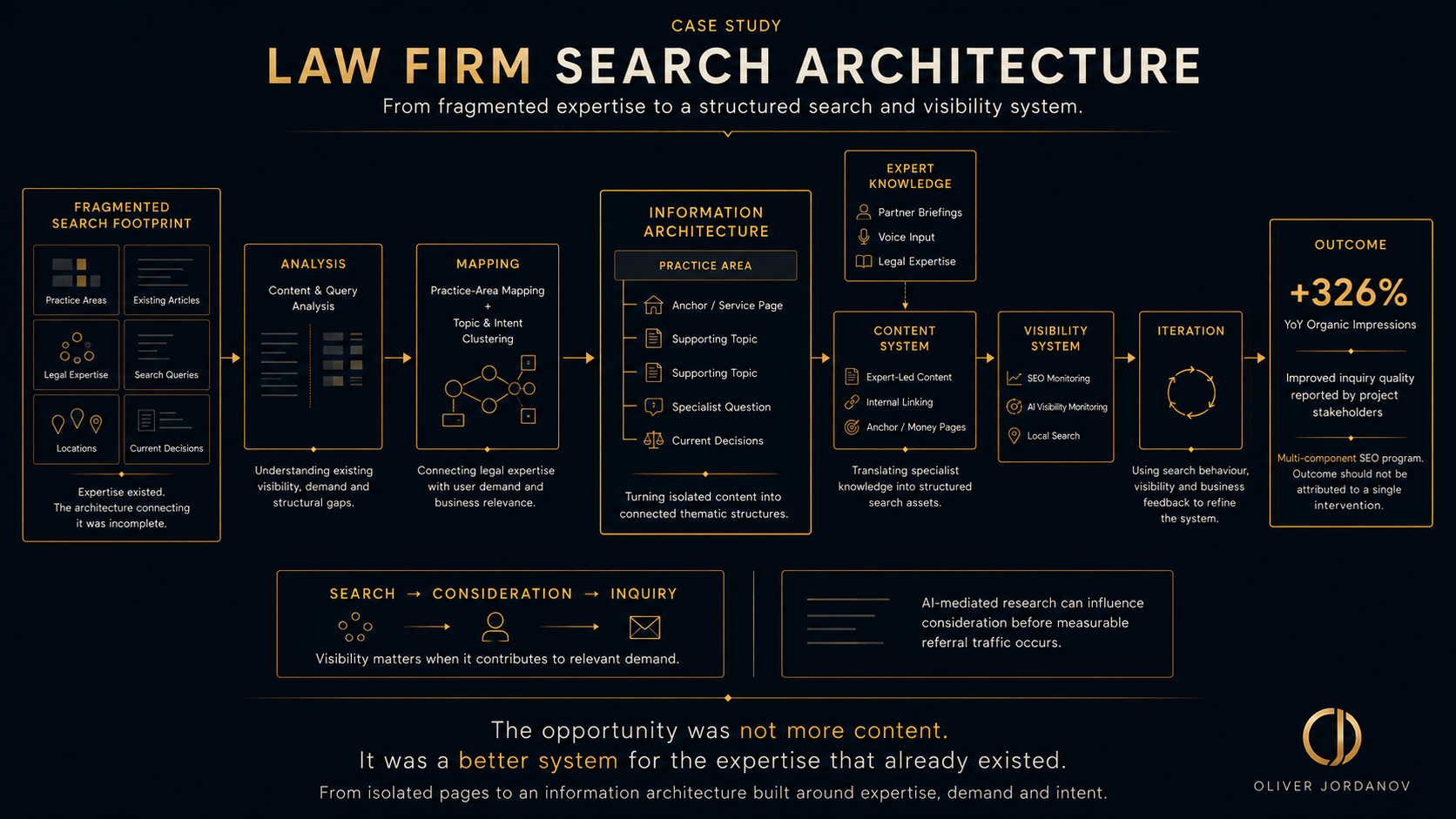
Instead of treating every article as an independent SEO asset, content became part of a broader information architecture.
Building Topic Structures Around Legal Expertise
Individual practice areas were translated into structured topic environments.
A simplified representation looks like this:
Employment Law
├── Dismissal Protection
├── Termination Without Notice
├── Termination by Registered Mail
└── Current Decisions
Public / Civil Service Law
├── Incapacity for Service
├── Retirement after 45 Years
├── Performance Assessments
├── Disciplinary Proceedings
└── Current Decisions
Simplified reconstruction of the information architecture developed for the project.
The exact structures differed by practice area.
The underlying principle remained consistent:
Important commercial topics should become identifiable destinations supported by closely related specialist knowledge.
Turning Expert Knowledge Into Search Assets
A second challenge was content production.
Legal content cannot simply be expanded from keyword data.
Subject-matter expertise matters.
The workflow therefore combined structured search research with direct input from the firm’s legal experts.
Partners could provide expertise through briefings and voice input.
That knowledge was then translated into structured content designed around:
- the underlying legal question
- user intent
- topical relationships
- search demand
- comprehensibility
- internal linking
- the role of the page within the wider architecture
This reduced the distance between professional expertise and searchable information.
The objective was not to replace expert knowledge with SEO content.
It was to make expert knowledge structurally accessible.
The Working Model
The project developed into an iterative search system:
Existing Search Footprint
↓
Content & Query Analysis
↓
Practice-Area Mapping
↓
Topic & Intent Clustering
↓
Information Architecture
↓
Anchor / Money Pages
↓
Expert Voice Input
↓
Content Production & Internal Linking
↓
SEO + AI Visibility Monitoring
↓
Iteration
Rather than separating strategy, content and measurement, each stage informed the next.
Beyond Traditional Organic Search
As the project evolved, monitoring expanded beyond conventional rankings and traffic.
The search environment itself was changing.
Potential clients increasingly encounter professional services through AI-generated answers, summaries and recommendations before reaching a website.
AI visibility monitoring was therefore added alongside traditional search analysis.
The objective was not to replace SEO metrics.
It was to understand a larger search footprint:
Where is the firm discoverable?
Which topics is it associated with?
Where does it appear as a source?
How is its expertise interpreted?
This created a bridge between traditional organic search and emerging AI-mediated discovery.
Local Search and Conversion Paths
For a law firm, visibility alone is not enough.
Users eventually need to understand where the firm operates, which expertise is relevant and how to make contact.
The project therefore also addressed the relationship between the firm’s three locations, contact architecture and local search signals.
Conversion paths were reviewed with a simple objective:
Make it easier for the right prospective clients to reach the right part of the firm.
This is an important distinction.
The goal was not simply to maximize lead volume.
It was to improve the relationship between search intent and inquiry quality.
Outcome
Following the implementation of the SEO program, organic impressions increased:
+326% YoY
The program combined information architecture, topic clustering, expert-led content development, internal linking, local search improvements and ongoing search and AI visibility monitoring.
The result should therefore not be attributed to a single intervention.
More importantly, partner feedback indicated an improvement in the quality of incoming inquiries, including stronger demand across several strategically relevant practice areas.
This matters because search performance should ultimately be evaluated beyond visibility alone.
More impressions are useful.
More relevant opportunities are better.
When AI Search Becomes Part of the Customer Journey
One reported prospect interaction provided an early indication of how professional-services discovery is changing.
According to partner feedback, a corporate prospect used ChatGPT while comparing potential law firms.
The firm was ultimately selected, with its professional website presence and perceived expertise reported among the factors influencing the decision.
This is a single reported customer journey.
It does not establish direct AI attribution.
But it illustrates something increasingly important:
Search systems can influence consideration before a measurable website conversion occurs.
A prospective client may research.
Compare.
Build confidence.
Create a shortlist.
And only then visit or contact a provider.
That is why AI visibility cannot be understood exclusively through referral traffic.
What the Case Demonstrates
The strongest lesson from the project is not that publishing more content produces more impressions.
It is almost the opposite.
The firm already possessed substantial expertise.
The opportunity came from organizing that expertise into a system that made relationships between services, questions, topics and experts clearer.
That required several disciplines to work together:
Search Strategy
Determine where search demand intersects with commercially relevant expertise.
Information Architecture
Create coherent structures around practice areas and user problems.
Expert-Led Content
Transform specialist knowledge into accessible information without separating it from its professional context.
Internal Linking
Connect supporting information with strategically important destinations.
Local Search
Connect expertise with locations and appropriate conversion paths.
AI Visibility Monitoring
Observe how the firm’s information appears within emerging search and answer environments.
The individual tactics matter.
The architecture connecting them matters more.
Strategic Implication
Professional-services organizations often already possess the knowledge required to build substantial search authority.
What they lack is not necessarily information.
They lack an architecture that makes that information discoverable, interpretable and useful across different search environments.
This case illustrates the transition from:
content as isolated pages
to
content as an information system.
That transition becomes increasingly important as search expands beyond rankings and website visits into AI-mediated interpretation, comparison and recommendation.
Closing Thesis
Search visibility is not created by content volume alone.
It emerges from the relationship between expertise, structure, demand and interpretation.
In this project, the objective was therefore never simply to produce more legal content.
It was to build a search system around the expertise that already existed.
The measurable result was substantial organic visibility growth.
The more important result was a stronger connection between search visibility and commercially relevant demand.
Related Concepts
How AI Selection Works
The overarching framework describing how AI systems interpret, retrieve, evaluate and select information.
Entity Clarity
The degree to which an entity can be consistently identified, understood and differentiated across information environments.
Eligibility
The conditions that determine whether an entity can be considered for selection.
Retrieval
How potentially relevant information enters the active decision space for a specific request.
Search Influence
How search systems shape awareness, consideration and selection before measurable traffic occurs.