
Why search systems may operate on representations of sources rather than sources themselves.
Core Concept · Search Systems · Information Architecture
A published source and the information available to a search system are not necessarily the same thing.
A webpage may contain thousands of words, structured data, images, links and entity references.
A retrieval system may operate on only part of that information.
It may have access to a title.
A URL.
Extracted passages.
Entity attributes.
Structured records.
Cached content.
Or another machine-available representation derived from the source.
This creates a fundamental distinction:
Source ≠ Representation
Search Representation describes the layer through which information from the source environment becomes available to retrieval and later decision processes.
Definition
A Search Representation is a machine-available representation of a source, entity or information object through which retrieval and subsequent search-system processes can operate.
The representation does not have to reproduce the original source completely.
It may preserve some information, transform other information and omit information that exists at the source.
Conceptually:
Source
↓
Search Representation
↓
Retrieval
↓
Candidate Evaluation
↓
Selection
The important distinction is not the precise technical implementation.
It is that downstream systems can only operate on information that becomes available to them in some usable form.
The Source Is Not the Representation
A source exists in its original information environment.
A webpage has HTML.
A product may have a product page, feed data and structured attributes.
A business may exist across its website, business listings and other databases.
A news article may exist on the publisher’s infrastructure.
But search systems do not necessarily evaluate these sources directly every time they process a request.
Instead, information may become available through representations created, stored or supplied elsewhere.
Possible representations can include:
- URLs
- titles
- extracted text
- passages or chunks
- entities
- attributes
- structured data
- metadata
- embeddings or other retrieval-oriented representations
- cached content
- stored source representations
- specialized database records
These examples should not be interpreted as one universal architecture.
Different retrieval systems can construct and use different representations.
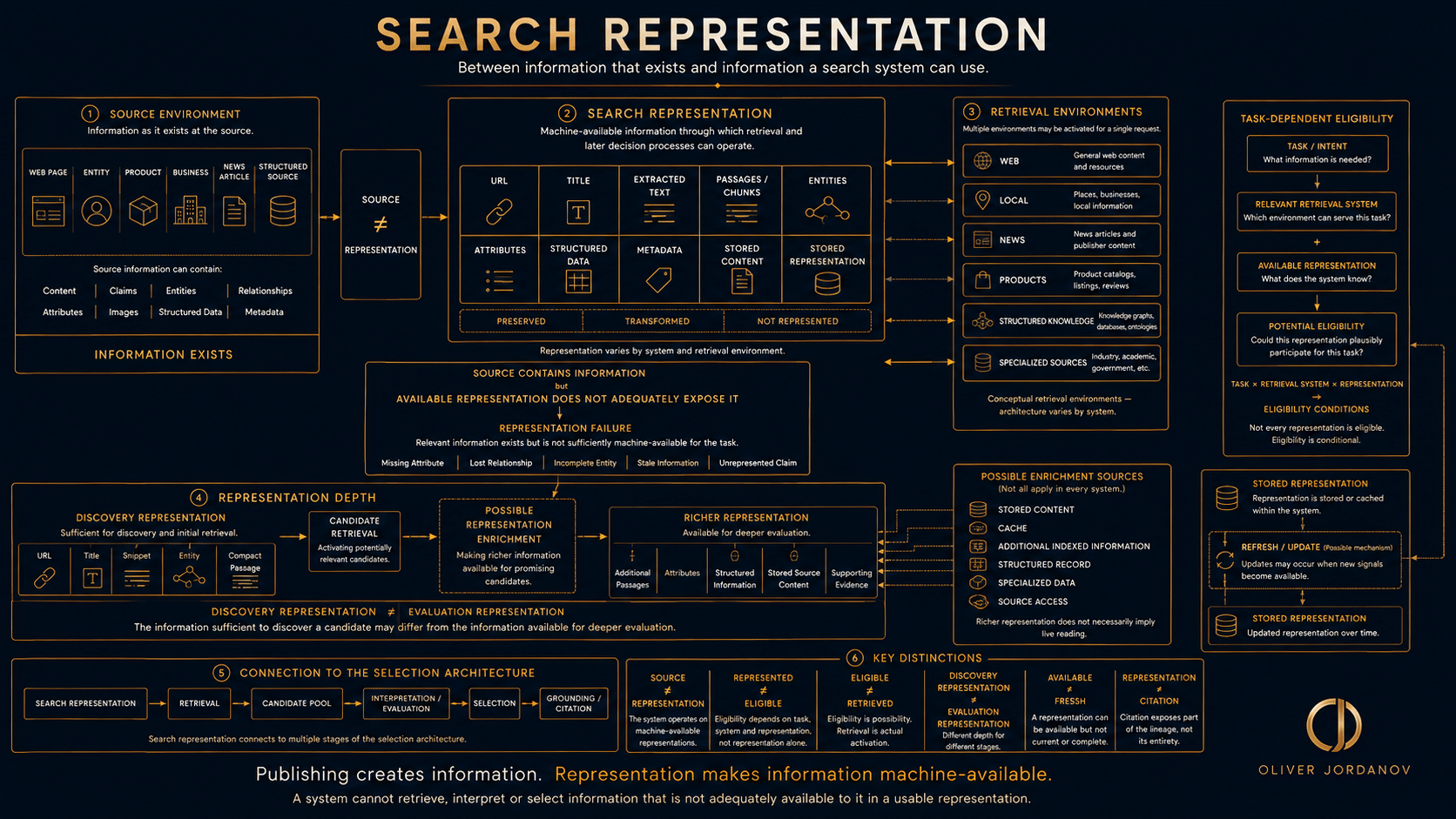
Representation Is Selective
A Search Representation is not necessarily a copy of the source.
It is selective.
Some source information may be preserved.
Some may be transformed.
Some may become structured.
Some may not be represented at all.
This creates an important visibility problem.
Information can exist at the source without being meaningfully available in the representation used for retrieval.
A page may therefore be comprehensive for a human reader while exposing a much narrower information surface to a particular search system.
Publishing information and making that information machine-available are related problems.
They are not identical.
Representation Depends on the Retrieval Environment
There is no reason to assume that an entity has one universal Search Representation.
Different retrieval environments can know different things about the same entity.
A general web retrieval system may operate on webpages and extracted passages.
A local system may rely more heavily on business attributes, location data and specialized records.
A product system may require structured product information.
A news environment may depend on different ingestion and freshness mechanisms.
An image system may construct another representation entirely.
Conceptually:
ONE ENTITY
↓
MULTIPLE RETRIEVAL ENVIRONMENTS
↓
DIFFERENT AVAILABLE REPRESENTATIONS
The relevant question therefore becomes:
What does this retrieval system know about this source or entity?
That question is different from:
What information exists on the website?
Search Representation and Eligibility
Search Representation helps clarify Eligibility.
Eligibility is not determined only by whether information exists.
The relevant retrieval system must have access to a representation that allows the information to plausibly participate in the task.
This creates a functional relationship:
Task
Retrieval System
Available Representation
↓
Eligibility
The same source or entity can therefore have different eligibility conditions across different retrieval environments.
A strong source cannot participate through information that the relevant system cannot access or represent adequately.
Representation is therefore one condition of eligibility.
It is not synonymous with eligibility itself.
Search Representation and Retrieval
Eligibility describes the possibility of participation.
Retrieval determines what actually enters the active decision space for a particular request.
Search Representation sits between these ideas.
Retrieval cannot surface information in a form that is completely unavailable to the retrieval mechanism.
Conceptually:
Source Information
↓
Available Representation
↓
Potential Eligibility
↓
Retrieval
↓
Candidate Pool
A retrieval failure may therefore sometimes originate earlier than retrieval itself.
The information may exist.
But its available representation may fail to expose the properties required for the task.
This is better understood as a Representation Failure than simply a ranking problem.
Representation Failure
Representation Failure occurs when relevant information exists at the source but is not adequately available through the representation used by the relevant retrieval system.
Possible forms include:
- important information is absent from the available representation
- entity relationships are unclear or lost
- attributes required for the task are unavailable
- source information is stale
- extracted information misrepresents the source
- important content is structurally difficult to access
- different systems maintain inconsistent representations of the same entity
This distinction matters diagnostically.
A source can fail before Candidate Evaluation ever begins.
Improving content quality alone may not solve that problem if the relevant information never becomes adequately represented.
Representation Depth
Not every decision requires the same amount of source information.
A compact representation may be sufficient to discover a candidate.
Deeper evaluation may require more information.
This suggests a useful distinction between different levels of representation depth.
Conceptually:
Discovery Representation
↓
Candidate Retrieval
↓
Richer Representation
↓
Candidate Evaluation
A system may initially encounter only enough information to establish potential relevance.
A promising candidate may subsequently become available through additional passages, attributes, structured information or stored source content.
This process can be described as Representation Enrichment.
Representation Enrichment
Representation Enrichment describes the availability of additional information about an already discovered candidate when deeper evaluation requires it.
The important distinction is:
The representation sufficient for discovery does not have to be identical to the representation available for evaluation.
A compact representation may establish relevance.
A richer representation may provide evidence, context, attributes or claims required for later decisions.
Representation Enrichment should not automatically be interpreted as a live visit to the original source.
The richer information could come from:
- previously stored content
- cached source representations
- additional indexed passages
- structured records
- specialized data sources
- another retrieval mechanism
- a fresh source access
The architecture varies by system.
The durable principle is that representation depth can change during the decision process.
Search Representation and Source Memory
Some search architectures may maintain richer stored representations of sources over time.
Conceptually, this creates a distinction between:
Source
Stored Representation
Current Retrieval
and
Representation Refresh
A stored representation may persist even when the live source has changed.
It may also be refreshed independently of a specific user request.
This makes freshness a separate problem from availability.
A source can be represented but represented imperfectly.
It can be represented richly but with stale information.
It can be current at the source while an available stored representation remains older.
We should therefore distinguish:
Does a representation exist?
from:
How complete and current is that representation?
Specific monitoring, cache or refresh architectures remain implementation questions.
The broader principle does not depend on them.
Search Representation and Interpretation
Representation and Interpretation should not be conflated.
Search Representation concerns:
What information is available to the system?
Interpretation concerns:
What meaning can the system construct from that information?
A representation provides the material from which interpretation can operate.
Weak representations can constrain interpretation.
Incomplete entity information can create ambiguity.
Missing relationships can change meaning.
Stale attributes can produce incorrect contextual conclusions.
Interpretation quality therefore depends partly on representation quality.
But interpretation remains a distinct process.
Representation determines the available information surface.
Interpretation constructs meaning from that surface.
Search Representation and Grounding
Grounding introduces another important relationship.
A generated claim may ultimately need to connect back through evidence to an identifiable source.
Conceptually:
Source
↓
Representation
↓
Retrieved Evidence
↓
Selected Claim
↓
Generated Statement
The representation layer can therefore affect evidence lineage.
A system may select information from a machine representation while presenting a citation or attribution to the underlying source.
This is another reason why:
Source ≠ Representation ≠ Citation
Citation makes a source relationship visible to the user.
It does not reveal the complete representation architecture through which the information became available.
Search Representation Is Not an Index
The term Search Representation is deliberately broader than Indexed Representation.
Indexes are one important way of making information searchable.
But future search architectures do not need to depend exclusively on conventional search indexes.
Information may become available through:
- indexes
- caches
- feeds
- databases
- knowledge systems
- APIs
- stored memory
- specialized retrieval infrastructure
The lasting concept is therefore not indexing itself.
It is machine availability through representation.
Search Representation describes that functional layer without assuming how a particular system implements it.
Strategic Perspective
Traditional search optimization often asks whether a page can be crawled, indexed and ranked.
Those questions remain important.
Search Representation adds another diagnostic question:
What representation of this information is actually available to the system that must retrieve it?
This shifts analysis from the source alone toward the relationship between:
Source
Representation
Retrieval Environment
Task
A technically accessible webpage is not automatically an effective representation in every retrieval environment.
A clear representation does not guarantee retrieval.
Retrieval does not guarantee selection.
But without an adequate representation, later decision stages may never have access to the information required to evaluate the source properly.
Relationship to the Concepts Library
Search Representation connects the information environment with the request-dependent selection architecture.
Entity Clarity affects how consistently entities and relationships can be represented.
Eligibility describes whether information can plausibly participate within a particular task, retrieval system and representation.
Retrieval determines which available representations enter the active Candidate Pool.
Candidate Pool contains the request-specific candidates available for evaluation, potentially originating from different representation types.
Interpretation constructs meaning from the information available through those representations.
Candidate Evaluation compares retrieved candidates against the current request.
Grounding connects selected claims through evidence and representations back to identifiable sources.
Selection Systems describes how these mechanisms interact across a broader decision architecture.
Search Representation therefore occupies a critical interface:
between information that exists and information that a search system can actually use.
Closing Thesis
Publishing creates information.
It does not guarantee machine availability.
Search systems operate through representations of sources, entities and information objects.
Those representations may differ across retrieval environments.
They may differ in depth.
They may differ in freshness.
And they may expose only part of what exists at the source.
The durable Search Principle is therefore:
A system cannot retrieve, interpret or select information that is not adequately available to it in some usable representation.
Understanding AI-mediated search requires understanding not only the source.
It requires understanding the representation through which the source becomes machine-available.
Related Concepts
Entity Clarity
How consistent entity identity and relationships reduce ambiguity across machine representations.
Eligibility
Why participation depends on the task, retrieval system and representation available within that environment.
Retrieval
How retrieval systems activate available representations for a specific information need.
Candidate Pool
The request-specific decision space created from retrieved candidates and different representation types.
Interpretation
How AI systems construct meaning from the information available through machine representations.
Grounding
How claims connect through representations and evidence to identifiable underlying sources.