
Identifying where informational problems become commercially actionable inside AI-mediated search.
AI Search Lab · Research Method · Commercial AI Visibility
Traditional search intent classification usually begins with the user.
What is the user asking for?
Is the query informational?
Commercial?
Transactional?
That distinction remains useful.
But AI-mediated search introduces another question.
What commercial relevance does the system construct from the user’s problem?
A user does not necessarily need to ask for a provider, product or service before an AI response introduces one.
An informational or operational question can remain informational at the prompt level while the response begins constructing a commercial solution space.
I refer to this transition as the Commercial Transition.
Commercial Transition Mapping is a method for identifying where these transitions occur across an AI-mediated information journey.
Definition
A Commercial Transition occurs when an AI-mediated response moves from explaining a problem or task toward introducing commercially actionable solution categories, providers or selection criteria.
Commercial Transition Mapping describes the systematic analysis of where and how these transitions occur across related user questions.
The method asks:
At what point does the system begin constructing commercial relevance — even though the user has not explicitly requested a commercial answer?
This distinction matters because:
User Intent ≠ Response Commerciality
An informational prompt can produce a commercially relevant response.
And a commercially oriented prompt does not necessarily produce concrete Brand Selection.
Why Traditional Intent Classification Misses This
Traditional intent classification describes the apparent objective of a query.
A simplified model might distinguish:
Informational
↓
Commercial Investigation
↓
Transactional
This is useful for understanding user demand.
But it does not fully describe what happens inside AI-mediated responses.
Consider an operational question such as:
How should I organize this process?
The user may still be seeking information.
But the system can determine that a particular class of commercial infrastructure is a practical solution.
The prompt remains informational.
The response has crossed a commercial boundary.
Commercial Transition Mapping therefore adds another analytical dimension:
not only what the user explicitly asks for, but when the system itself begins constructing a commercial solution space.
The Commercial Transition
Commerciality does not have to appear all at once.
Research Note 001 observed several increasingly specific forms.
Conceptually:
PROBLEM
↓
COMMERCIAL CATEGORY
↓
SELECTION CRITERIA
↓
CANDIDATE SET
↓
BRAND SELECTION
These stages describe different levels of commercial response behavior.
A solution category can appear without any company being named.
Concrete companies can appear without one being preferred.
A Candidate Set can exist without Brand Selection.
And Brand Selection can occur with different rationales depending on the task.
The Commercial Transition therefore should not be reduced to:
Brand mentioned = commercial
The transition can begin much earlier.
What Research Note 001 Observed
Commercial Transition Mapping emerged from the first experiments of the AI Search Lab.
Research Note 001 examined 46 documented ChatGPT Search responses across three connected experiments in a narrowly defined German financial-services context.
The experiments observed a progression from educational questions toward increasingly explicit provider decisions.
Experiment 001
Commercial solution categories appeared in 24 of 24 responses.
During the more operational journey stages, a target-adjacent infrastructure class reached at least a clear category recommendation in 12 of 12 responses.
Concrete brands remained rare.
No Brand Selection occurred.
Experiment 002
The same operational questions were repeated without the preceding conversation.
11 of 12 standalone responses still reached at least the category-recommendation level.
For these prompts, accumulated conversation context was therefore not a necessary condition for the observed Commercial Emergence.
Experiment 003
The prompts then became progressively more decision-oriented.
Both replications followed the same escalation:
S0 / S1 → Category Recommendation
S2 → Candidate Set
S3 / S4 → Justified Brand Selection
Concrete target companies appeared in 6 of 10 responses.
Justified Brand Selection appeared in 4 of 10.
→ Read AI Search Research Note 001
From Observation to Mapping
Research Note 001 observed the phenomenon.
Commercial Transition Mapping turns that observation into a repeatable analytical question.
Instead of monitoring only explicit provider prompts such as:
Which provider should I choose?
a Commercial Transition Map starts earlier.
It follows the information journey from problem understanding toward commercial decision-making.
A simplified mapping sequence might include:
Problem Understanding
What is the user trying to understand?
Operational Problem
What does the user need to implement, organize or solve?
Category Emergence
At which question does a commercial solution category first appear?
Selection Criteria
When does the system begin explaining how alternatives should be evaluated?
Candidate Set
When do concrete organizations, products or providers appear?
Selection
When are candidates prioritized or recommended?
Selection Rationale
Which characteristics explain the selection or exclusion?
The objective is not to force every journey into these stages.
It is to locate the transitions that actually occur.
What a Commercial Transition Map Measures
A useful map should distinguish several observable states.
| Layer | Question |
|---|---|
| Problem Relevance | Which problems create relevance for the category? |
| Category Association | When does the system introduce the commercial solution class? |
| Selection Criteria | Which characteristics become relevant for evaluating alternatives? |
| Candidate-Set Inclusion | Which concrete entities enter consideration? |
| Selection | Which candidates are prioritized or recommended? |
| Selection Rationale | Which evidence or characteristics justify that outcome? |
These states should be measured separately.
A company can have strong Category Association while remaining absent from the Candidate Set.
It can enter the Candidate Set repeatedly without being selected.
And it can be selected under one decision context but not another.
Commercial Transition Mapping Is Not Keyword Mapping
The method does not replace keyword research.
It asks a different question.
Keyword mapping typically connects:
Query → Intent → Page
Commercial Transition Mapping examines:
Problem → AI Response → Commercial Transition → Candidate Formation → Selection
The unit of analysis is therefore not simply search volume or query classification.
It is the change in response behavior across an information journey.
This makes the method particularly useful where AI systems synthesize information rather than merely return ranked documents.
Commercial Transition Mapping Is Not Prompt Tracking
Prompt tracking can tell an organization whether it appears for a predefined set of questions.
Commercial Transition Mapping attempts to understand why those questions belong together.
It asks:
Where does the category emerge?
Where do concrete candidates emerge?
Where does selection begin?
Which criteria appear between those stages?
The objective is not to build the largest possible prompt list.
It is to identify the decision structure connecting related prompts.
Practical Use
Commercial Transition Mapping can provide a structured starting point for several kinds of analysis.
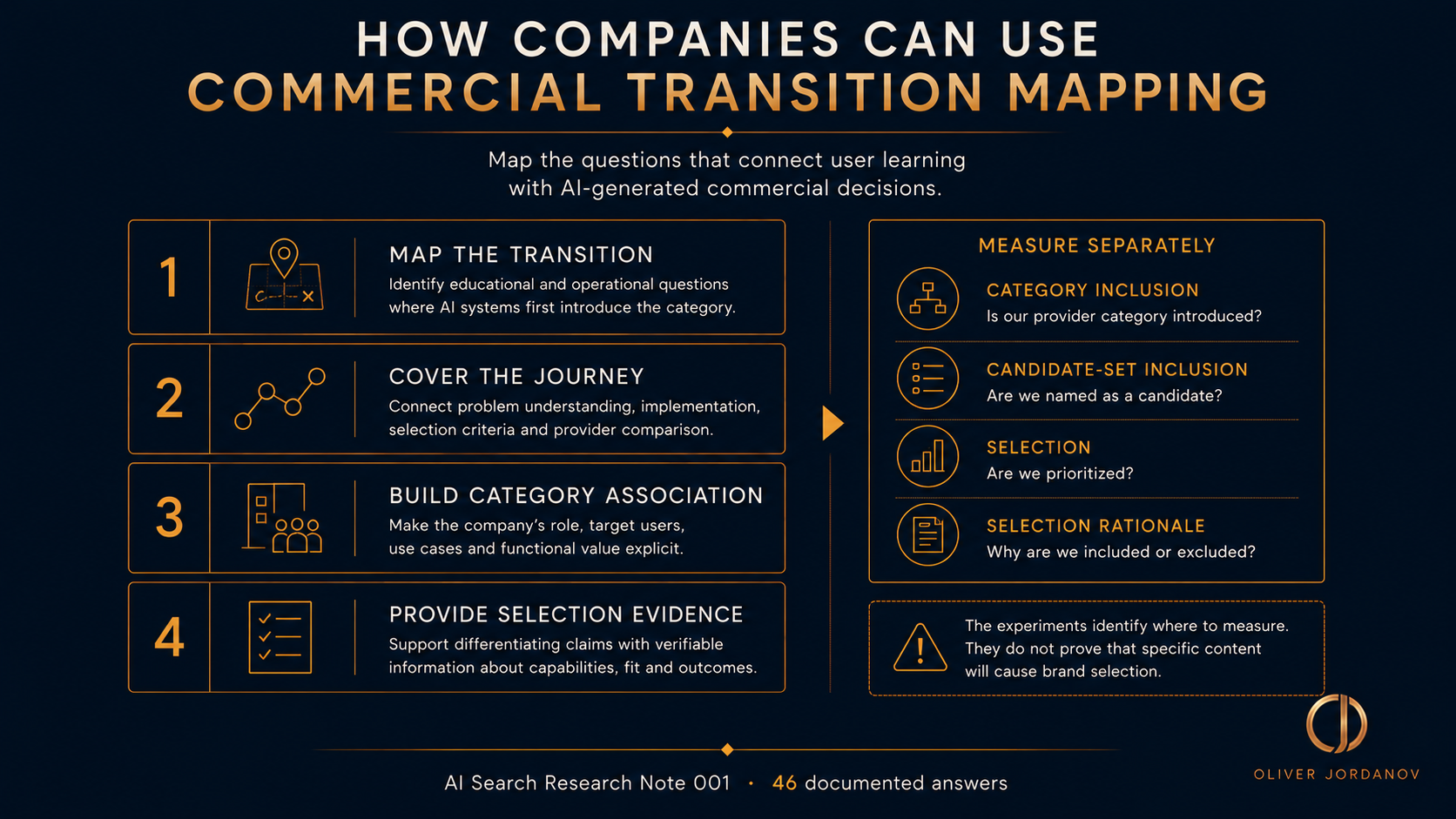
1. Map the Transition
Identify educational and operational questions where AI systems first introduce the relevant commercial category.
Do not begin only with direct provider prompts.
2. Cover the Journey
Examine whether the organization’s information environment supports the progression from:
Problem Understanding
to
Operational Implementation
to
Selection Criteria
to
Provider Comparison
This does not imply creating one page for every prompt.
The objective is coherent information coverage.
3. Build Category Association
Make the relationship between the organization and relevant:
- problems
- tasks
- target users
- use cases
- functional value
clear enough to investigate whether the entity becomes associated with the category when those problems arise.
4. Provide Selection Evidence
Candidate inclusion and Brand Selection require different measurements.
Where AI responses distinguish providers using criteria such as capabilities, integrations, target groups, operating models, costs or specialization, companies can investigate whether those distinctions are supported by verifiable evidence.
The objective is not to manufacture claims for AI systems.
It is to make legitimate differentiation observable and supportable.
5. Measure the Layers Separately
Track:
Category Inclusion
Candidate-Set Inclusion
Selection
Selection Rationale
Do not collapse them into one AI Visibility score.
Each represents a different point in the commercial decision architecture.
What We Can Currently Infer
The current evidence supports a limited inference.
INFERENCE
For the operational prompts tested in Research Note 001, explicit provider intent was not required for an AI response to introduce a commercial solution category.
This suggests that conventional query intent alone may not fully describe commercial opportunity within AI-mediated search.
The response can become commercially actionable before the prompt becomes explicitly commercial.
That is the analytical gap Commercial Transition Mapping is designed to examine.
What Remains a Hypothesis
Commercial Transition Mapping does not yet establish how companies can reliably change these transitions.
Several important questions remain open.
HYPOTHESIS
Clearer Category Association may increase the probability that an entity enters relevant Candidate Sets.
HYPOTHESIS
Stronger Selection Evidence may improve Selection relevance when AI responses compare providers against specific criteria.
HYPOTHESIS
Different markets may contain different Commercial Transition points even for structurally similar information journeys.
HYPOTHESIS
Commercial Transitions may vary across models, retrieval environments, personas and time.
These hypotheses require additional experiments.
They should not be presented as established optimization rules.
What Commercial Transition Mapping Does Not Claim
The method does not assume:
- every informational journey becomes commercial
- every operational question introduces a provider category
- every category transition produces concrete brands
- Candidate-Set Inclusion leads to Selection
- Selection remains stable across repeated runs
- content changes directly cause Brand Selection
- every AI system follows the same decision architecture
Commercial Transition Mapping is a research method for locating and comparing observable transitions.
It is not a deterministic funnel.
Relationship to the AI Search Lab
The AI Search Lab separates three levels of work.
OBSERVATION
What happened in the documented responses?
↓
INFERENCE
What interpretation is reasonably supported?
↓
HYPOTHESIS
What should be tested next?
Commercial Transition Mapping sits between the first two.
It provides a structured way to document where commercial response behavior changes.
Future experiments can then test why those transitions occur and whether controlled changes alter them.
Strategic Perspective
AI-mediated search complicates a familiar distinction.
Historically, commercial intent has largely been inferred from what the user asks.
AI systems can introduce another layer:
commercial interpretation by the system itself.
That does not eliminate user intent.
It adds another object of analysis.
For companies, the useful question becomes:
At which informational problems does the system begin constructing a commercial solution space around our category?
That question can reveal opportunities that direct provider-prompt tracking alone does not capture.
Closing Thesis
A query does not need explicit commercial intent for an AI response to become commercially relevant.
The transition can begin when the system connects an informational or operational problem with a commercial solution category.
Commercial Transition Mapping is a method for locating that boundary.
It does not tell us how to manipulate it.
It tells us where to observe it, what to measure around it and which hypotheses are worth testing next.
That is the distinction between a research method and an optimization formula.
Related Research
AI Search Research Note 001 — From Educational Questions to Brand Selection
Three connected experiments documenting the observed progression from Commercial Emergence through Candidate Sets to justified Brand Selection.
Related Concepts
Search Influence
How machine selection and search exposure can influence human awareness, consideration and decisions.
Candidate Pool
The request-specific decision space containing information available for evaluation.
Candidate Evaluation
How retrieved candidates compete against the current information need and available alternatives.
Search Representation
How source information becomes machine-available across retrieval environments.
Retrieval
How relevant representations enter the active decision space for a specific request.